Your Employee Just Threatened to Sue, So Here's What to Do First
"Put an employee on a PIP and she is threatening to sue the company." If you're here, you probably typed something close to it, maybe at 11 at night with your stomach in a knot.
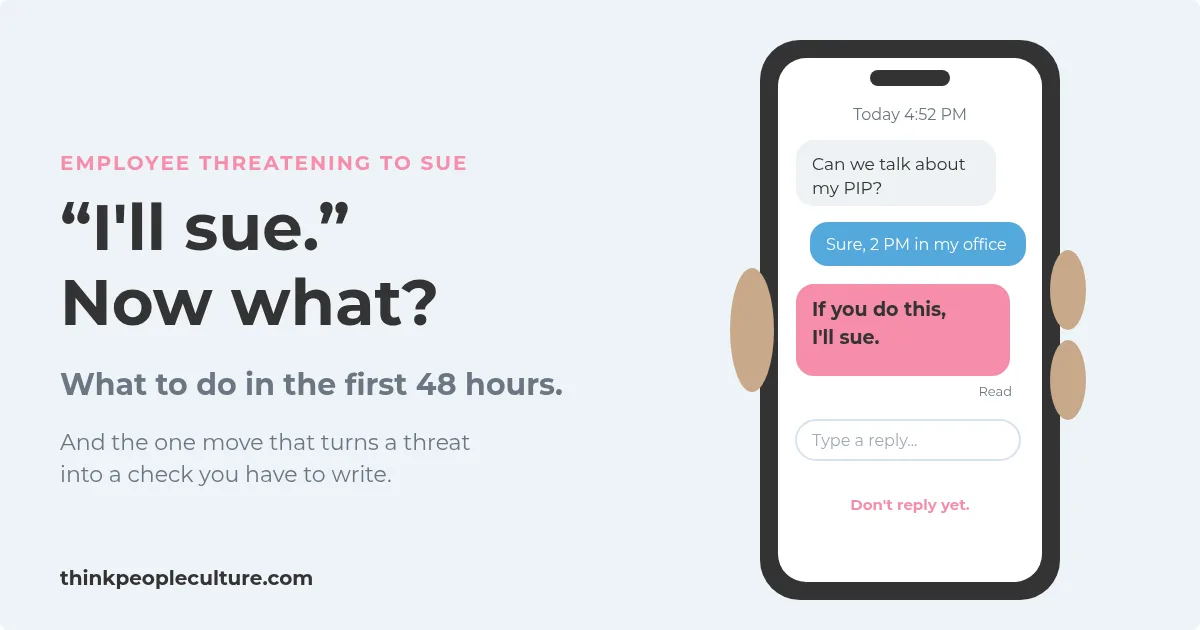
Picture this, you're ten minutes into a PIP meeting with your sales lead, you've got the goals printed out, and she leans back and says, "If you do this, I'll sue." Your stomach drops, and the next thing out of your mouth will matter more than anything on that printout.
She said one more thing in that meeting, and it's the part that decides whether this goes away or goes to court. I'll get to it in the PIP section. And there's one move owners make in the first week that turns a threat they'd never hear about again into a check they have to write. I'll name it before we're done.
The short answer: A threat to sue is only a warning until someone actually files. Don't argue, don't punish them for saying it and don't change anything about how you treat them. Keep every record, write a dated timeline that day, check your insurance and call your employment attorney before you reply to anything in writing. If a demand letter shows up, the deadline in it was picked by their lawyer, not a court, and your attorney decides how to answer.
Most threats never turn into a lawsuit. The ones that do usually got help from something the owner did in the two weeks after the threat. So that's where we'll spend our time today.
If your worry is that one wrong move may cause you a lawsuit, or that there are just too many laws to keep straight, good, that worry is about to turn into a plan.
Step One Happens in the Room
When someone says "I'll sue," the urge is to defend yourself right there, in that moment. You want to explain the numbers, list every missed deadline and remind them how patient you've been, but don't.
Say something like, "I hear you. I want this to be fair, so let's finish going over the plan and you'll get a copy." Then keep going, calmly, the same way you would have if they'd said nothing.
Nothing you say in the heat of that moment helps you later, and plenty of it ends up quoted in a letter. Lawyers love a direct quote the way your dog loves a dropped french fry.
After the meeting, watch for the small stuff. You'll probably recognize at least one of these:
- They start CC'ing their personal Gmail on every work email.
- They mention that their cousin, their roommate or their neighbor "is a lawyer."
- A written request for their personnel file shows up out of nowhere.
- A one star review of your company appears that weekend.
- Your manager fires off a 10 PM text that starts with "Look," and you find out about it the next morning.
- The office goes weirdly quiet, because everyone already heard.
None of these means a lawsuit is coming. All of them mean it's time to slow down and do the next steps by the book.
The Takeaway: the threat is rarely the problem, what you do next is.
What to Do in the First 48 Hours
I walk clients through the same steps, in this order, every time.
- Write down exactly what they said, with the date, the time and who was in the room. Do it the same day, while you still remember the words.
- Freeze everything. Keep every email, text, Slack message, note and review about this person. Lawyers call this a litigation hold. Deleting things now is the worst move you can make, even if it's "just cleaning up." Nothing says "I have something to hide" like a Slack channel that suddenly has fewer messages than it did on Tuesday.
- Build a dated timeline of the performance problems from the records you already have, like emails, project trackers and client notes. Don't backfill notes and pretend they're old.
- Check your insurance. If you have employment practices liability insurance (EPLI), read the notice section. A lot of policies want to hear about a threatened claim quickly, and late notice can put coverage at risk. More on EPLI below, because a lot of owners aren't sure if they even have it.
- Call your employment attorney before you reply to anything in writing. I prepare the HR side and your attorney makes the legal call.
- Tell as few people as possible. Keep it to the manager involved and whoever runs payroll, and that's about it. Office gossip about a lawsuit threat becomes a witness list.
The Takeaway: the first 48 hours decide whether you look careful or caught.
What Not to Do (This Is Where Most Owners Get Hurt)
In California, the threat itself can be protected. If what they're upset about is discrimination, harassment, unpaid wages, safety or something they think is illegal, then complaining about it, or saying they'll file a claim over it, is protected activity.
Punishing them for it is retaliation under the Fair Employment and Housing Act (Government Code 12940(h)) and the Labor Code (Labor Code 98.6 and Labor Code 1102.5).
And under Labor Code 98.6, if you take action against someone within 90 days of certain protected activity, the law presumes it was retaliation and it's on you to prove otherwise. A Labor Code violation there can also cost up to $10,000 per violation (California Labor Commissioner).
Here's the move I promised to name. The owner gets angry, quietly changes how they treat the person, and hands them a brand new claim. The original complaint might have gone nowhere, but the payback is easy to prove, and it's the part that turns into a check. So, for now, don't:
- Fire them, cut their hours, change their schedule or move them off their best accounts.
- Speed up the PIP, add new goals or quietly drop it.
- Leave them out of meetings or emails they used to be on.
- Say "I heard you're talking to a lawyer" or anything close to it.
- Post, text or vent about it to anyone outside the small group above.
Later your attorney may tell you some of these are fine. Let them be the one to say so.
Should You Keep the PIP Going?
Usually, yes. Remember the second thing the sales lead said? It was, "Everybody else misses their numbers too."
That's the sentence that matters, because it's really a fairness question. If she's right, and you're only holding her to the standard, the PIP looks like a setup. If she's wrong, and you can show the same standard applied to everyone, the PIP looks like what it is.
So before you take the next step, check these three things:
- Did others with the same numbers get the same treatment?
- Do the goals in the PIP match what you've told her before, in writing?
- Is the timeline the same one you've used for anyone else?
If all three hold up, keep the PIP on the same schedule, with the same goals, and document every check in the same day it happens. You stopping it now can look like you knew it was unfair. Speeding it up can look like payback.
The Takeaway: a fair process, run the same way it would have run without the threat, is your best defense.
Got a Demand Letter From a Former Employee? Start Here
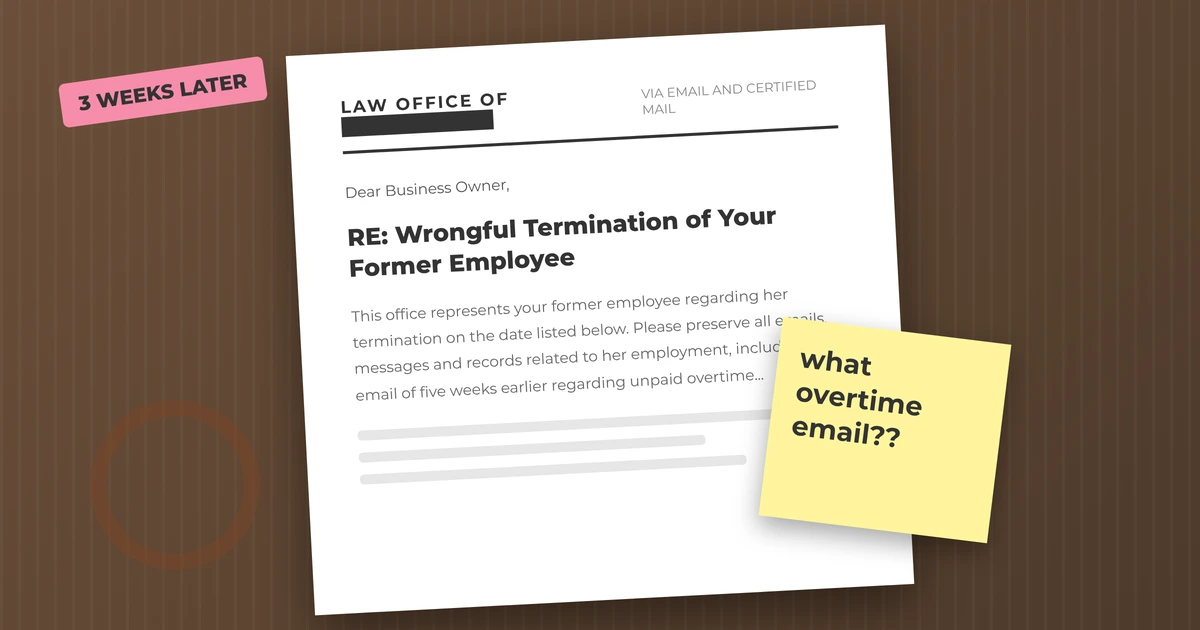
A demand letter is a lawyer's letter saying your former employee has a claim and wants money to settle it. It often lists what they say happened and gives you a date to respond by.
Here's the part most owners don't know. In most cases, that date was picked by their lawyer, not by a court or a law. Missing it doesn't make you lose. Think of it as a suggestion printed on very expensive letterhead. Ignoring the letter is still a bad idea, though, because the next step is usually a filing with a state agency or a court, and those deadlines are real.
When it lands:
- Don't call or email the former employee or their lawyer.
- Note the date you received it and keep the envelope.
- Send it to your employment attorney the same day, and to your insurance carrier if you have EPLI.
- Pull the personnel file, payroll records and every message about the issue in the letter.
- Write your dated timeline if you haven't already.
How Long Do You Have to Respond to a Demand Letter?
There's no single legal deadline for answering the letter itself. Your attorney decides when and how to answer, and sometimes the answer is a short note asking for more time.
The deadlines that do have teeth are the records requests that often come with the letter, or right before it.
| What they ask for | Your deadline in California | The law |
|---|---|---|
| Copy of their personnel file | 30 calendar days from the written request (35 if you both agree in writing) | Labor Code 1198.5 |
| Payroll records | 21 calendar days from the request | Labor Code 226(c) |
| Copies of anything they signed to get or keep the job | On request | Labor Code 432 |
Put those dates on your calendar the day the request arrives. Blowing a records deadline hands them a second claim for free.
How Long Can They Wait to File?
Longer than you'd guess. For discrimination, harassment and retaliation claims, a California employee has three years from the last harm to file with the Civil Rights Department (California Civil Rights Department). I break down the other clocks in what counts as wrongful termination in California.
Three years is long enough that the manager involved might be gone. Your file has to tell the story without anyone in the room.
What Is EPLI, and Why Call Them So Early?
Employment practices liability insurance (EPLI) covers businesses against claims by employees, former employees and job candidates. It can pay legal costs, settlements and judgments for claims like wrongful termination, retaliatory discharge and wrongful discipline (Triple-I, the Insurance Information Institute).
Most EPLI policies are "claims made," which means the policy has to be in force both when the event happened and when the claim is filed (Triple-I). That's why the notice section matters so much, and why a threat is the moment to read your policy, not the day the lawsuit lands.
If you don't know whether you have it, ask your insurance broker this week. It's a five minute email that could save you from paying a lawyer out of your own pocket.
Where I Come In
Maybe you've been left high and dry when it mattered most, or you've heard "we legally can't advise you on that" one too many times. That's the gap I fill. When a client calls me with "they said they'll sue," I take the HR side off their plate. I build the timeline, pull the records, check whether the process was fair and consistent, and hand your attorney a clean file so they're not billing you to sort through a mess. I also coach your manager through every conversation from here on, so nobody says the wrong thing in a hallway.
So, What Happens When You Get This Right?
Usually, not much, and that's the whole point. In our example, the owner wrote down the sentence, kept the PIP on its schedule, didn't change a thing about how the sales lead was treated, and called the attorney that afternoon. Thirty days later the sales lead either hit her numbers or she didn't, and either way the file told the same calm, dated story it told on day one. There was nothing new for a lawyer to grab, and most of the time that's how these end, quietly, with no letter at all.
If you want to see exactly what I handle, it's in the Terminations and Employee Issues section on my services page. If the threat came up during a firing, my guide to firing an employee in California covers the meeting itself.
Questions to Ask Yourself Before You Reply to Anything
1. Did I write down exactly what they said, with the date?
2. In the last 90 days, did this person complain, report something, ask for leave or ask for an accommodation?
3. Have I treated someone else with the same problem the same way?
4. Is every record about this person saved, including texts and Slack?
5. Have I told my attorney, and my insurance carrier if I have EPLI?
6. If their lawyer read my file three years from now, would it make sense without me in the room?
If any answer lands on "uh, maybe," that's your moment to slow down. When it can't wait, put "urgent" in your message and you'll hear back within four business hours. Book a Termination Sanity Check before you reply, not after.
This is the HR point of view based on experience and my understanding, not legal advice.
Common Questions
What should I do if an employee threatens to sue?
Stay calm, write down exactly what they said, keep every record, build a dated timeline and call your employment attorney before you reply in writing. Don't change how you treat them.
Can I fire an employee for threatening to sue?
Not for that reason. If the threat is about discrimination, harassment, unpaid wages, safety or something they believe is illegal, it can be protected, and punishing them for it is retaliation under Government Code 12940(h) and Labor Code 98.6 or 1102.5.
Should I keep a PIP going after an employee threatens to sue?
Usually yes, on the same schedule and with the same goals, as long as you've applied the same standard to others. Talk to your attorney before you change anything.
What do I do when I get a demand letter from a former employee?
Don't contact them or their lawyer. Note the date you got it, send it to your employment attorney and your EPLI carrier the same day, and pull the personnel file and payroll records.
How long does an employer have to respond to a demand letter?
There's usually no legal deadline for the letter itself; the date in it is set by the employee's lawyer. Records requests do have deadlines in California: 30 days for a personnel file (Labor Code 1198.5) and 21 days for payroll records (Labor Code 226).
How long does a California employee have to file a claim?
For discrimination, harassment and retaliation claims, three years from the last harm to file with the Civil Rights Department. Other claims run on their own clocks.
HR Help in Your Inbox
My free newsletter for owners with no HR person, with plain answers sent when there's something worth reading.
We respect your privacy. Unsubscribe at any time.