How to Fire an Employee in California
Smart owners and managers do this the hard way all the time. Firing someone isn't the scary part. Firing someone badly, in California, with a late final check and a "performance" story that changed three times, is the real scary part. This is how to fire an employee in California without turning one bad Tuesday into a year of lawyer emails.
One owner I worked with got stuck on this exact decision. The employee had performance problems and had been caught lying about the work, and the owner had almost nothing in writing. One question kept running on a loop in their head: what if they sue and say it was discrimination? So the problem got bigger and bigger and BIGGER, and the owner got more scared of a conversation that hadn't even happened yet. The plan they landed on wasn't brave. It was a file, a date, and a paper trail built before the big conversation. We'll get to that.
Why Firing Someone in California Carries So Much Risk
California leans toward the employee and the paperwork rules are strict. You can usually end an at will relationship and the Labor Code says employment with no specified term may be ended by either side on notice (Labor Code 2922). But at will has a lot of exceptions and the biggest ones are discrimination, retaliation, and pay mistakes.
The state doesn't take these lightly. The California Civil Rights Department logged 4,072 employment complaint investigations in 2023 according to its own 2023 Annual Report (Table 1). That's one agency, for a single year, before anyone files a wage claim or hires a lawyer.
So, the goal isn't "avoid ever being sued." Anyone can sue anyone. The goal is that if someone does, your file is boring and your story is the same on day one and day one thousand.
Start With the Business Decision
Before the law, ask the business question: Is this termination about a performance problem, a conduct problem, or a role that no longer exists?
Those are three very different conversations and mixing them is how the story gets muddy.
Write the termination reason in one plain sentence. If you can't, you're not ready. People online say "the less you say the better," and there is a teeny tiny kernel of truth there, but silence isn't a plan. A clear reason you can repeat is a plan.
Also ask who else is involved in the termination decision. A manager who "just wants this person gone" isn't a reason. A pattern, with dates, is.
Confirm the Employment Context
Check what you actually signed with this employee. Offer letter, employment agreement, handbook, any union or contract terms. A written promise of "for cause only," or a contract for a specified term longer than a month, changes the whole play.
Then check the person's situation. Are they a full time employee, part timer, or a worker you may have labeled a contractor? Misclassified people are a whole different mess, and I'd want a second set of eyes on it.
Finally, make note of anything pending: an open leave, a worker's comp claim, a pregnancy, a recent complaint. None of these makes a firing impossible. They just make a clean paper trail a must.
Review the Reason for Termination
The reason has to be real, consistent, and the same one you give everyone who asks. Shifting reasons are where lawyers start circling. "It was performance" in the email and "it was attitude" in the meeting is a brilliant gift to the other side.
Say it clearly: what happened, what was said about it before, and what the standard is. Do yourself a favor and skip the adjectives. "Missed the deadline four times after two written warnings" beats "not a team player" every day.
If the reason is a layoff or a role cut, say exactly that. Don't dress a layoff up as a performance firing to make it feel easier. It backfires!
Check for Retaliation and Discrimination Risk
This is where the "sue happy" stories come from. Ask yourself one blunt question: in the last year, did this person do anything protected? Report harassment, ask for an accommodation, take protected leave, file a wage complaint, raise a safety concern?
If it's a yes, the timing alone can look like retaliation, even if your reason is solid. That's not a stop sign though. It's a "slow down, document, and get advice" sign.
Look at the pattern too. Who else has had this same issue and what happened to them? If the answer is "nothing," you've got a consistency problem before you have a termination problem.
Audit the Documentation
Everyone online says it the same way: document, document, document. And they're right and still most owners don't have it. Pull the reviews, warnings, emails and notes. Put the documentation in date order, because documentation without dates is just an opinion.
Remember that owner I spoke about earlier, the one stuck on the decision? The way out was to start the file that day, set clear expectations in writing, give the person a real chance to fix it with dates attached, and decide ahead of time what "fixed" looks like. If it still wasn't fixed, the decision was no longer a panic. It was a conclusion.
Ask whether a stranger could read the documentation and understand what happened without you in the room. There's one catch though, documentation written after you decided to fire someone looks like what it is. Don't backfill your documentation. Write down the facts as they happened and make sure to note the date you wrote them.
Apply the Same Standard Consistently
This is the quiet killer. You fired Dana for being late, but Marcus was late for a year and still has a desk. Now Dana has a story, and a lawyer has a theme.
Compare apples to apples: same issue, same role, same manager, same warnings. If you can't explain the difference in a sentence, fix that first. Sometimes the answer is to hold off. Sometimes it's to deal with both situations at once.
Consistency is boring, and boring is what you want.
Build the California Termination Checklist
Here's the short version: Print it, tape it to the folder, and tick it off.
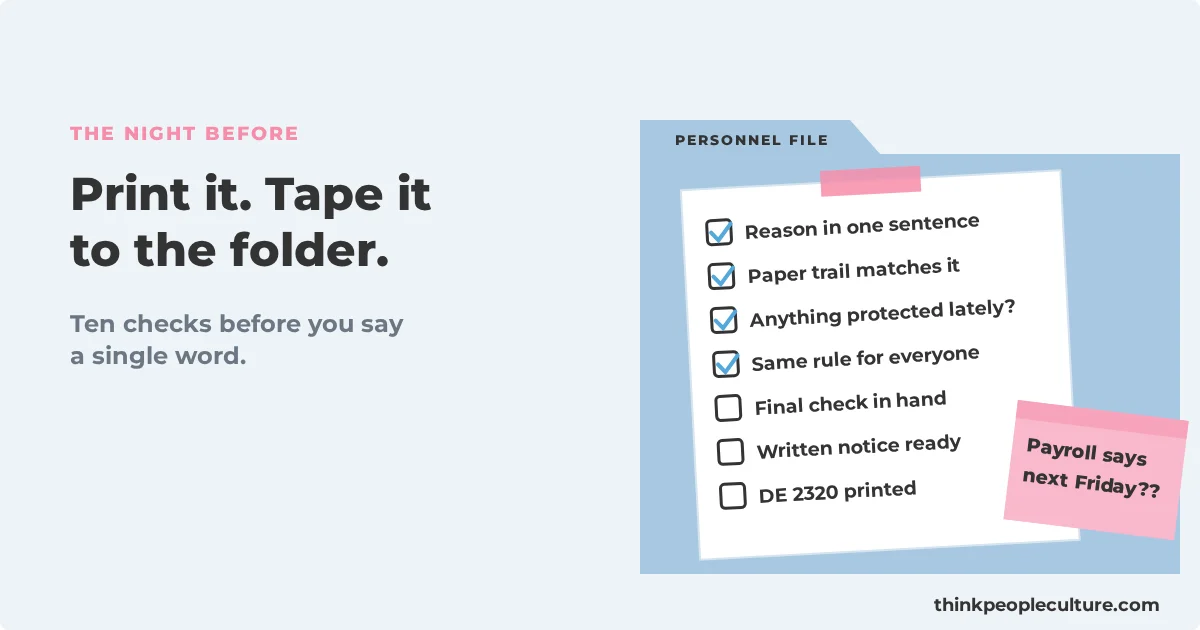
Decide the termination reason in one sentence. Pull the file and read it out loud. Check for protected activity and pending leave. Confirm the same standard was applied to others. Get the final pay ready including all earned vacation. Prepare the written notice of termination. Pick the time, the room, and who attends. Plan system access and equipment return. Write your talking points. Line up your answers for the "what happens now" part.
Prepare the Termination Meeting
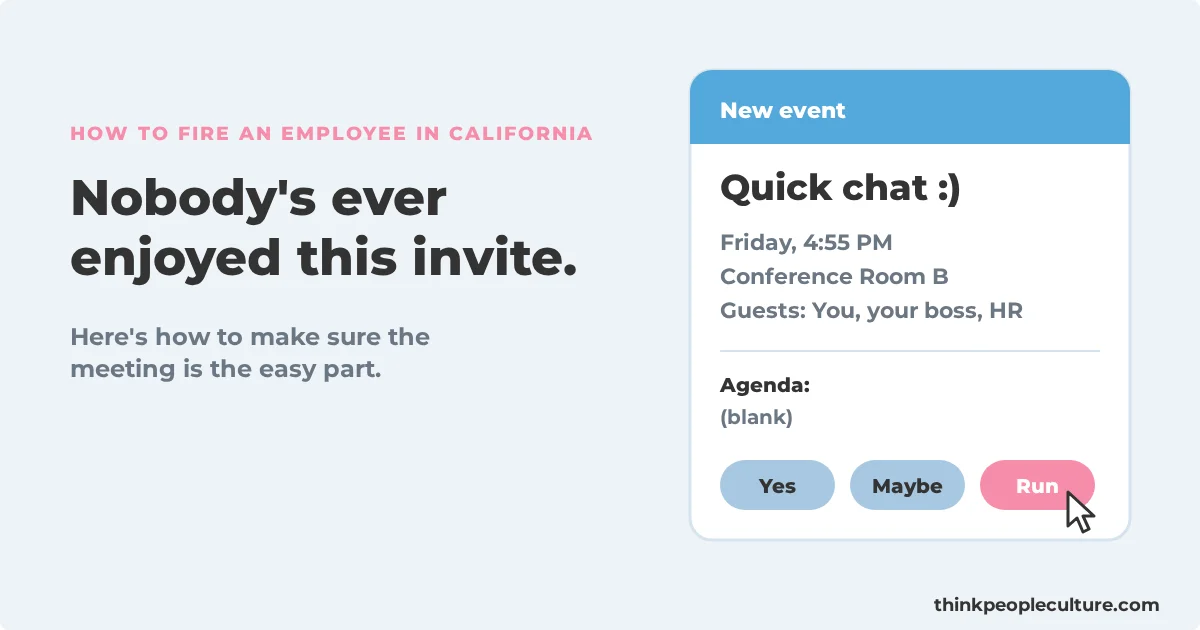
Keep the termination meeting short, private, and about ten minutes. Two people in the room, you and one other manager or HR person, so there's a witness and nobody's alone. Don't do it by text or email unless there's genuinely no other option.
Decide ahead of time what you'll say, and what you won't. You're not there to debate or prove anything to the employee. You're there to deliver a decision that's already been made.
Here's another one:
A manager at a small California startup wouldn't do their job and deliver the termination news to their own employee, so the HR person got stuck as the messenger, just saying "it's at will" to someone who deserved to hear it from their own boss.
That's how you turn a termination into a story the whole company retells. The manager makes the decision and delivers it; HR or a consultant prepares, advises, and sits in. Think of the Moneyball scene, where the message is clear, kind, and over fast. Rehearse it once out loud. I know it'll feel silly and it also works.
Deliver the Message Clearly and Respectfully
Rip the Band-Aid off. Open with the decision in the first sentence, then the reason in one more, then what happens next. Use "we," not "I," because this is a company decision, not a personal one.
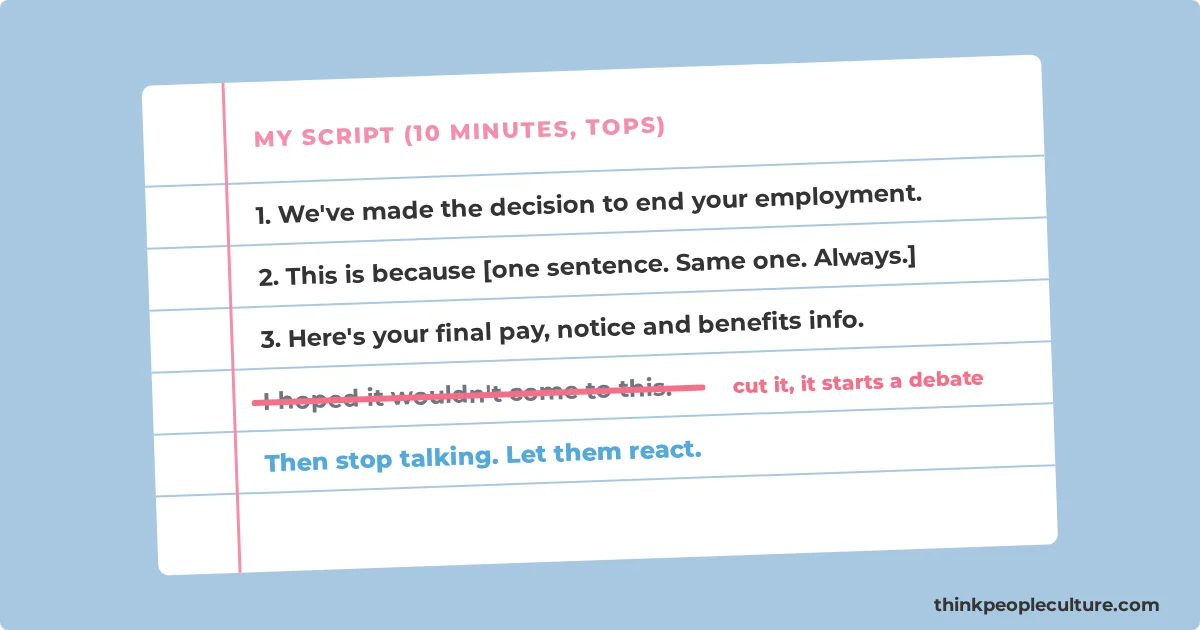
A first time manager once wrote the speech the day before, and the first draft had a line that said "I hoped it wouldn't come to this." The advice back was to cut it, and it was right. That one sentence invites a debate. The meeting went fine in the end, and it went fine because the warnings were already in writing.
Don't argue, apologize for the decision, or reopen the file. If they get emotional, let them. If they ask "why," give the same reason you wrote down; use the same words, every single time.
Respect matters in the room, in the moment, more than most people think. People forgive a hard message. They don't forgive being talked down to, or being told "hold on one quick minute" while you check your phone or email. Give them your undivided attention until the meeting is finished. Being brushed off is often what turns a quiet exit into a complaint.
Handle Final Pay and Benefits Carefully
Final pay is where good owners get burned by a small mistake. In California, when you fire someone, all wages earned are due immediately at the time of termination, including accrued vacation, and the Labor Commissioner says payment is made at the place of termination (California Labor Commissioner, final wages upon discharge). Earned, unused vacation counts as wages earned when someone leaves (California Labor Commissioner, waiting time penalty).
So, bring the final pay to the termination meeting. Not "next payroll." Not "we'll mail it to you."
Here's what late costs look like, with a made up example:
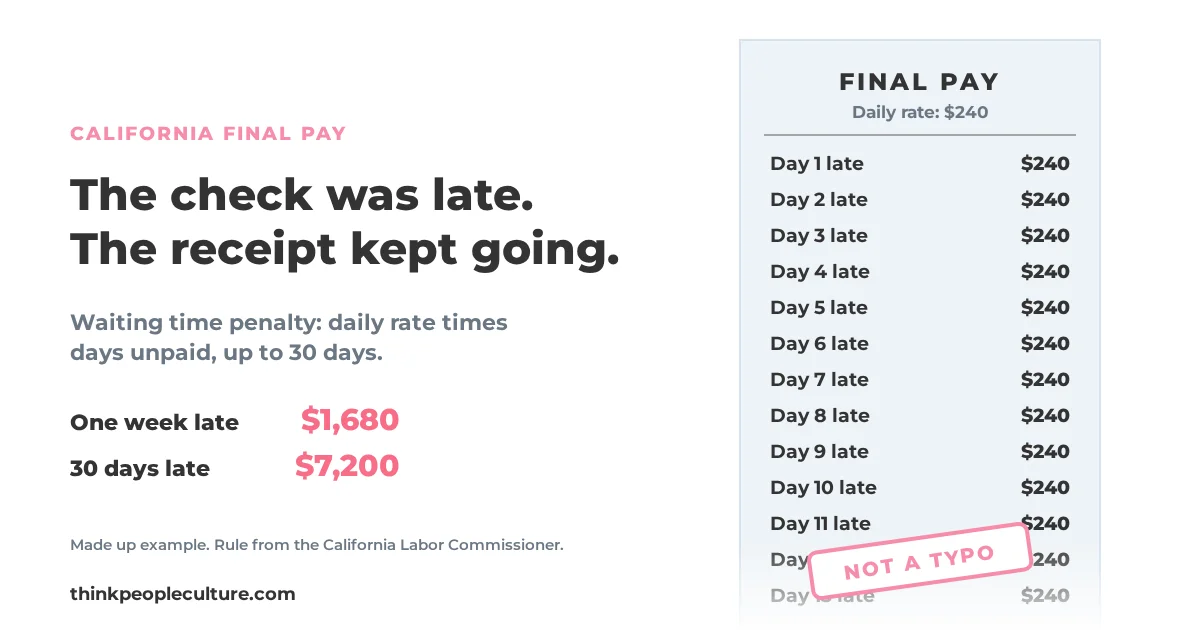
If the person earns $240 a day and the check is a week late, that's $1,680 in waiting time penalties on top of what you owed the employee. Keep it late long enough and the penalty can run up to 30 days of pay, which is $7,200 in this example.
The state's rule is that you're responsible for that employee's daily rate times the days they go unpaid, for up to 30 days. That's a lot of money for a calendar mistake, and it's the most avoidable one in any employee termination.
You also owe the employee a written notice. The EDD says you must immediately give written notice to employees if they are fired or laid off, and it publishes a sample notice that meets the minimum (EDD, required notices and pamphlets). The sample only needs the person's name, the date, and the change in status, not a long explanation. The same page lists the booklet For Your Benefit (DE 2320) among the pamphlets you give employees when needed, so hand it over with the notice.
One more thing from the internet, and it's wrong. People will tell you that you need "cause" or the person can't collect unemployment. Not how it works. Anyone out of work can apply, and EDD decides eligibility after it interviews the person, and you as the employer, when it's a firing.
Protect Privacy After the Meeting
Don't announce why the employee left. "Alex is no longer with the company, and Sam will cover the account" is enough. Skip the gossip, even the friendly kind.
Keep the file in a locked spot with a short list of people who can see it. If a reference call comes in, send it to one person, and keep it to dates and title unless you have a clear policy.
Most privacy messes happen after the meeting, in a Slack channel, by someone trying to be helpful.
Manage Access, Property, and Records
Plan this before the meeting. Cut system access at the time of the conversation with the employee, not an hour later. An hour is a long time for someone with a grudge and a Forward button. Collect the laptop, badge, and keys, or arrange a prepaid shipping label if they work remote.
Save the termination records, and keep them longer than you think. Employers have to keep a copy of each employee's personnel records for at least three years after employment ends, and former employees can ask to see them (Labor Code 1198.5). Wage statement copies have to be kept at least three years too (Labor Code 226). If a request comes in, the clock matters: the law gives the employer 30 calendar days to respond to a personnel records request and sets a $750 penalty for missing it.
So, keep the final file, the termination date, the written notice, the pay stub with the final wages, and a copy of anything you handed them, all in one place.
Make the Exit Consistent With Your Culture
The people who stay are watching you. If the exit is cruel, sloppy, or secret, your best people start updating their resumes. If it's clear and decent, they trust the next hard call too.
Tell the team what they need to know about the employee leaving, keep it short, and move the work along.
Then check in with the manager who had to do this. It's not easy, and it's easy to forget they carry it.
Culture isn't the poster in the break room. It's what you do on the worst Tuesday of the quarter.
Slow Down, Verify, Then Act
If you read all this and thought, "I'm not sure we're ready," that's the right instinct. A day or two of checking is cheap. A rushed firing isn't.
This is the kind of call I help with. I set managers up with the scripts, the steps, and the answers to the questions they'll get, and I can join the meeting by video if that helps. I'm not a lawyer, so for anything legal, your attorney has the final say, and I'll tell you when it's time to call one.
If you're about to have this conversation, book a Termination Sanity Check. Want the checklist and the words for the meeting on one page first? Get the free California Termination Day Checklist and Script. And if you want the bigger picture on getting steady HR support, read what fractional HR leadership is or see how I support California employers.
Common Questions
When do I have to pay someone I fire in California?
Right away, at the time of termination. Final pay includes earned vacation (Labor Code 201; Labor Commissioner pages linked above).
Can I fire someone without a reason in California?
Usually yes, because the Labor Code lets either side end an at will relationship on notice (Labor Code 2922). The exceptions are big, though. Discrimination, retaliation, and contract promises are the usual traps.
Do I have to give an employee a termination letter?
Yes, a written notice of the change in relationship. The EDD says you must immediately give written notice to employees who are fired or laid off, and its sample notice only needs the date and the status.
Do I have to pay out unused vacation when I fire someone in California?
Yes. Earned, unused vacation counts as wages and goes in the final check at the time of termination (Labor Code 227.3).
What happens if the final check is late?
A waiting time penalty can apply: the person's daily rate for each day the pay is late, up to 30 days (Labor Code 203).
Can I fire someone by text or email?
Better not to. If you have to, keep it as clear and short as you would say it in person, and still get the final pay done right.
How long do I keep the records?
At least three years after the person leaves for personnel records, and at least three years for wage statement copies (Labor Code 1198.5 and 226).
Should I call a lawyer?
If there's a leave, complaint, a protected issue, or a lot of money at stake, yes. I help you get ready and your attorney covers the legal call.
Hire Better. Lead Smarter. Don't Suck!
Get HR Insights Delivered
Join our newsletter for the latest HR trends, tips, and best practices delivered straight to your inbox.
We respect your privacy. Unsubscribe at any time.