How RPO Works When It Runs Under Your Brand
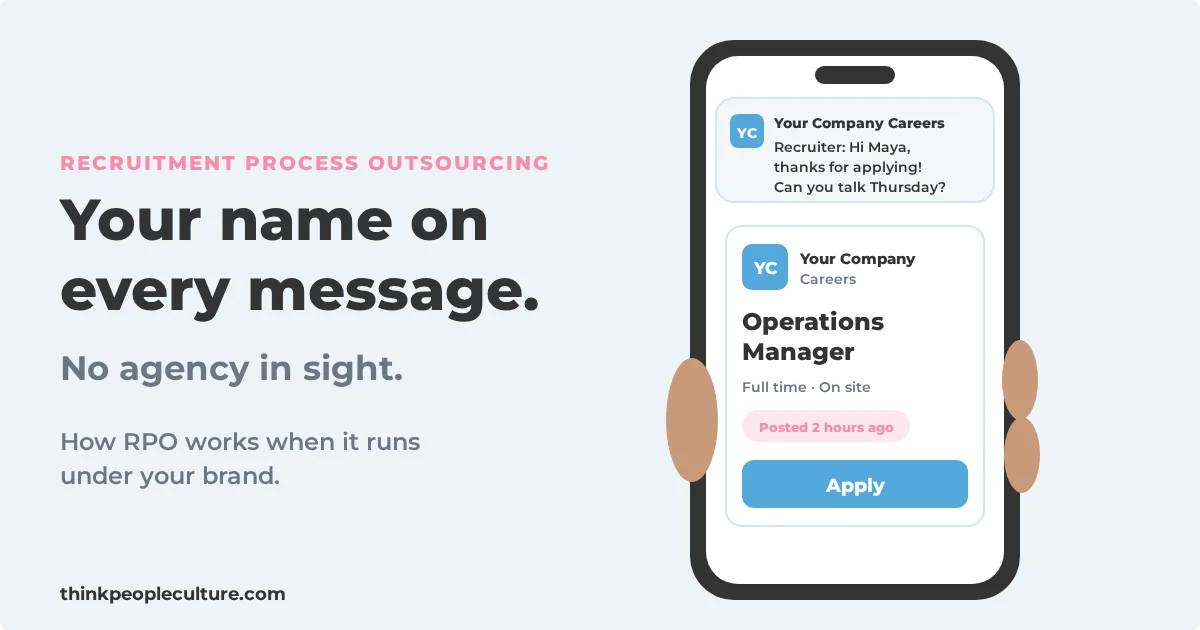
Recruitment Process Outsourcing, or RPO, is when you borrow a recruiter who acts like your own “in house recruiter.” They use your company name, run your hiring from the Job Description to the signed offer, and candidates never see an outside firm. You get a real hiring process without building a recruiting department.
If you've got open roles, a Hiring Manager who hasn't answered a candidate since last Tuesday and a job post that reads like a ransom note, this one's for you. Every good candidate is looking for their Pink Pony Club, the place where people are actually glad they showed up. (Yes, the HR guy just quoted Chappell Roan. Stay with me.) Think of it as a recruiting team that wears your company's t-shirt (here's what's included). Below is how that actually works, what it costs you to keep doing it the old way and when it's the wrong call.
What Is Recruitment Process Outsourcing?
In plain English, you hand some or all of your hiring to someone outside who runs it like they work for you. Instead of sending you a stack of resumes and a bill, they own the process itself, which means the Job Description, the sourcing, the screening, the interview schedule and the offer.
Most owners have never heard the term, but they've felt the problem. Hiring lands on whoever has the least on their plate that week, which is nobody, so it drifts. Candidates wait, good ones take other offers and you end up interviewing the person who was still available.
White label is the part that makes RPO different from an agency. The recruiter works under your brand, so candidates never meet a middleman. As far as candidates know, they're talking to your own recruiting team. That matters, because candidates judge your company by how you hire them.
Short version: Someone runs your hiring like they're on your team, under your name, from start to finish.
Why Growing Companies Are Turning to RPO
Growing companies turn to RPO because hiring keeps getting slower and more expensive, and most teams of 12 to 350 people don't have a recruiter on staff to carry it. The work still has to get done, so it falls on founders and managers who already have full time jobs.
The numbers back this up. In SHRM's 2026 Recruiting Executives Benchmarking, over 2 in 3 organizations reported struggles hiring for open positions, and the median Time to Fill for nonexecutive roles was 39 calendar days. SHRM's 2025 benchmarking release put the average Cost per Hire for nonexecutive roles at $5,475, and found that only 20% of organizations even track quality of hire.
Thirty nine days is a long time for your best salesperson to also be doing the job of the person who quit. And if only one company in five tracks whether its hires turn out well, most companies are paying for hiring without ever checking what they bought. That's like buying a car and never looking to see if it starts.
Short version: Hiring is slow and pricey for almost everyone. RPO puts one person in charge, so it stops landing on your desk.
How White Label RPO Actually Works
White label RPO works by putting the recruiter inside your brand, so every step a candidate sees looks and sounds like your company. The recruiter follows your process, speaks in your voice and reports to you, and you still decide who gets hired.
Here's what my RPO work covers, step by step:
- Job Description and market analysis. Before anything gets posted, the role gets defined and checked against the market, so you're not asking for a unicorn at a pony's pay.
- Sourcing and screening. This goes well beyond posting the job and hoping. The recruiter goes and finds people, then screens them, so your Hiring Manager sees a short list instead of a pile.
- Interview coordination. Scheduling, prep and follow up that keep candidates warm and make your company look like a place worth working, so nobody waits two weeks to hear "we went another direction." Candidates can handle a no. What they can't stand is radio silence.
- Getting the yes. Help landing your top pick, instead of losing them in the last mile over a start date or a pay gap you could have closed.
- Day 1 ready. The handoff from "yes" to Day 1, so the person you worked so hard to hire actually shows up and sticks.
Put it all together and it's your own recruiting team, minus the hiring of one.
Short version: From the Job Description to Day 1, every step carries your name.
RPO vs. Hiring a Recruiter
RPO usually beats hiring a recruiter when your hiring comes in waves or you aren't sure how long the push will last. A full time recruiter makes more sense once you're hiring steadily all year and the work truly fills a seat.
There's also a funny catch with hiring a recruiter because you actually have to recruit the recruiter first. So, the hiring problem you're trying to solve becomes the first hiring problem you have to solve.
Here's how the three common options stack up:
| RPO (white label) | Staffing or search agency | In house recruiter | |
|---|---|---|---|
| Who candidates think they're talking to | Your company | The agency | Your company |
| How you pay | Flat monthly rate | A fee for each hire | Salary, benefits and tools |
| Who owns the process | A dedicated recruiter running your whole process | The agency, for the roles they're paid to fill | Your employee |
| Commitment | Three month minimum with Think People.Culture | Per role | A full time hire |
| Best when | Several roles over the next few months | One hard to fill role | Steady hiring all year |
Here's how I put it on my services page: "Unlike traditional contingent recruiters, we offer a flat monthly rate with a dedicated recruiter who handles your entire recruitment process." That flat rate changes the incentive, because the recruiter isn't racing to get a fee on whoever says yes first. If you've ever gotten one of those spammy "I have the perfect candidate for you" emails, you already know how the per hire fee model works.
Short version: RPO for a hiring push, an agency for one hard role, an in house recruiter once hiring is steady all year.
What Good RPO Looks Like in Practice
Good RPO looks like a hiring process candidates remember for the right reasons, with fast replies, clear steps and an offer that doesn't surprise anyone. You should feel it too, because your week gets lighter instead of busier.
Here are the signs it's working:
- The Job Description is written and agreed on before a single post goes live.
- Every candidate hears back, including the ones who don't get the job.
- Your Hiring Manager gets a short list of people worth meeting, with notes on why.
- Interviews follow a plan, so every candidate gets asked about what the job actually needs. Keep it to two or three rounds. Candidates call anything past that a waste of time, and they're right.
- The offer is handled with care, and the new hire has a plan for Day 1.
I've been part of more than 7,000 hires over 20+ years, and the pattern doesn't change. Most hiring goes wrong long before the offer. The post is vague, the interviews wander and great candidates get left hanging, so they take the other offer. I used to hear "Thanks, but these aren't who I'm looking for. I'll know it when I see it" all the time. Now, before the search starts, I have the Hiring Manager describe the candidate who hits 80% of the job in real detail, and commit to moving every qualified 80% candidate through interviews. "I'll know it when I see it" doesn't survive that conversation.
One story that stuck with me came from Hannah Brewer, a recruiter at Sprint People, who wrote about losing a candidate who was an "EXACT match" for her client. The client was growing fast, and the people making decisions lived in meetings. Weeks turned into months. There was another month between the third and final interview and the offer showed up more than a week after that.
By then the candidate had taken another job. Not for a better company or for a bigger title or for more money. According to Hannah, "She chose them because they made her feel wanted." Basically, she found her Pink Pony Club. And your hiring process? That's the mom in the song, on the phone asking why she can't just wait three more weeks. And when you finally do call back, the candidate assumes they were your backup plan.
The same situation from the other side of the table I can think of came from a candidate quoted by Intelligent Employment: "After three rounds of interviews, I was told to expect feedback 'soon.' Two weeks later, I still hadn't heard anything. Another company gave me an offer in three days. It wasn't a hard choice."
Neither one of those companies had a talent problem. They had a nobody's job problem. I wrote a whole book about fixing that, Don't Suck at Recruiting. It’s a great book, if I do say so myself.
Short version: Fast replies, a short list worth your time, and candidates who feel wanted.
Is RPO Right for Your Company Right Now?
RPO is a good fit if you have several roles to fill over the next few months and nobody whose real job is recruiting. It's probably the wrong fit if you only hire once or twice a year, or if you already have a recruiter who's doing great work.
Ask yourself these questions:
- Do you have two or more roles open, or coming soon?
- Is hiring being done by people who were hired to do something else?
- Have you lost a good candidate because nobody followed up?
- Can you give a recruiter at least three months to do it right?
That last one matters. Recruiting with Think People.Culture runs on a three month minimum, because good hires take time to find.
Sometimes hiring isn't the real problem. If people keep leaving soon after they start, or you don't have a handbook, a pay structure or anybody owning HR, fix that first, or you'll just be pouring new people into a leaky bucket. That's where fractional HR leadership comes in, and if your team is in California, here's how I handle fractional HR for California companies.
Here's a question worth sitting with, though. If the role you need most is still open 39 days from now, who on your team is covering it, and what is that costing you?
Short version: Several roles, no recruiter, and three months to do it right? That's an RPO fit.
Frequently Asked Questions
More answers about how I work are on the FAQ page.
Will candidates know they're working with an outside recruiter?
Not unless you want them to. With white label RPO, the recruiter uses your company's name, your email and your process, so to candidates it's simply your company hiring.
How long does an RPO engagement last?
Recruiting with Think People.Culture runs on a three month minimum, because good hires take time to find. Many hiring pushes need longer than that, and you'll know the plan before anything starts.
How is RPO priced?
It's a flat monthly rate with a dedicated recruiter, instead of a fee for each hire. Each package includes the support hours needed to properly manage your open requisitions.
Is RPO only for big companies?
No. I work with companies of roughly 12 to 350 employees across California and the US, and that's often where RPO helps most, because there's no recruiting team to lean on.
Ready to Stop Hiring on the Side of Your Desk?
If you've got roles open and nobody whose job it is to fill them, that's the exact gap RPO was built for. Book a call, bring your list of open roles and the Job Description you like least, and I'll tell you honestly whether RPO makes sense for you or whether something else will fix it faster.
Hire Better. Lead Smarter. Don't Suck!
Get HR Insights Delivered
Join our newsletter for the latest HR trends, tips, and best practices delivered straight to your inbox.
We respect your privacy. Unsubscribe at any time.