Fractional HR Leadership: What It Is, What It Costs, and When It's the Wrong Call
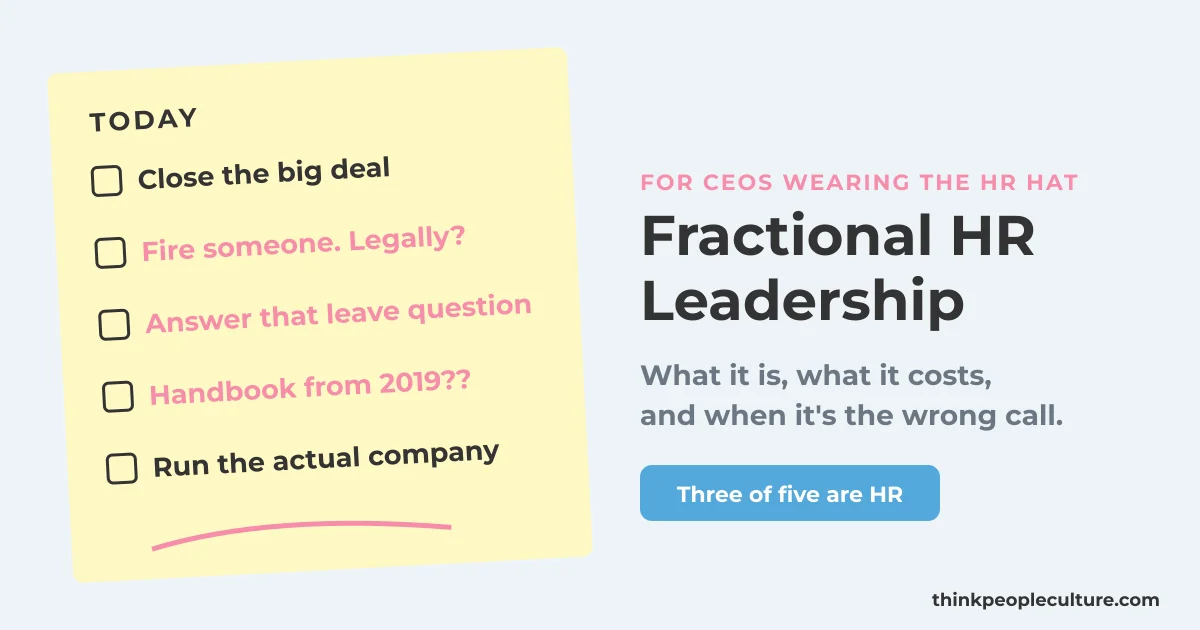
Most owners I talk to say some version of the same thing. "Our HR needs aren't big enough to hire a full time person, but they're way too big to ignore." Then they tell me about the week. Someone quit, someone needs to be let go, a manager asked a leave question nobody could answer, and all of it landed on the CEO's desk, right next to the actual job.
That's the gap fractional HR fills. Most of what's written about fractional HR services comes from firms selling them, me included, and most of it reads like the same brochure, strategic, flexible and a fraction of the cost. Here's the version I'd give a CEO across the table, covering what it is, what it really costs, what happens in the first 90 days, and when it's the wrong call.
What Is Fractional HR Leadership?
Fractional HR leadership means CPO or CHRO level judgment and HR expertise brought into a company that doesn't need, or isn't ready for, a full time HR executive. The good ones diagnose before they prescribe, own the hard calls, and do the work instead of handing you advice and a binder.
The key word is "owns." A help line answers questions. A real fractional HR leader takes the problem off your desk and keeps it until it's solved, and it's the same senior person every time, so you never have to explain who you are again.
Who Actually Needs a Fractional HR Leader?
The sweet spot is a white collar company with roughly 12 to 350 employees and no HR person, or an HR gap because the last one left. The CEO is wearing many hats, and one of them is HR, badly, at 9 p.m.
Nobody calls me because they woke up wanting an HR strategy. They call because one thing went sideways. It's a first time firing an employee that has to be done right. It's a handbook copied off the internet years ago that's wrong for their state. It's a great salesperson who got promoted to manager last month and is now quietly melting down. Or it's the company that grew faster than its systems and woke up with forty people, three states and no rules.
If you've caught yourself saying, "I just want this off my plate so I can run my company," that's the signal.
What Are the Benefits of Fractional HR?
The biggest benefit of fractional HR is executive judgment on the calls that can actually hurt you, without carrying an executive salary through all the weeks they don't come up, and with HR processes built to hold up as you grow.
Here's what that range looks like in real life. In the morning it's a Pregnancy Disability Leave question that has to be handled exactly right. In the afternoon it's sitting with your head of sales after someone quit, working out what that open salary frees up, and folding it into your Compensation Philosophy so it funds the new role you actually need. A generalist can usually handle the morning. The afternoon is where the money gets saved or lost, and that takes someone who's sat in the C suite.
The benefit nobody puts in the brochure is timing. Most of the expensive HR messes I clean up were cheap a month earlier, back when someone could have made one phone call. Having a senior leader in your corner means that call happens before the lawyer letter instead of after it.
What Does a Fractional HR Leader Do Day to Day?
There isn't a day to day the way there is with an employee. The work covers whatever the assessment ranks highest, and it's usually some mix of these.
Compliance and state law. This is where owners get nervous, and they should. The rules change by state, sometimes by city, and a generic answer can cost real money. A good fractional leader tells you plainly when something is an HR call and when it's a legal one. HR prepares, your attorney reviews. If anyone tells you HR and legal are the same job, keep your wallet in your pocket. For California employers, that includes the written safety plans the state now requires, which I broke down in this California workplace violence prevention guide.
Employee Relations and hard conversations. Complaints, performance problems, terminations, and the awkward Tuesday conversation nobody wants to have. One person owning it from the first call to the last document is the difference between a clean exit and a demand letter.
Hiring. Job descriptions, interview scorecards, offers, and when it makes sense, running the recruiting itself. Recruiting is one piece of fractional HR, and I wrote a whole book on not getting it wrong.
Manager Training. Most managers were promoted because they were good at the job, not because anyone taught them to lead. That gap drives a lot of quiet turnover, which I got into in How to Prevent High Performer Burnout, and it's why leadership coaching often ends up in the plan.
Policies, handbooks and records. An Employee Handbook built for your state and your actual company, plus the files and forms that protect you if something does happen. If you're starting from zero, here's what goes into a handbook that works.
How Fractional HR Leadership Works, Step by Step
Fractional HR gets sold a few different ways. The most common is a slice of time, a set number of hours a week on retainer, and market data puts a typical fractional CHRO at about 13 hours a week. Others work like an hourly HR consultant, take on a single project, or step in as an interim leader for a few months. Some start with a real assessment and some don't, so ask. Firms that publish their approach tend to split the first 90 days into diagnose, design and execute, which is a fair outline.
How I run it
I don't sell hours. The work is project based, under a contract of 60, 90 or 180 days, or a full year, for one flat fee a month. Nobody's watching a clock, not you and not me, because counting hours is a great way to get the hours and miss the work.
Diagnose. We figure out what's actually wrong, which isn't always the thing you called about.
Scope and proposal. The work, the timeline and the fee, in writing, before anything starts.
Intake. Documents, people, history, and the stuff nobody ever wrote down.
Assessment. The whole HR function, with every gap ranked by what could hurt you most, in plain English. You won't need a decoder ring.
The 90 day roadmap. Vetted with you and broken down by week, risk, priority, owner, progress and what comes next. Anything on fire goes to the top of week one.
The build. Strategic and tactical at the same time, done hands on. Sometimes that means I set the direction and your people do the work. Sometimes it means I'm in it, driving onboarding, setting up coaching for your leaders, or running weekly one on ones with your top five. One recent client, a B2B company of about 15 people, is a good example. We fixed a contractor classification risk first, then built the whole HR foundation inside 90 days.
What comes next. Most clients keep working with me in some form after the build, whether that's the next build, ongoing leadership, or simply having me there for the hard calls.
And you get me, not a team of juniors behind a logo. I learn your business, I don't vanish, and you'll typically hear back within six business hours. For a real emergency, you have my cell. I'm not a lawyer, but after more than 20 years in this work, if you bring me a question I'll get you an answer, and if it's one I shouldn't answer, I'll tell you exactly who to call.
What Does Fractional HR Cost?
The honest way to price fractional HR is against the seat you'd otherwise fill. A VP of HR runs roughly $165,000 to $290,000 in base salary depending on the market, from Minneapolis at the low end to San Francisco and New York at the top. Add a typical target bonus of 20 to 25 percent, plus about $35,000 in employer payroll taxes and health coverage, and the first year lands around $230,000 to $395,000, before equity. A Chief People Officer runs higher still, with target bonuses closer to 40 to 50 percent of base. And if you use a search firm to find either one, executive search typically adds 25 to 35 percent of first year pay. These ranges move every year, so treat them as a snapshot.
Fractional pricing runs from about $1,500 a month for a generalist, to $4,000 to $7,000 for a fractional HR director, to $15,000 a month for a fractional CHRO. What I charge for a senior level project usually lands around a quarter to a third of that first year cost of a VP of HR, with no search fee and no severance if it isn't working.
The cheap end of the market isn't a scam, it's a different product. Forms, a help line or a few hours of HR support won't build your Compensation Philosophy, protect your reputation in a messy termination, or get your managers leading. If you want forms and answers, buy forms and answers. If you want someone who owns the outcome, that's the senior end, and pretending one is the other is how a cheap monthly decision turns into a very expensive one.
Fractional HR vs. a PEO, an HR Subscription, a Consultant or a Full Time Hire
The fastest way to sort the options is to ask who owns the hard call when it lands.
| Option | What it handles | Who owns the hard call |
|---|---|---|
| A PEO | Payroll, benefits and the paperwork behind them | Mostly you. The real HR work often goes undone. |
| An HR subscription | A help line, templates and a portal | You. They answer questions, and you make the decision. |
| Traditional HR consulting | One project with a start and an end | You again, once the project wraps. |
| A fractional HR leader | Strategic HR, the hard calls and a defined build, then ongoing support | They do, start to finish, with your sign off. |
| A full time HR hire | Everything, every day | They do, and you're paying for the whole seat. |
None of these is wrong. A PEO can be great at payroll and benefits, and I've set one up for a client who needed exactly that. If you're asking yourself "Do I really need a PEO?", the honest answer is that it depends on whether your problem is paperwork or decisions. A PEO fixes paperwork. If your "dedicated" HR rep has changed four times this year, though, you don't really have one, and nobody owns your decisions.
When Fractional HR Is the Wrong Call
Fractional HR is the wrong call in four situations. Any experienced HR leader worth hiring will tell you so up front, and I turn work down for exactly these reasons.
You're very small and nothing's on fire. Under a dozen people with no open issues, a solid handbook, a payroll provider and a good employment attorney on speed dial may be all you need for now.
The daily work already fills a seat. Once HR questions are coming in all day, every day, you need someone in the building. A good fractional leader writes that job description and helps you hire for it, even though it means you'll need them less.
You want someone to agree with you. If the plan is already made and you just want HR to sign off on it, save your money. The value is someone senior enough to say "don't do that" before you do it.
Nobody on the leadership team will make decisions. Fractional works when leaders act on the advice. If every recommendation turns into another meeting about having a meeting, no HR model fixes that.
How Do You Choose the Right Fractional HR Partner?
There are plenty of good HR professionals doing this work, and a few you should run from. Ask these before you sign anything.
Who exactly will I be talking to, and will it be the same person every time? How fast do you answer when something is on fire, and what does "fast" mean in hours? Do you know the laws in my state, or will I get a generic answer? What's included, and what isn't, in writing? How do I leave if it isn't working? And will you tell me when it's time to hire a full time HR person, even if that means I need you less?
The red flags show up early. You get passed from one person to the next. Nobody takes responsibility when something goes wrong. The advice sounds like a chatbot wrote it. And the price keeps moving. If you're seeing two of those in the sales process, you'll see all four after you sign.
Common Questions About Fractional HR Leadership
How much does fractional HR cost? Published ranges run from about $1,500 a month for a fractional HR generalist to $15,000 a month for a fractional CHRO. Compare that to a full time VP of HR, which runs roughly $230,000 to $395,000 in the first year once bonus, payroll taxes and health coverage are added, before equity or a search fee.
Can fractional HR replace an HR department? For most companies under a few hundred employees, yes, because the work is real but doesn't fill a full time seat. When the daily volume does fill one, a good fractional leader builds the plan for that hire and helps you make it.
Is fractional HR leadership right for a company with 12 to 350 employees? That's the range it fits best, especially white collar companies with no HR person or an HR gap. Below that, a handbook, a payroll provider and an attorney may be enough. Above it, you probably want a full internal team.
How is fractional HR different from outsourced HR? Outsourced HR usually means a service that handles tasks like payroll, forms or a help line, while you still make every decision. Fractional HR leadership means a senior person who owns your people strategy and the hard calls, and who knows your company well enough to tell you no.
What does a fractional HR leader do in the first 90 days? A good one diagnoses the real problem, scopes the work, and assesses the whole HR function before building anything. Then they turn that into a roadmap broken down by week, risk, priority and owner, and work through it with you, hands on, so the basics hold on their own by day 90.
Where to Start
Start with the thing that's sitting on your desk right now, the one you keep meaning to deal with. That's usually the most expensive problem you have, and it's cheaper this month than it'll be next month.
If you step back for a moment and picture that thing still sitting there in 90 days, what's it cost you? Count your leaders' time, your own Tuesdays, and how much closer it's crept to a lawyer letter. And if it were actually handled, by someone who's sat in the room where the budget gets built, what would you do with the time you got back?
If you already know those answers, you also know whether this is a job for a help line or for someone who owns it. When it's the second kind, grab 15 minutes with me and bring the situation. Sometimes the answer is a 90 day build. Sometimes it's a good employment attorney, and I'll tell you which one I'd call. Either way, you'll hang up knowing exactly what you're dealing with, and you can see how fractional HR works with me before you ever pick up the phone.
Get HR Insights Delivered
Join our newsletter for the latest HR trends, tips, and best practices delivered straight to your inbox.
We respect your privacy. Unsubscribe at any time.