When Does a Startup Need a Fractional CHRO? (And When to Go Full Time)
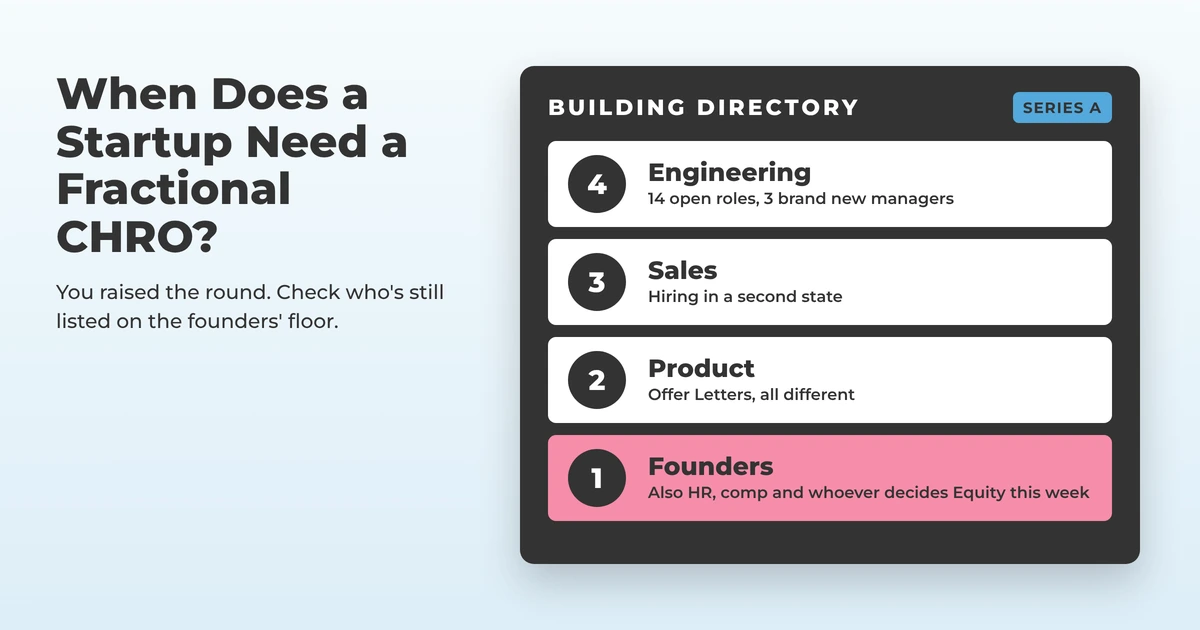
The money hit the bank on a Tuesday, and by Friday you had 14 open roles, three brand new managers and nobody who has ever built a Compensation Band. Sound familiar?
The short answer: Most startups need a fractional CHRO in the months after a funding round, when offers, Equity and new managers pile up faster than anyone can handle. Think of one as senior HR leadership you share with a few other companies, on a set contract. They build your Compensation Bands, Equity rules, Manager Training, Performance Reviews and the plan for hard calls like a Layoff. ChartHop puts a first Head of People at 20 to 40 people, when a team plans to double. As of October 2026, GoFractional's benchmark puts most fractional CHROs at $125 to $250 an hour, with retainers from about $16,000 to $24,500 a month. A full time HR Manager earns a median of $149,280 a year before Benefits (BLS, May 2025). You switch to a full time CHRO when the people work fills a full week, every week.
Somewhere in the next six months, one Slack message will tell you if you set this up right. I'll show you which message further down.
This CEO of a 34 person fintech closed her Series A in the spring. Five months later she'd hired 19 people. Every offer got worked out in Slack DMs between her, her cofounder and whoever was hiring that week.
Then two senior engineers on the same team grabbed lunch and compared Offer Letters. They had the same title and the same start month, but one had nearly twice the Equity.
By Monday, the one with less had a recruiter's message open in another tab. The spreadsheet that held every offer lived in a tab named "comp FINAL final v7."
I'll tell you what we did with that spreadsheet, and what it would have cost to leave it alone. First, it helps to get clear on what this role really does, because most founders picture the wrong job.
What Does a Fractional CHRO Actually Do at a Startup?
CHRO stands for Chief Human Resources Officer. Some startups call the same seat a Chief People Officer or Head of People. A fractional CHRO does that job part of the week for a few companies, the same model as a fractional CFO, and at a startup it covers eight areas.
- Compensation Bands and a Compensation Structure with levels, so every offer comes from the same page.
- Equity rules, so two people in the same seat don't get wildly different grants.
- Manager Training for the people who just heard "congrats, you have reports."
- Performance Reviews that don't get skipped the second things get busy.
- An Employee Handbook and Worker Classification that hold up in every state you hire in.
- Organizational Design, so everyone knows who reports to whom as you add layers.
- A plan for the hard calls, like Employee Relations issues, a Termination or a first Layoff.
- A people slide for your board that says more than "we hired a lot."
Your pay philosophy right now is probably whatever you said on the last call. That's a philosophy the same way a junk drawer is a filing system.
This is people strategy backed by senior HR expertise. It decides how your People Operations should work, and then it builds them. Recruiters fill seats and Payroll software pays people, and neither one does this part. For a deeper look at the role itself, my post on fractional HR leadership walks through it.
There's also one hire most founders make first that quietly makes all of this worse. I'll get to it in a minute.
The Takeaway: Get someone who owns the system behind your people decisions, so you stop making them one DM at a time.
Seven Signs Your Startup Needs a Fractional CHRO (Headcount Isn't First)
You don't need one at five people. You probably need one sooner than you think. ChartHop puts the moment for a first Head of People between 20 and 40 people, when the team plans to double in the next year (ChartHop).
These seven signals usually show up before the headcount does.
- You just raised. Hiring is about to speed up, and every shortcut you take now gets copied 20 times.
- Every offer gets built from scratch. Pay depends on who negotiated hardest that week, and nobody wrote down the reasoning.
- Your strongest people now run teams. Nobody taught them how to manage.
- You're hiring in a second state. Each new state brings its own pay, leave and posting rules.
- Your board wants a people plan. Investors are asking about hiring and retention, and right now the plan lives in your head.
- You crossed 15 or 20 people. Federal laws like Title VII and the ADA cover employers with 15 or more employees who worked 20 or more weeks this year or last. Age discrimination law starts at 20 employees (EEOC).
- A hard call showed up. It might be a complaint, a Termination or the first time you're talking about cutting roles.
Your top salesperson got promoted on Friday. By Monday, they'd learned that "manager" mostly means answering questions Google can't.
If three or more of those sound like your week, your HR needs are too big to ignore and too small for a full time executive. That's the exact gap the fractional model fills.
And, at some point, you'll want to replace your fractional CHRO with a full time one. I'll tell you where that line sits before the end.
The Takeaway: Watch for the signals before the headcount, because they show up first.
The Hire Most Founders Make First, and Why It Backfires
That hire is usually a recruiter, because Talent Acquisition feels like the urgent problem. It makes sense on paper. You've got 14 open roles, so you hire someone to fill them.
The trouble is what the recruiter is filling them into. There are no Compensation Bands, no Leveling and no managers who know how to onboard anyone. So, the recruiter does a great job, and the mess grows faster.
Hiring a recruiter before you have Compensation Bands is like hiring a valet before you've built the parking lot. The cars show up fast, and then everybody's circling.
The other common first move is a junior HR Generalist who's supposed to cover everything. A good Generalist is gold for the daily work, like Onboarding, Benefits questions and paperwork. Most can't also set your Equity rules or coach your cofounder through a Termination, and that's not fair to ask of them.
Senior HR leadership goes first and builds the system. Then your recruiter and your Generalist have something real to work inside.
The Takeaway: Build the system before you hire people to run it, or you'll pay to scale the mess.
Fractional CHRO vs Full Time CHRO vs HR Generalist vs PEO: The Number Most Founders Miss
| Fractional CHRO | Full time CHRO, Head of People or HR Director | HR Generalist | PEO | |
|---|---|---|---|---|
| What it is | Senior HR leadership, part time, on a contract | Senior HR leadership on staff full time | A hands on HR employee | A company that becomes co employer for Payroll and Benefits |
| What you get | Strategy and the full build of bands, Equity rules, managers and hard calls | The same, plus a full week every week | Daily HR work, like Onboarding, Benefits questions and records | Payroll, Benefits plans and HR tools |
| Cost, as of October 2026 | GoFractional puts most at $125 to $250 an hour, with retainers from about $16,000 to $24,500 a month | HR Managers, the closest BLS group, earn a median of $149,280 a year before Benefits | HR Specialists earn a median of $75,940 a year before Benefits (BLS) | A per employee fee that varies by provider |
| Best for | About 12 to 350 people, often right after a raise | When the work fills a full week | When the system exists and needs someone to run it | Small teams that want bigger company Benefits |
| Where it falls short | It's part time, so the fit has to be right | Hard to find, slow to hire and hard to undo | Not built to set strategy or make senior calls | Doesn't build your bands, train managers or own hard calls |
Sources: GoFractional fractional CHRO guide, BLS Human Resources Managers and BLS Human Resources Specialists, read October 25, 2026.
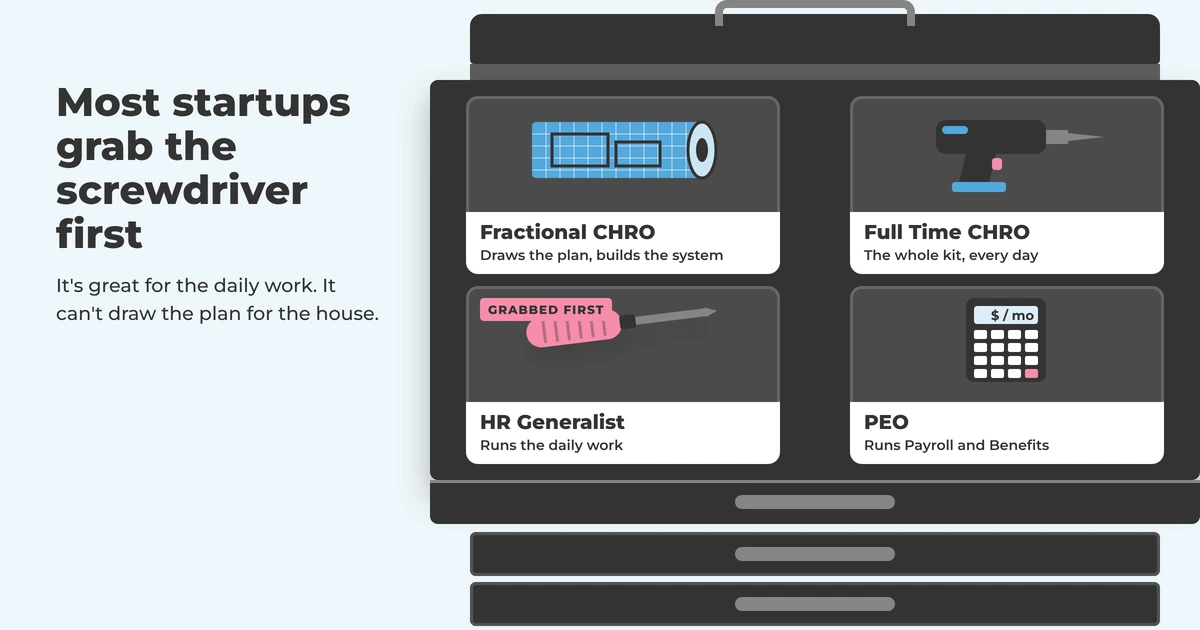
The salary isn't the whole bill for a full time hire. In private industry, wages make up roughly 70% of what employers pay per hour, and Benefits cover the rest (BLS, June 2026). So, a $149,280 salary works out to about $213,000 a year all in. That's about $17,800 a month before Equity, and before the months it takes to find the right person.
If a PEO is on your list too, my post on fractional HR vs a PEO vs an HR consultant breaks that choice down. And, if you want the full cost picture, here's what fractional HR costs per month.
The Takeaway: The right choice matches the work you have today and leaves room for the work you'll have after the next raise.
What Waiting Costs You
Back to that Slack message I promised you. It usually says some version of "Hey, can we talk about my Equity?"
That message means someone compared notes. And, when you're scaling fast and one person compares notes, the whole team usually has.
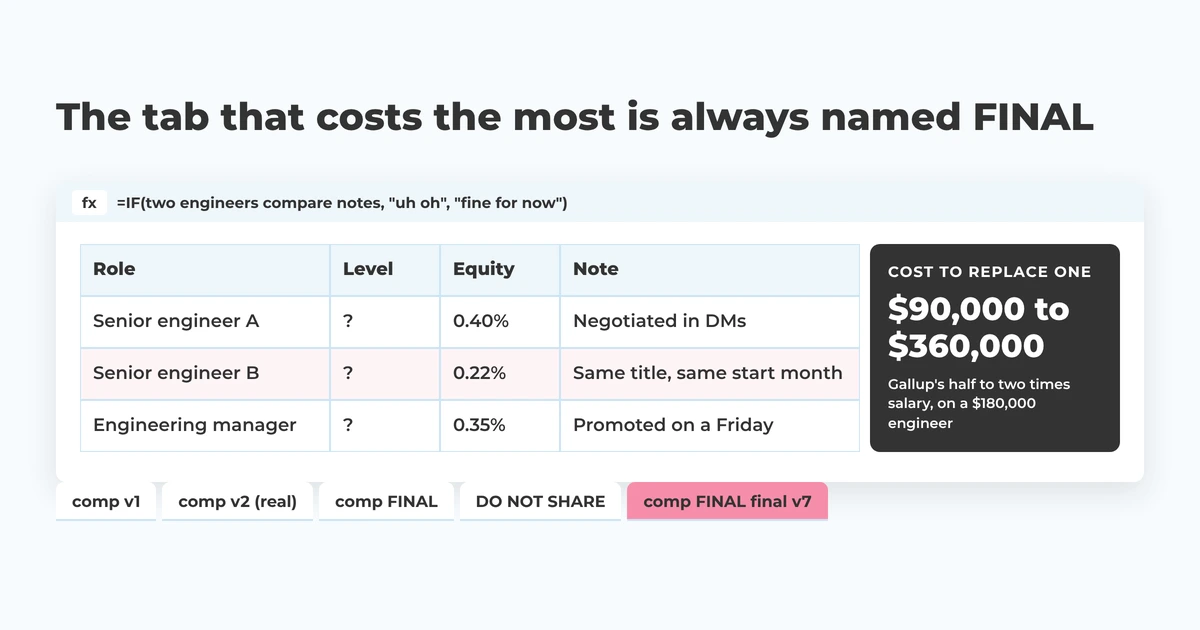
Losing that person is expensive. A 2019 Gallup study put the cost of replacing an employee at one half to two times their yearly salary (Gallup). Say a senior engineer earns $180,000. Replacing them would cost $90,000 to $360,000.
Cutting your workforce brings its own rules. Under the federal WARN Act, employers with 100 or more employees generally must give 60 calendar days' written notice before a mass Layoff (U.S. Department of Labor). That means 500 or more people at one site, or 50 to 499 if they're at least a third of the site's workers (DOL Employer's Guide to WARN). Many states add their own versions.
Most founders wait for the first real problem, and by then the fix costs more.
The Takeaway: Count the cost of one lost senior hire, then compare it to what it costs to prevent it.
What the First 90 Days With a Fractional CHRO Look Like
- Month one, find the gaps. Read every Offer Letter, Equity grant and job title. Check Worker Classification and the rules in each state you hire in. Talk to your managers.
- Month two, build the core. Set Compensation Bands with Leveling, fix the outliers and start Manager Training. Pick a Performance Review rhythm your team can keep.
- Month three, make it run without you. Finish the Employee Handbook for each state, tighten Onboarding and write the plan for hard calls. Then hand your board a people slide that answers its questions.
So, what happened with "comp FINAL final v7"? We built Compensation Bands for that fintech in about three weeks. Every role got a level, and every level got a range. The engineer with less Equity got a refresh grant that put him inside his band, plus a clear answer about why.
He stayed, and offers since then come from one page instead of a Slack thread. The tab got renamed to something boring, which is the nicest thing that can happen to a spreadsheet.
For the month by month version, read what a fractional HR person does in the first 90 days. If you want to see how I work with funded teams, here's my page on fractional CHRO for startups.
The Takeaway: Ask for a written 90 day plan before you start any engagement, and walk away if there isn't one.
When to Hire a Full Time CHRO Instead
That's the line I promised you. You need a full time CHRO when the people work fills a full week, every week, and stays that way.
That usually happens when you're managing an HR department of your own, with more than one Generalist. It also happens when your leadership team is getting ready for an IPO, a big acquisition or a Layoff big enough to trigger WARN. The timing depends on how fast you're changing. A startup doubling every year can hit that point near 100 people, while a steadier company of 300 might still do fine with fractional help.
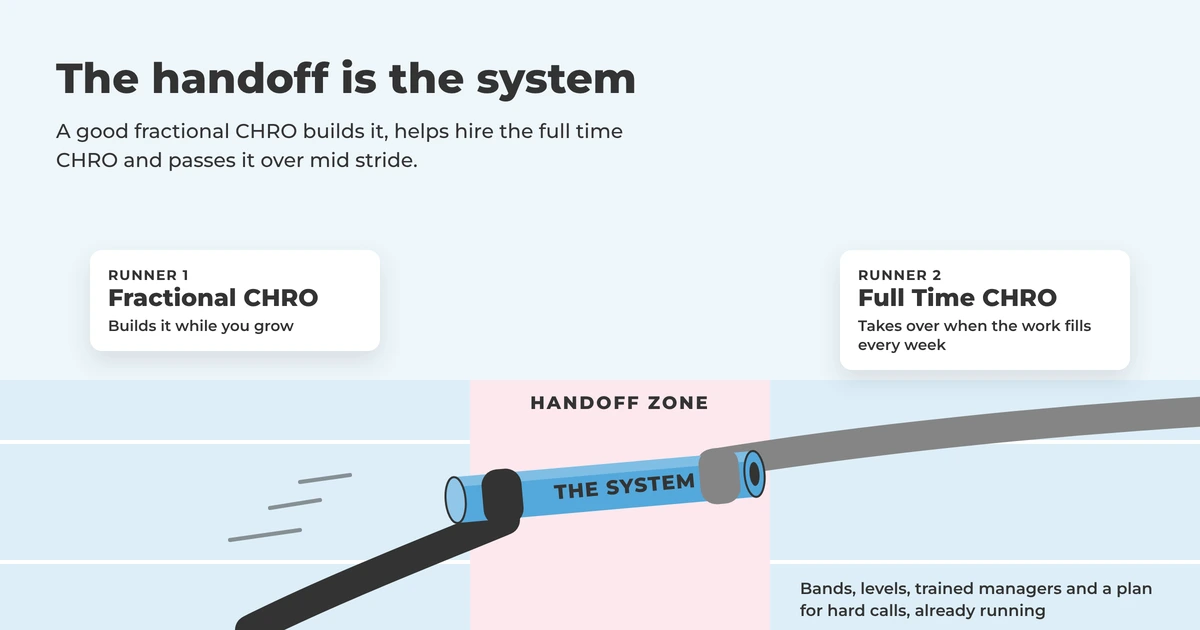
A good fractional leader will tell you when you've hit that point. Then they'll help you write the job, interview the finalists and hand over a system that already works.
Your board deck has a slide for burn rate, runway and churn, and the people slide is a photo from the offsite. Part of the job is making that slide boring, too.
The Takeaway: Hire full time when the work is full time, and let your part time CHRO help pick the person.
Questions to Ask Before Hiring a Fractional CHRO (and the Answer That Should Worry You)
Ask These on the First Call
1. Will I work with you every time, or will you hand me off to someone else?
2. What will you build in the first 90 days, and how will I know it's done?
3. Have you done this on a part time or project basis for a startup our size?
4. How do you set Compensation Bands and Equity rules when every offer so far has been different?
5. Who's in the room with me when there's a complaint or a Termination?
6. How fast do you answer when something can't wait?
7. How do I know when it's time to hire a full time CHRO, and will you help me hire them?
The answer that should worry you is a vague one, like "we'll figure that out once we're in." If you hear it more than once, keep looking.
Maybe you just raised, your offers don't match and your new managers are figuring it out as they go. Someone senior can build the system with you now and help you grow into the next stage, long before a full time executive makes sense. Grab 25 minutes with me and we'll figure out which problem you're solving first. You can also see how I work with growing companies on my services page. For more on building a startup team, read how tech startups can grow talent with HR.
This is the HR point of view based on experience and my understanding, not legal advice. Market rates are as published on the date read and can change.
Common Questions
What is a fractional CHRO?
It's a senior HR leader you share with a few other companies. You get Chief Human Resources Officer judgment for part of each week, under a set contract. They build Compensation Bands, Equity rules, Manager Training and the plan for hard calls.
How much does a fractional CHRO cost in 2026?
As of October 2026, GoFractional's benchmark puts most fractional CHROs at $125 to $250 an hour. It lists monthly retainers from about $16,000 to $24,500. The price depends on scope, stage and how fast the work needs to happen.
When should a startup hire a fractional CHRO?
The common trigger is a funding round followed by a hiring push. ChartHop puts a first Head of People at 20 to 40 people, when a team expects to double. Mismatched offers and brand new managers are the early warning signs.
What's the difference between a fractional CHRO and an Interim CHRO?
An Interim CHRO usually works full time for a short stretch to fill a gap, like between hires. A fractional CHRO works part time on an ongoing contract and often works with more than one company.
Does a fractional CHRO replace a PEO or HR software?
No. A PEO or HR software runs Payroll, Benefits and records. A fractional CHRO decides how your people side should work and builds it. Many startups use both.
How many hours does a fractional CHRO work?
It depends on the scope. Many are sold as a monthly retainer with a set number of hours. Others, like Think People Culture, charge one flat monthly fee without tracking hours.
When should a startup hire a full time CHRO instead?
When the people work fills a full week, every week. That often means you're running an HR team or getting ready for an IPO, a big acquisition or a large Layoff. A fast growing startup can hit that point near 100 people.
Can a fractional CHRO help with a Layoff?
Yes. They can plan who is affected, check the notice rules and write what managers will say. Under the federal WARN Act, employers with 100 or more employees generally owe 60 days' written notice before a mass Layoff. That means 500 or more people at one site, or 50 to 499 if they're at least a third of the site's workers.
HR Help in Your Inbox
My free newsletter for owners with no HR person, with plain answers sent when there's something worth reading.
We respect your privacy. Unsubscribe at any time.