Fractional HR vs PEO vs HR Consultant: Which Way to Outsource HR Fits Your Company?
Every PEO pitch makes the same promise, you'll never have to think about HR again. Then you think about HR every Monday, and some Sundays too. The PEO did what it promised, it just promised less than it sounded like. "HR" covers three very different jobs, and most owners buy the one that solves the problem they had last month.
So, let's sort it out. If you're trying to decide how to outsource HR, this is Fractional HR vs PEO vs HR Consultant in plain English. You'll see what each one costs, what each one won't do, and how to tell which one fits your company right now.
One client, a design studio of about 70 people, signed with a PEO because the sales deck said "we'll be your HR department." Their office manager had been doing HR on the side for years, and after the switch she kept doing all of it. Every Friday she emailed the PEO a list of what she'd handled so it would be "on record." Three months in, the PEO's quarterly review had a slide called Wins This Quarter, and every single bullet on it was hers. Nobody in the room said a word. Hang on to that slide, because how they got out is the part that matters.
What a PEO (Professional Employer Organization) Actually Does
Here's how it works, the PEO becomes your co employer. It takes on admin like payroll and payroll tax under its own tax ID, pools your people into its employee benefits plans, and usually handles Workers' Compensation and some compliance help. A PEO may also offer an HR software platform and a help line. It's a big industry. According to NAPEO, the PEO trade group, 502 PEOs serve more than 233,000 mostly small and midsize businesses that employ 5.4 million people.
Here's the part the deck skips, under co employment you still run your company. NAPEO's own FAQ says the client company is responsible for business decisions, day to day supervision, job assignments, employee reviews and pay. TriNet says the client makes all final hiring and termination decisions. Insperity says wage and hour compliance stays with your company. So, the hard calls, the ones that end up in a demand letter, are still decided by you.
What you do get is real. Payroll processing gets done, taxes get filed, and small teams can often get better benefits than they'd find alone. If a PEO is IRS certified (a CPEO), the IRS treats it as the employer for federal employment taxes on the wages it pays. That's a nice layer of protection on the tax side. You'll also hear about an employer of record, or EOR, which is a different setup mostly used to hire people where you don't have your own company set up.
What you usually don't get is a human resources partner who knows your people. Owners tell me the same things over and over about PEO "HR advisors." It's a help desk, the answers are generic, and the advisor sends links you could have Googled yourself. The help desk is very polite. It just sends you the same article you already found, with a ticket number on it.
The Takeaway: A PEO handles the HR administration of being an employer. It doesn't make your people decisions for you.
What an HR Consultant Does
An HR Consultant is project based. You hire one for a specific HR project like building an Employee Handbook, or to fix job classifications, run an investigation, or set up a pay structure, and when the project's done, so are they. Dover's published market range puts HR projects at $2,000 to $15,000, with hourly work at $75 to $250.
This is the right call when you have one clear problem and an internal HR person or office manager who can keep things running after. It's the wrong call when the problem keeps changing shape every week, because then you're buying a new project every month and paying for the consultant to learn your business over and over.
The Takeaway: An HR Consultant is great for a single fix with a finish line. They aren't built to be there for the next fire.
What Fractional HR Does
Fractional HR is a senior HR leader who works with you part time, on an ongoing basis. Think a few days a month or a set number of hours a week, usually on a monthly retainer. They do the strategy and the hands on HR tasks, coach your managers, clean up HR compliance, and they're the person in the room when something goes sideways.
You might think "fractional" is just a new word for consultant. Fair enough, Fractional HR is a consultant who stays for dinner, learns everybody's name and is still there when the dishes pile up. That staying is the whole point. If you want the longer version, I wrote about what Fractional HR leadership is.
The fit is usually companies that are too small for a full time HR team and too big to ignore the people side of the HR function. Fractional HR doesn't run payroll, so most of these companies keep a payroll provider or a PEO next to it.
The Takeaway: Fractional HR gives you HR judgment that sticks around, without the full time salary.
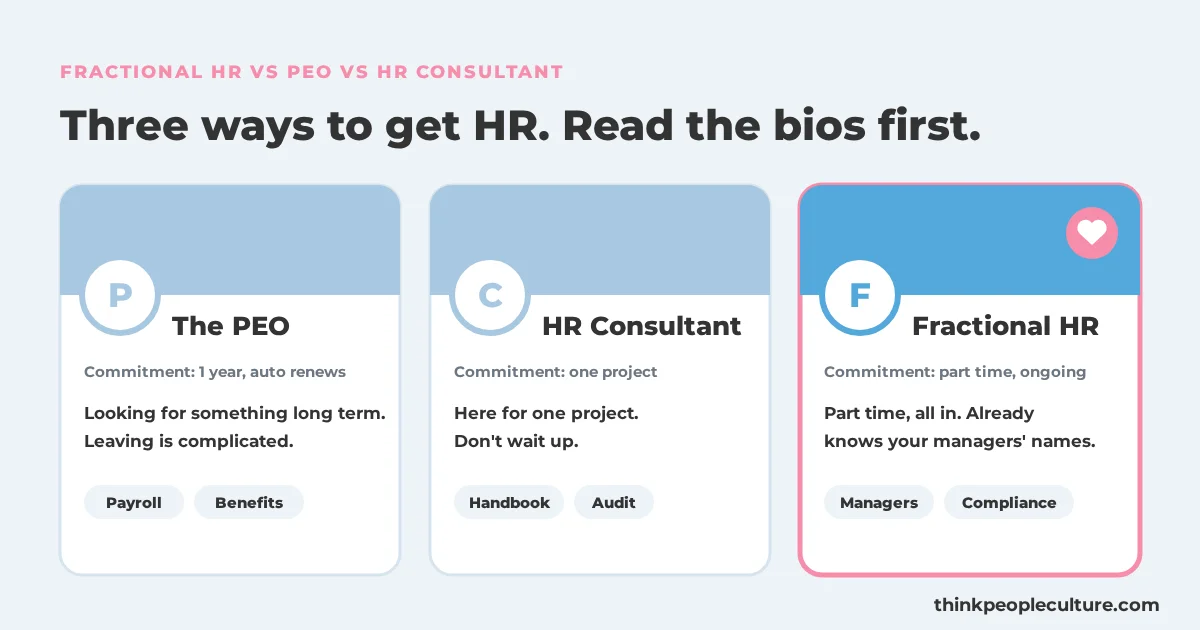
Fractional HR vs PEO vs HR Consultant, Side by Side
| PEO | HR Consultant | Fractional HR | |
|---|---|---|---|
| What you're buying | Payroll, payroll tax, benefits pool, Workers' Comp, admin | One project with a finish line | An ongoing, part time senior HR leader |
| Who makes people decisions | You do | You do, with their recommendation | You do, with someone who knows your people next to you |
| Knows your team | Rarely | For the length of the project | Yes, that's the job |
| How it's priced | Per employee per month, plus benefits | Per project or per hour | Usually a monthly retainer |
| Hard part | Renewals and getting out | Starts over every project | Finding the right person |
| Best when | Admin and benefits are the pain | One clear problem | Managers, complaints, growth and compliance keep piling up |
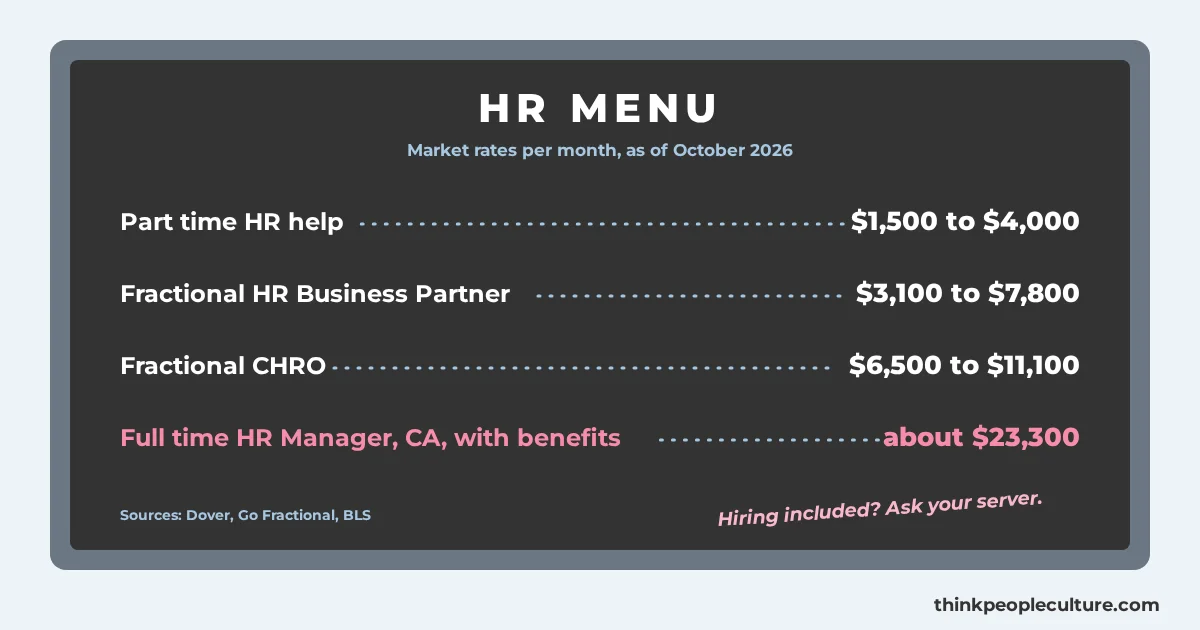
For a sense of market pricing, as of October 2026: Justworks publishes PEO plans at $79 and $124 per employee per month before benefits. Go Fractional's rate benchmark lists a Fractional HR Business Partner at $3,100 to $7,800 a month at about 13 hours a week. I break the whole money question down in how much Fractional HR costs per month.
The "Who's in the Room" Test
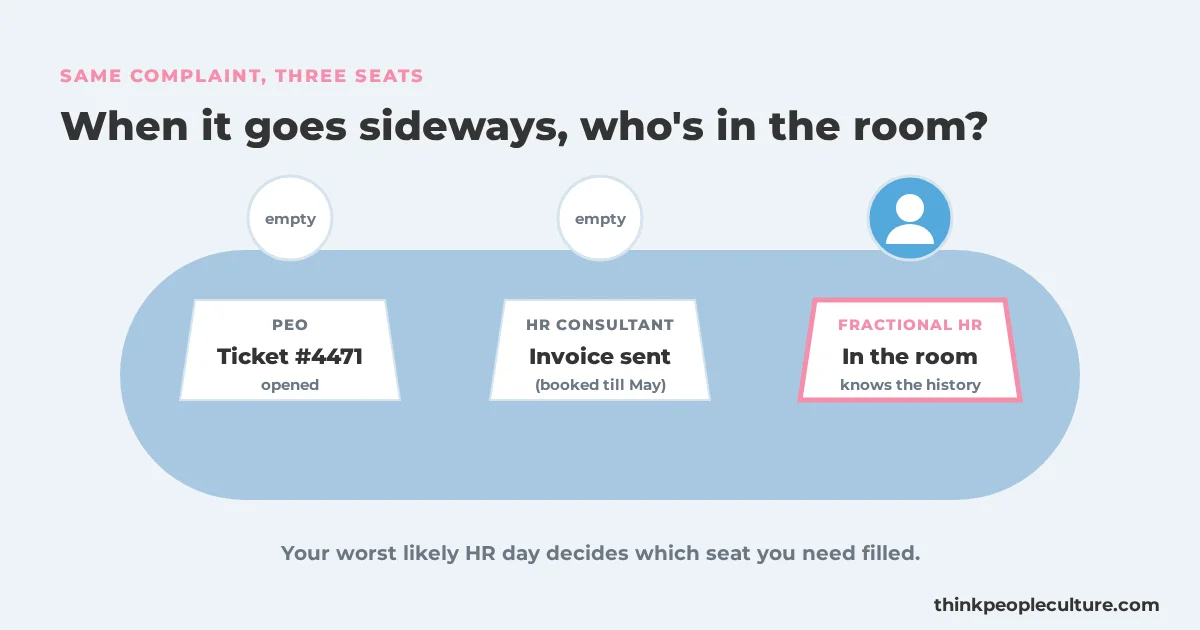
The easiest way to choose is to picture your worst likely HR day. A manager wants to fire someone who just asked for leave. Two employees aren't speaking and one of them filed a complaint. Payroll got a final check wrong. Now ask, who's in the room with you?
With a PEO, you open a ticket and wait. With an HR Consultant, you call, they're booked on another project, and the clock starts on a new invoice. With Fractional HR, the person who already knows the manager, the employee and the history is the one helping you make the call. If your worst likely day is "payroll is late," a PEO might be all you need. If your worst likely day involves people, you want a person.
The Takeaway: Pick the option that matches your worst likely day, not your easiest one.
What Leaving PEOs Really Costs
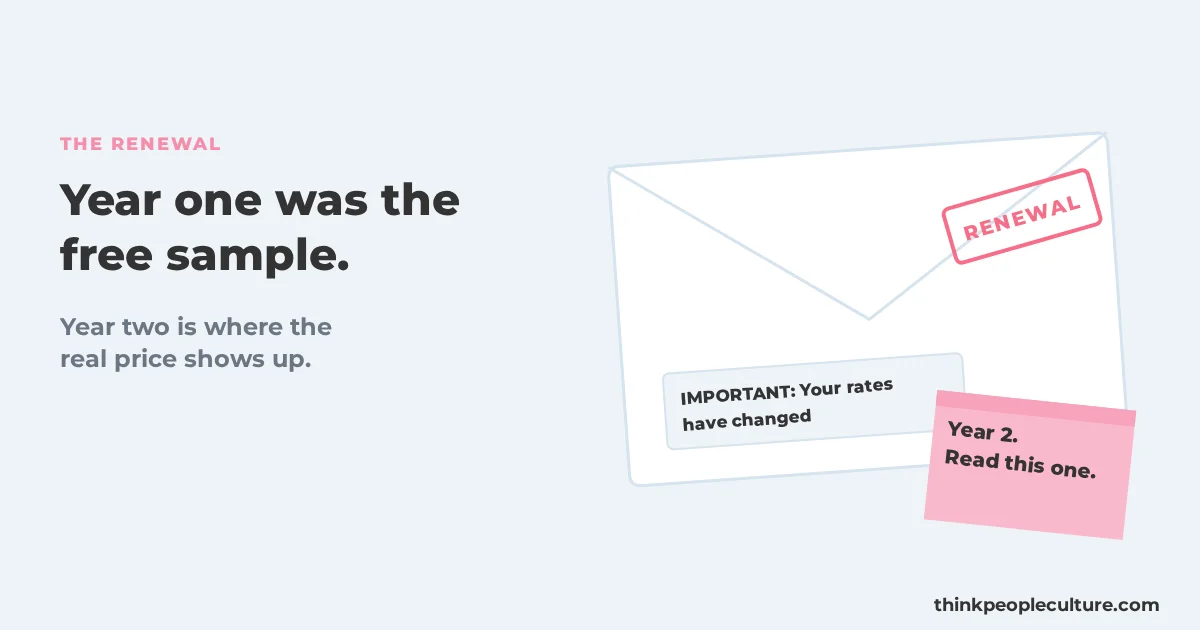
Owners who've been through a PEO tell me the same three things. First, the honeymoon rates don't last, and the renewal is where the real price shows up. Year one is the free sample at the grocery store, and year two is the full price aisle. Second, the fees are hard to see, and plenty of owners can't tell what they're being billed for. Third, it's hard to get out from under it once you're in, because you're replacing payroll, benefits, Workers' Comp and every little workflow the PEO handled quietly in the background.
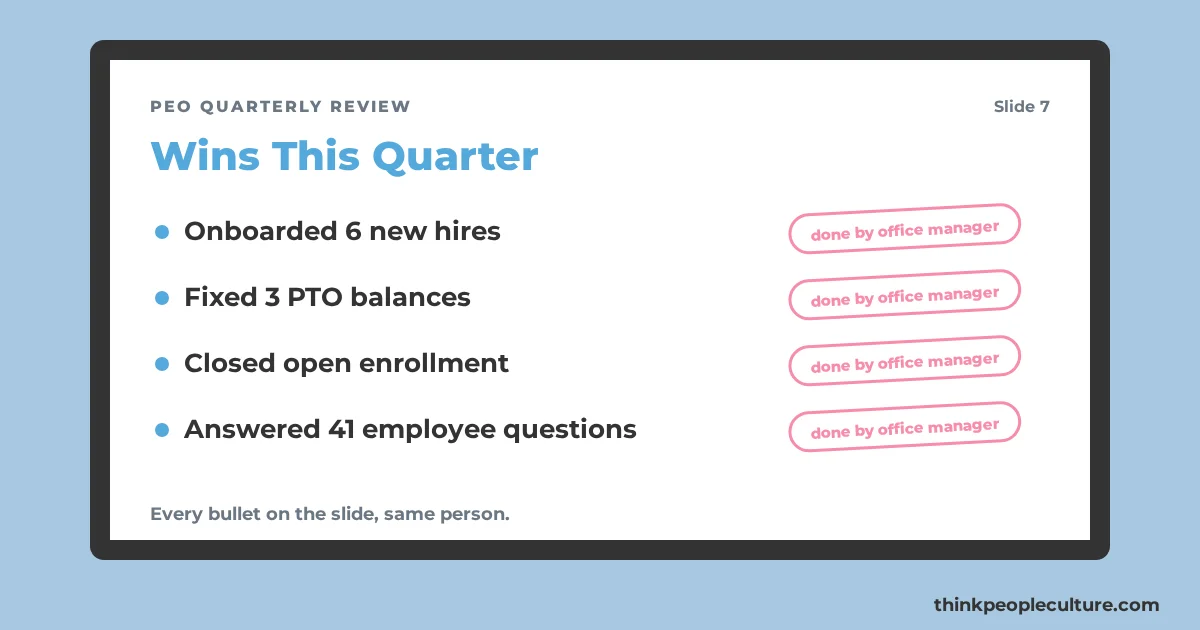
Back to that design studio. After the Wins This Quarter slide, the owner finally asked the office manager what the PEO actually did for them. She pulled up her Friday emails and the answer was "file what I send." Then the benefits renewal came in way up. Leaving took most of a quarter, with a spreadsheet of every task the PEO touched, a benefits broker shopping plans, a new payroll provider, and a Fractional HR lead to own the people side. The office manager got her Fridays back. Nobody misses that slide.
The Takeaway: If you're already doing the HR work yourself, you're paying a premium for simple and getting the hard parts anyway.
Can You Use a PEO and Fractional HR at the Same Time?
Yes, and for a lot of companies that's the smart setup. The PEO runs payroll and employee benefits, the day to day HR operations. Fractional HR handles managers, complaints, terminations, hiring, policies and the California curveballs. Even owners who like their PEO tell me the same thing, get an HR person for the sticky stuff even if you keep the PEO.
The other common setup is no PEO at all, just a payroll provider, a benefits broker and Fractional HR. That one gives you more control and fewer surprises at renewal, but someone has to manage more vendors. A good Fractional HR person will tell you honestly which one fits, including when you don't need them yet.
How to Pick the Right HR Solution, Based on What's Breaking
Start with the symptom, not the vendor. If payroll mistakes, benefits costs and tax filings are the pain, look at a PEO or a payroll provider plus a broker. If you have one clear project like an Employee Handbook or a pay structure, hire an HR Consultant. If managers keep bringing you people problems, complaints have nowhere to go, you're hiring fast, or you're in California and nobody's sure what's compliant, that's Fractional HR. If you already have an in house HR person who's drowning, Fractional HR support can sit above them and take the hard calls.
And, if it's all of the above, that's normal for a company between 30 and 150 people. It usually means you've outgrown "the office manager handles it," which I wrote about in we're 60 people with no HR and things are breaking.
Questions to Ask Before You Outsource HR
If the answers are vague, that's your answer. Before you outsource any of it, get those answers in writing. If you want help reading a PEO proposal against your real needs, or you're trying to figure out whether you need Fractional HR at all, book a short call with me. Tell me what's going on and I'll tell you if I'm the right fit. You can also see the HR services I offer, how I support California employers or the answers to common questions. Weighing a low cost HR subscription too? Read Fractional HR vs Bambee.
Common Questions
What is the difference between Fractional HR and a PEO?
A PEO is a co employer that runs payroll, payroll tax and benefits for you. Fractional HR is a part time senior HR leader who works with your managers and people. A PEO handles admin, and Fractional HR handles judgment and leadership.
Is an HR Consultant the same as Fractional HR?
Not quite. An HR Consultant usually does one project and leaves. Fractional HR is ongoing, usually on a monthly retainer, and gets to know your people and your history.
Can a business use Fractional HR and a PEO at the same time?
Yes, many companies use a PEO for payroll and benefits and Fractional HR for managers, complaints, hiring and compliance.
Does a PEO take on my legal responsibility as an employer?
Only part of it, and only what the contract says. NAPEO says the PEO and the client split employer duties by contract, and the client still makes business decisions, supervises employees and sets pay. TriNet says the client makes final hiring and termination decisions.
How much does a PEO cost?
It depends on headcount, benefits and Workers' Comp. As one public example, Justworks lists its PEO plans at $79 and $124 per employee per month before benefits, as of October 2026. Always ask for the total yearly cost in writing.
How much does Fractional HR cost?
Market rates vary by hours and seniority. Go Fractional's benchmark lists a Fractional HR Business Partner at $3,100 to $7,800 a month at about 13 hours a week, as of October 2026.
Is it hard to leave a PEO?
It can be. You'll need to replace payroll, benefits, Workers' Comp and every workflow the PEO handled, so plan for it like a project with its own timeline.
How do I decide which one is right for my business?
Match it to what's breaking. Admin and benefits point to a PEO. One clear project points to an HR Consultant. Ongoing people problems, growth and compliance point to Fractional HR.
Hire Better. Lead Smarter. Don't Suck!
Get HR Insights Delivered
Join our newsletter for the latest HR trends, tips, and best practices delivered straight to your inbox.
We respect your privacy. Unsubscribe at any time.