Does a Small Business Need an HR Department? We're 60 People and Things Are Breaking
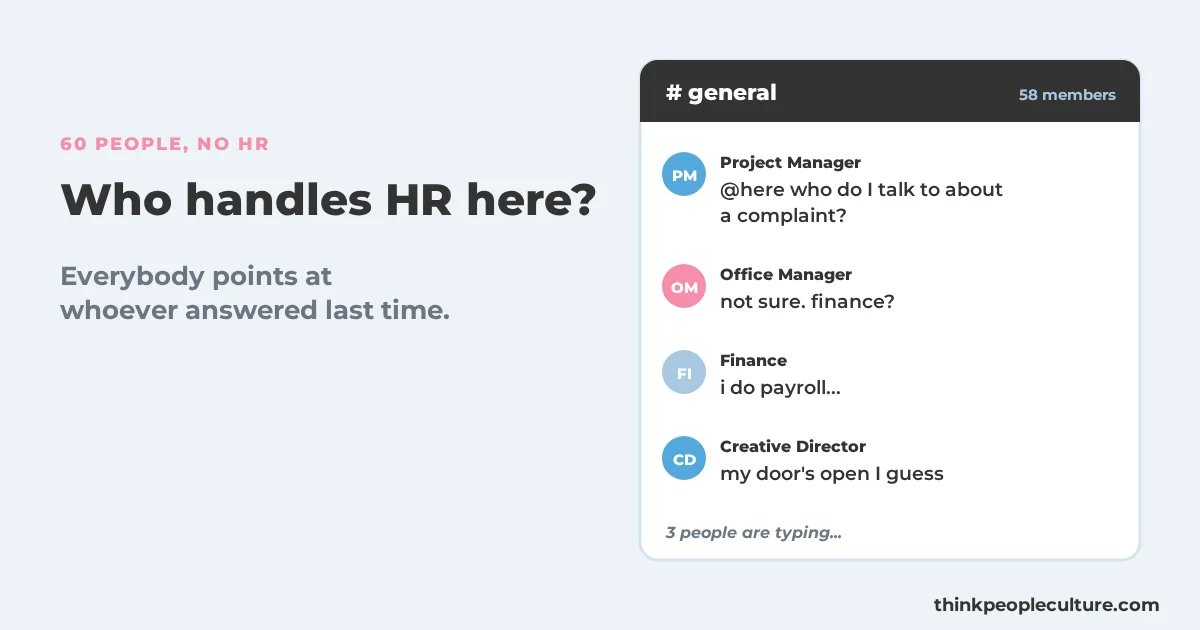
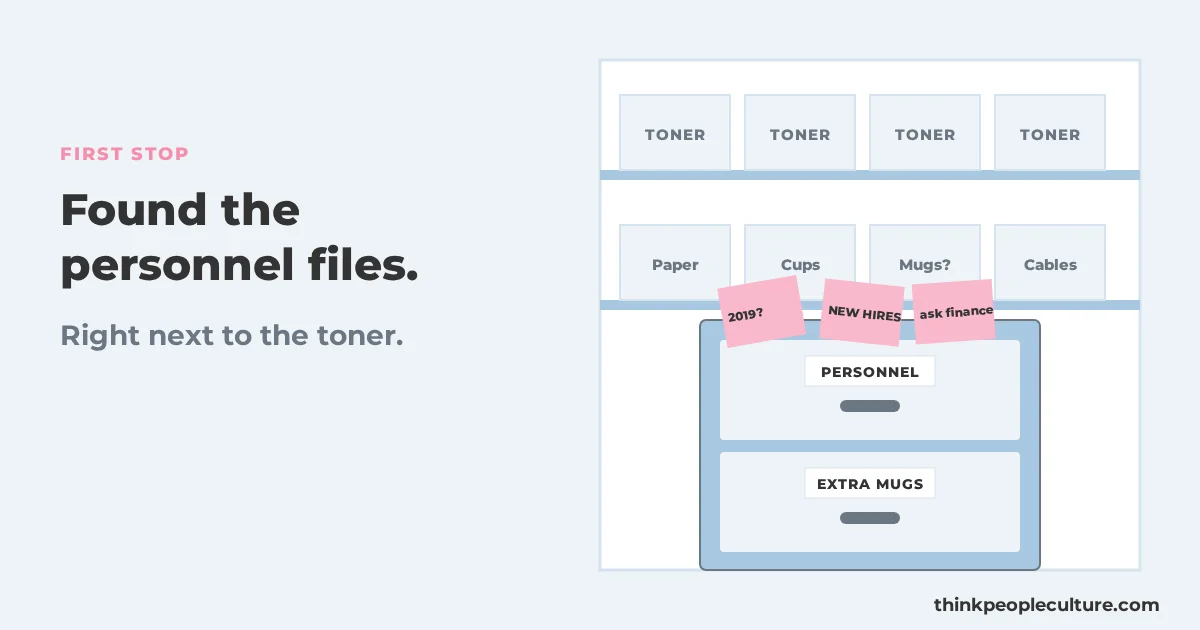
"Just ask finance, they'll know." That was the entire HR plan at a marketing agency I worked with, about 60 people and growing fast. The controller ran payroll, benefits and Workers' Comp, plus whatever else landed on her desk. "Other duties as assigned" was doing a lot of heavy lifting in her job description. The creative director had become the person everyone vented to, mostly because her door was open and she was nice about it. Personnel files lived in a filing cabinet in the supply closet, right next to the toner, and half the folders were labeled with sticky notes. Everybody joked about it. Then an employee complaint sat in someone's inbox for three weeks because nobody knew whose job it was to open it. That's when the jokes stopped, and I'll tell you what we found when we opened the cabinet.
If you're a small business owner, CEO or COO whose company grew from 15 to 60 people and the HR function still lives in somebody's spare time, this is for you. Here's what you're legally on the hook for, what usually breaks, and what to fix first.
Does a Small Business Legally Need an HR Department?
No, there's no law that says you must have an HR person or an HR department. Even the U.S. Chamber of Commerce says it plainly: "There's no 'rule' that a small business must have a team or manager in charge of HR activities."
But, the laws don't care who does the work, only that it gets done. Each of these laws puts the duty on "the employer," which means you. Payroll, leave, harassment training, I-9s, complaints and terminations are all human resources work, and it has to be handled correctly whether you have an HR Manager or not. So, the real question for a business owner is who's doing the HR work, and whether they're doing it right. That's why most small businesses need some kind of HR support well before they need an HR department.
The Takeaway: You don't legally need an HR person. You legally need the HR work done, and at 60 people there's a lot of it.
The Headcount Lines You Crossed on the Way to 60
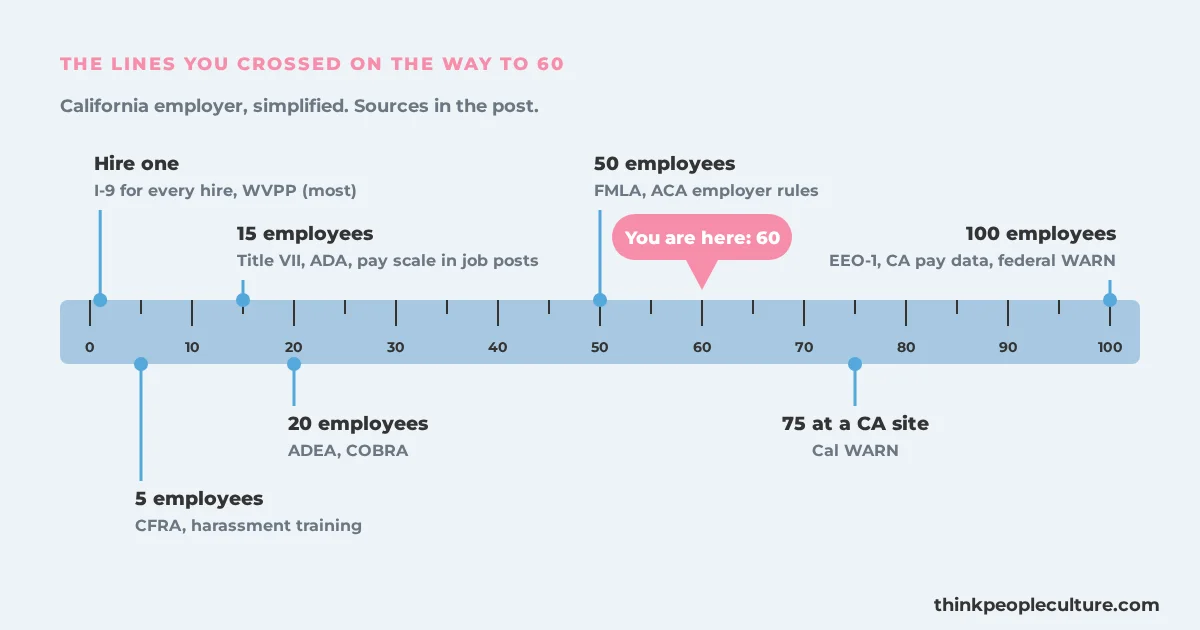
Most small businesses don't notice these lines because nobody sends a letter when you cross one. Here are the big ones for a California employer, with the exact sources.
Every employer, from hire number one: a Form I-9 for every new hire. Since July 1, 2024, most California employers also need a Workplace Violence Prevention Plan. There are limited exceptions, such as some sites with fewer than 10 employees that aren't open to the public (Labor Code 6401.9).
5 employees: California's family and medical leave law, CFRA, applies (Government Code 12945.2). So does required harassment prevention training, at least 2 hours for supervisors and 1 hour for everyone else, every 2 years (Government Code 12950.1).
15 employees: Title VII and the ADA apply under federal law, according to the EEOC. In California, job postings must include the pay scale (Labor Code 432.3).
20 employees: the Age Discrimination in Employment Act applies (EEOC), and so does federal COBRA.
50 employees: the federal FMLA applies once you have 50 or more employees for 20 or more workweeks. You also become an applicable large employer under the ACA when you average 50 or more full time employees, counting full time equivalents (IRS).
Coming up next: 75 employees at a California location brings in Cal WARN layoff notice rules. At 100 come the federal EEO-1 report and California pay data reporting.
This is a summary, not legal advice. For anything with real money or a real dispute on the line, your employment attorney gets the final say.
What Actually Breaks at 60
When I walk into a company with no HR, the list of what I find is almost always the same. I almost always find at least one labor law problem, and it usually shows up in the same places.
Nobody owns it. HR is somebody's side job, usually the office manager or the person who runs finance. When something new comes up, it goes to whoever handled the last weird thing. That's how your best project manager ends up as the company's unofficial leave expert.
Onboarding paperwork goes missing. I-9s are the classic one. During a busy hiring stretch, forms get skipped, filled in wrong or never filed. The first thing I do at a company like this is an I-9 audit, fast.
People are paid wrong without anyone meaning to. Office roles get set up as salaried and exempt because it's simpler, when the job doesn't qualify. In California that turns into unpaid overtime and meal break problems. I wrote a whole post on pay and classification problems growing companies ignore.
Managers hand their admin to whoever does HR. Write ups, schedules, onboarding plans and "can you just talk to them?" all get dumped on the side job person. Managers stop managing employee performance because someone else always cleans it up. If that sounds familiar, read manager training for new leaders.
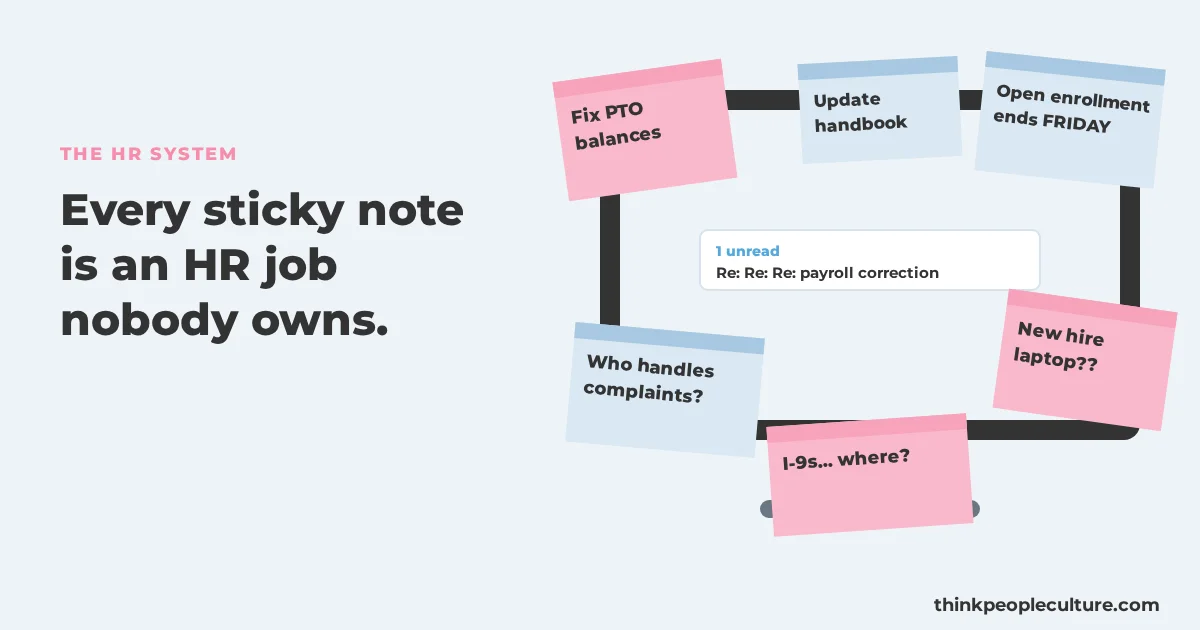
Complaints have nowhere to go. Employees want someone they see as fair to take a complaint to. When the only option is the owner, or the owner's best friend, people either stay quiet or go outside the company. Neither one is good for you.
The Employee Handbook is from when you were 15 people. Or it's a template nobody's read. The policies don't match what you actually do, which is worse than no policy at all when a dispute comes up. Here's my guide to creating an Employee Handbook.
Firing gets scary. Without a paper trail or a consistent process, every termination feels like a risk, so bad performers stay too long. Here's how to fire an employee in California the right way.
The Takeaway: At 60 people, "we'll figure it out" has quietly become your policy.
Why Small Businesses Outgrow No HR Somewhere Past 30 People
At 20 people, the owner knows everyone, problems get solved in the hallway, and the finance person can handle payroll in an afternoon. That works fine at that size, it just doesn't scale. Every new hire adds more paperwork, more managers, more recruitment, more personalities and more ways for things to slip through the cracks, and the work environment gets harder to read from the owner's desk.
A lot of owners also put off HR because they don't want to feel "too corporate." Fair enough, nobody wants big company HR, and nobody wants a 60 person company running on a group chat and good vibes either. The goal is just enough structure that people know the rules, managers know their job and problems have a clear owner.
For a point of reference, SHRM's 2025 benchmarking data shows a median of 1.98 HR staff for every 100 employees. You don't need a full time HR Manager tomorrow, but at that ratio a company your size likely has more HR work than one person can do in their spare time.
What Small Businesses Need to Fix First
You don't have to fix everything at once, so here's the order I'd usually go in.
1. Name one owner. One person is responsible for HR decisions and follow up, even if they get outside help. This alone stops the "I thought you had it" problem, even if you outsource parts of the work.
2. Set up a real complaint path. Employees need to know who to go to, and that person needs to know what to do next.
3. Audit I-9s and personnel files. Find what's missing, fix what you can, and lock the files up.
4. Check pay and classification. Make sure every salaried role actually qualifies as exempt and that overtime and breaks are handled right.
5. Catch up on required training and plans. Harassment prevention training and, for most California employers, a Workplace Violence Prevention Plan. Here's my guide for California employers.
6. Update the Employee Handbook. Make it match what you actually do, and California law.
Back to that marketing agency. When we opened the supply closet cabinet, we found missing I-9s from the busiest hiring months, two coordinators paid as exempt who didn't qualify, and an Employee Handbook written when the company had 15 people. Within 90 days the complaint process had an owner, the files were out of the closet and locked up, the pay problems were fixed, and the controller went back to being the controller. The toner stayed.
Human Resources for Small Businesses: In House HR, Fractional HR, a PEO or HR Software
There's no single right HR solution, and it depends on what's breaking for you. Some small businesses outsource all of it, some hire an in house HR professional, and most mix the two based on their HR needs.
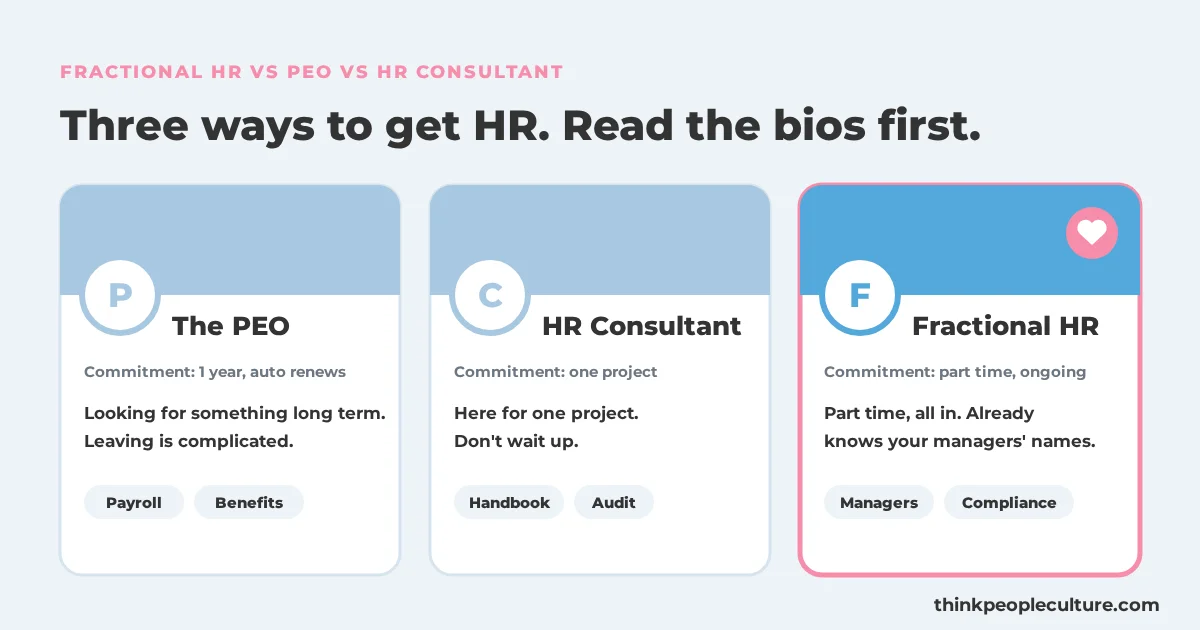
HR software keeps records and runs payroll, but it doesn't make decisions or handle a messy complaint. A PEO handles payroll, benefits and the tax side, but you still make the people decisions. A full time HR Manager is a great fit once there's enough work and budget for one. Fractional HR gives you a senior HR leader part time, which is usually the sweet spot between 30 and 150 people.
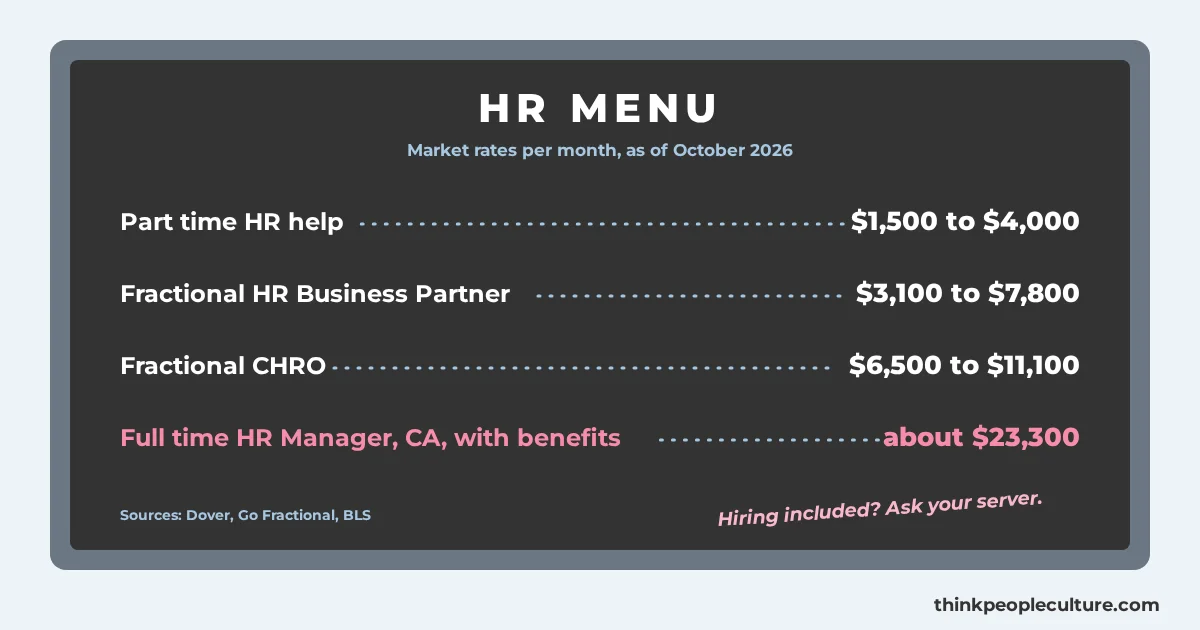
I compared these head to head in Fractional HR vs PEO vs HR Consultant, and I laid out real market prices in how much Fractional HR costs per month.
If you're the owner reading this with that sinking "this is us" feeling, book a short call with me. Tell me what's breaking and I'll tell you if I'm the right fit to fix it. You can also see my HR services, how I support California employers or the answers to common questions.
Common Questions
Does a small business legally need an HR department?
No federal or California employment law requires an HR person or department. The laws require the employer to handle duties like I-9s, leave, harassment training, final pay and complaints correctly, whoever does the work.
When does a small business need HR support?
There's no legal number. In practice, many companies feel it between 30 and 60 employees, when the work no longer fits in someone's spare time. SHRM's 2025 benchmarking shows a median of 1.98 HR staff per 100 employees.
What HR laws apply at 50 employees?
Federal FMLA applies to private employers with 50 or more employees for 20 or more workweeks, and the ACA employer rules apply when you average 50 or more full time employees, counting full time equivalents. In California, CFRA and harassment training already applied at 5 employees.
What are the risks of running a company without HR support?
Missing I-9s, misclassified employees, unpaid overtime, outdated policies, complaints that go nowhere and risky terminations. Each one can turn into a claim, a penalty or losing good people.
Can a small business manage HR without a full time HR team?
Yes, many small businesses stay compliant with a mix of payroll software or a PEO for admin plus Fractional HR for the people side, with one internal owner who keeps things moving.
Who usually handles HR in a company with no HR department?
Usually the office manager, the person who runs finance or the owner. It works for a while, then the volume and the legal risk outgrow a side job.
What should we fix first?
Name one owner, set up a complaint path, audit I-9s and files, check pay classification, catch up on required training and plans, and update the Employee Handbook.
Hire Better. Lead Smarter. Don't Suck!
Get HR Insights Delivered
Join our newsletter for the latest HR trends, tips, and best practices delivered straight to your inbox.
We respect your privacy. Unsubscribe at any time.