Pay and Classification Problems Growing Companies Ignore
Most founders don't wake up and decide to break wage law. They hire fast, hand out titles in Slack and set pay one offer at a time because a great candidate was about to walk. A year later somebody says "our pay is out of whack," and nobody can explain how it got that way.
If that sounds familiar, you're normal, and you're also sitting on a bill that grows every payday. So, here's where pay and job classification go sideways and when to fix them before a claim does it for you.
This is general information, not legal advice. For anything legal, I prepare the HR side and your employment attorney should review it.
Why Pay and Classification Mistakes Happen at Growing Companies
At 12 employees the founder knows everyone's pay by heart. At 60 there are three managers making offers, a pay spreadsheet with tabs named "FINAL" and "FINAL v2," and titles that mean whatever the person who typed them meant that day. Ask how raises get decided and you'll usually hear some version of "we never really built a pay scale."
Companies outgrow HR long before they hire HR. Between 12 and 350 employees, most have no HR leader reviewing pay and classification on a schedule, so titles get handed out like party favors, pay gets set in a panic and nobody checks if the Job Description still matches the job.
The Takeaway: If nobody owns pay and classification on a calendar, the mistakes are already there, you just haven't found them yet.
What Is Employee Misclassification and Why Does It Matter?
Employee misclassification means putting a worker in the wrong bucket. That can mean calling someone Exempt from overtime when they should be Nonexempt, or paying someone as a 1099 contractor when the law says they're an employee. Either way, the company can owe back pay, penalties and taxes for every pay period it ran.
The federal rules come from the Fair Labor Standards Act (FLSA), and California stacks stricter rules on top. The cost grows quietly until it shows up as a wage claim or a former employee with a good memory. The US Department of Labor's Wage and Hour Division recovered more than $259 million in back wages for 176,957 workers in fiscal year 2025, and that's the federal side alone.
Exempt vs. Nonexempt: A Common Source of Costly Errors
An Exempt employee is paid a salary and isn't owed overtime. A Nonexempt employee is owed overtime. To be Exempt, a person has to pass a salary test and a duties test. A title and a salary on their own don't make anyone Exempt. Salaried doesn't mean Exempt, no matter how many times someone says it in a meeting.
Federally, the salary level enforced today is $684 a week, or $35,568 a year, plus the executive, administrative or professional duties tests. California wants a lot more. An Exempt employee there must earn at least two times the state minimum wage for full time work and spend more than half their time on exempt duties. With the 2026 minimum wage at $16.90 an hour, that floor is $70,304 a year, almost double the federal number. The state already announced $17.40 an hour for 2027, which pushes the floor to $72,384, so a salary that passes today can fail next year.
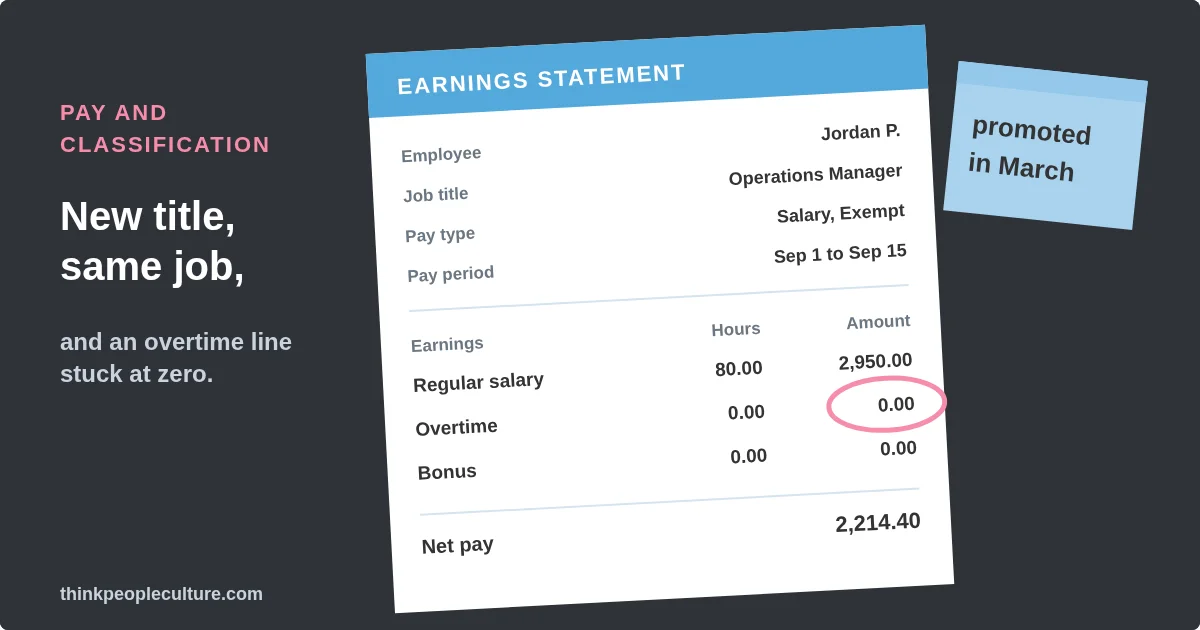
Here's the mistake I see most, you promote your best individual contributor to "Manager," switch them to salary and call them Exempt. But if they still spend most of the week doing the same hands on work, the duties didn't change, so in California they may still be Nonexempt. That's the "we promoted someone and forgot to reclassify them" problem, and every long week since could be unpaid overtime. From their side it sounds like "I got a title, and now they get 60 hours a week out of me for the same pay." Congratulations on the promotion, Mark, your hourly rate just went down.
Contractor vs. Employee: Where Growing Companies Get Burned
In California, a worker is an employee unless the company can prove all three parts of the ABC test. California adopted the test through AB 5 in 2019, and under the ABC test the company has to show all of these, no matter what the contract says:
- A. The worker is free from the company's control and direction, in the contract and in real life.
- B. The work is outside the usual course of the company's business.
- C. The worker is customarily engaged in an independently established trade or business of the same kind.
Part B trips up most companies. The California Franchise Tax Board example is a bakery that regularly hires cake decorators for its custom cakes, which is the bakery's usual business. If your "contractor" does what your employees do, you have a B problem.
Outside California, the IRS looks at behavioral control, financial control and the relationship of the parties. There's no such thing as a 1099 employee, though plenty of companies have tried to invent one. If you set the hours, supply the laptop and approve the timesheet, calling someone a contractor is like writing "cat" on your dog's collar, because it's still going to bark.
The Takeaway: Classification is decided by the work people actually do, not by the title, the contract or what was easiest at the time.
Signs Your Pay Structure Is Broken
Pay problems show up as hallway comments like "our offers keep getting turned down" or "why does the new hire make more than me?" Most trace back to setting pay one offer at a time, with nothing behind it but a gut feeling and a deadline.
Pay Compression and Why It Drives Away Your Best People
Pay Compression happens when new hires come in at or above people who've been doing the job for years. You needed someone fast, paid what the market wanted and never went back to adjust the people already there. The most expensive sentence in your company is "I trained the new guy, and he makes more than me." Right behind it is "they found money for the new hire but not for us." Your best people always find out, and they don't complain, they just quietly update their LinkedIn.
How to Know If Your Pay Ranges Are Out of Market
Start with a salary survey for your industry or free data from the Bureau of Labor Statistics. California also handed you a free tool, because employers with 15 or more employees must include the pay scale in every job posting, so your competitors' ranges are sitting on job boards right now. Some companies post a range so wide it's basically "somewhere between a sandwich and a boat," which is legal and tells everyone you either don't know your number or you're just trying to be cute to comply with the new pay transparency law in your state.
Role scope, location and equity also change what "market" means. A written Compensation Philosophy says where you pay against the market and why, so every offer stops being a fresh negotiation with yourself.
The Takeaway: If offers keep getting turned down or your veterans make less than your new hires, your pay structure is already sending you the bill.
How to Audit Your Pay and Classification Without Shutting Everything Down
You don't need to freeze hiring or panic the team, you need a list and an order.
- List every role with its title, pay, FLSA status and whether it's an employee or a contractor.
- Flag the high risk roles first: salaried people under the California floor, anyone promoted into a manager title in the last year, contractors doing core work and teams that grew fastest.
- Compare each Job Description to what the person actually does all week. Ask them and their manager, separately.
- Test every Exempt role against the salary and duties tests for each state where you have people.
- Run every contractor through the ABC test or the IRS control test.
- Compare pay to market, then look for Pay Compression and outliers inside each role.
- Write the plan: what gets fixed, in what order and what goes to your attorney.
What a Pay and Classification Audit Actually Looks Like
A real audit ends in a clear plan with a sequence, not a big scary binder. Here's one from my own work with the name left out, a B2B company of about 15 people had a long running contractor setup that carried real classification risk, and their handbook had never been rolled out. We fixed the classification risk first, then built the HR foundation in 90 days.
The Takeaway: An audit should end in a plan you can act on next pay cycle, not a pile of findings that scares everyone and changes nothing.
Fixing Classification and Pay the Right Way
First, talk to your employment attorney about back pay exposure because the past is a legal call. Then fix forward on a set date and update the Job Descriptions so they match the real work. Talk to every affected employee first, because nobody should learn they're now Nonexempt from their pay stub. Then set your ranges and put a pay review on the calendar. "There's no budget for raises" is a fair thing to say, right up until you price one wage claim or one resignation from your best person.
The Takeaway: Fix the past with your attorney, fix the future on a date, and tell people before their paycheck does.
When You Need Outside Help With Pay and Classification
Bring in help when nobody in house knows the tests, when you have people in California or multiple states, or when a complaint has already shown up.
That's where a Fractional HR leader earns their keep. I run pay and classification audits and build compensation structures as part of my HR Strategy and Fractional HR Leadership work, and if you’re in California you’ll also get California compliance built in. You get one senior person who owns it start to finish, on one flat monthly fee for a defined scope. The FAQ covers the details.
Bringing in help doesn't mean you failed, it means you'd rather pay for a fix than a defense. If your real issue is "our offers keep getting turned down," the fix usually starts with how you hire, which is what my book Don't Suck at Recruiting is about.
The Takeaway: If the risk is real and nobody owns it, outside help is the cheaper option, not the expensive one.
Frequently Asked Questions
What is the difference between an Exempt and a Nonexempt employee?
Exempt employees pass a salary test and a duties test and aren't owed overtime, and Nonexempt employees are. In California, Exempt employees must earn at least $70,304 a year in 2026 and spend more than half their time on exempt duties.
How do I know if someone I pay as a contractor should actually be an employee?
In California, the worker is an employee unless you can prove all three parts of the ABC test: free from your control, outside your usual business and running their own independent business.
What happens if my company has been misclassifying employees for years?
You may owe back wages, penalties and payroll taxes for the time it ran. Talk to your employment attorney about the past, then fix it forward on a set date.
What is Pay Compression and how do I fix it?
Pay Compression is when new hires earn as much as or more than people who've been in the role for years. Set ranges and plan adjustments, starting with the people you can least afford to lose.
Let's Find It Before Someone Else Does
If you thought of a specific person, title or contractor while reading this, that's your sign. The only real choice is whether you find it first or a former employee does. Book a call and we'll walk through where your biggest risk is and what to fix first.
Hire Better. Lead Smarter. Don't Suck!
Get HR Insights Delivered
Join our newsletter for the latest HR trends, tips, and best practices delivered straight to your inbox.
We respect your privacy. Unsubscribe at any time.