You Can Fire Anyone in California, Until the Email You Forgot Shows Up
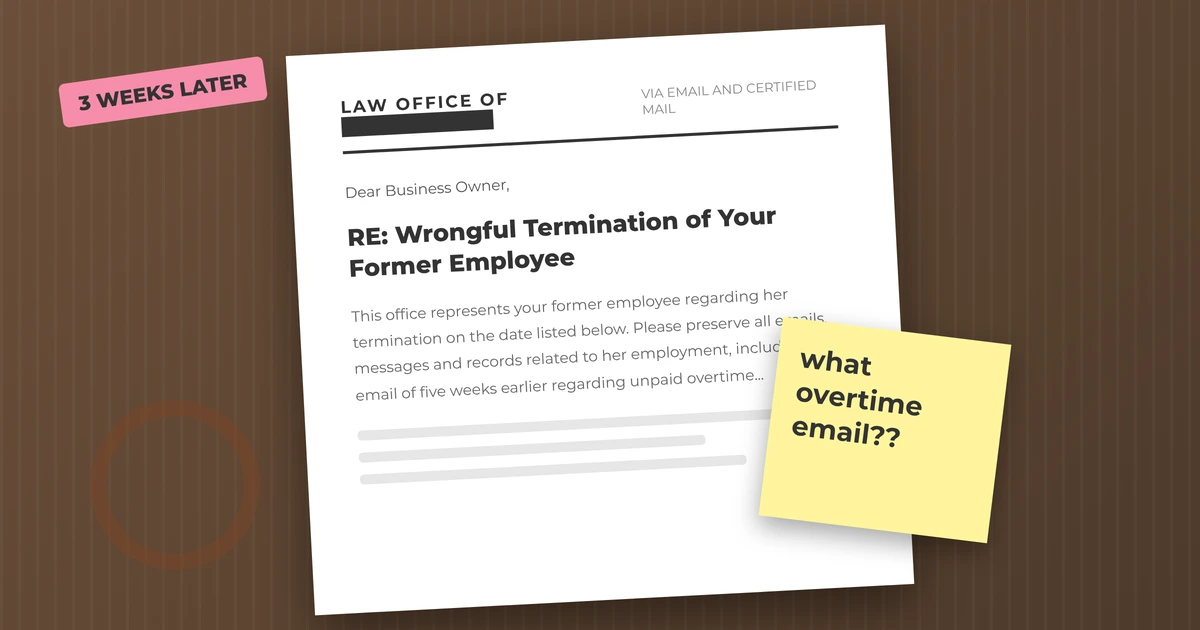
Three weeks after a 30 person agency let an account manager go, the founder got a letter with "wrongful termination" in bold and one email attached that he didn't even remember getting. If you're about to fire someone in California, that email is the part you should be worried about, and I'll tell you exactly what it said in a minute.
The short answer: In California you can usually fire someone without a reason. A firing turns into wrongful termination when the real reason is one the law protects, or when your timeline makes it look that way. That means discrimination, retaliation for a complaint, punishing someone for taking protected leave, firing someone for refusing to break the law or breaking a promise you made about how they could be let go. Being unfair, abrupt or rude isn't wrongful termination on its own, but it makes the illegal story a whole lot easier to believe.
The good news is you can usually fire someone here without giving a reason, but "usually" is doing a lot of heavy lifting in that sentence.
The account manager had real problems, like missed deadlines, a client who asked to have her pulled off the account and a launch that slipped twice. He'd been lenient about all of it for months, the kind of boss who doesn't like to micromanage, and none of it was documented anywhere but his own head. Then one Thursday he'd had enough and let her go "for performance."
And, five weeks before that Thursday, she'd emailed him a simple question: why wasn't her overtime on her paycheck?
He never answered it and forgot it existed, but her lawyer didn't, and if you've got an email like that sitting in your inbox right now, you're going to want to read the 90 day section below twice.
Is California Really an At Will State? Yes, With Holes You Could Drive a Truck Through
California is an at will state. The Labor Code says a job with no specified term "may be terminated at the will of either party on notice to the other" (Labor Code 2922). The California Supreme Court confirmed that presumption in Guz v. Bechtel National (2000), so you can usually let someone go for any reason or no reason at all.
So, where does "wrongful" come from? It comes from the exceptions, because at will lets you fire someone for a bad reason, just not for an illegal one. And, when your real reason isn't documented anywhere, the one who gets to suggest what it was is their lawyer, not you.
"We're at will" is the "trust me, I'm a doctor" of small business. It works great right up until somebody asks to see the chart.
The Takeaway: at will protects your decision, not the story around it, and the story is what you'll be asked to prove.
Now, let's talk about the five stories a lawyer can tell about your firing, because one of them is probably sitting in your Slack right now.
The 5 Ways a Normal Firing Turns Into Wrongful Termination in California
Nearly every wrongful termination claim against a small or midsize California company lands in one of these five buckets. Read them like a checklist with your person in mind.
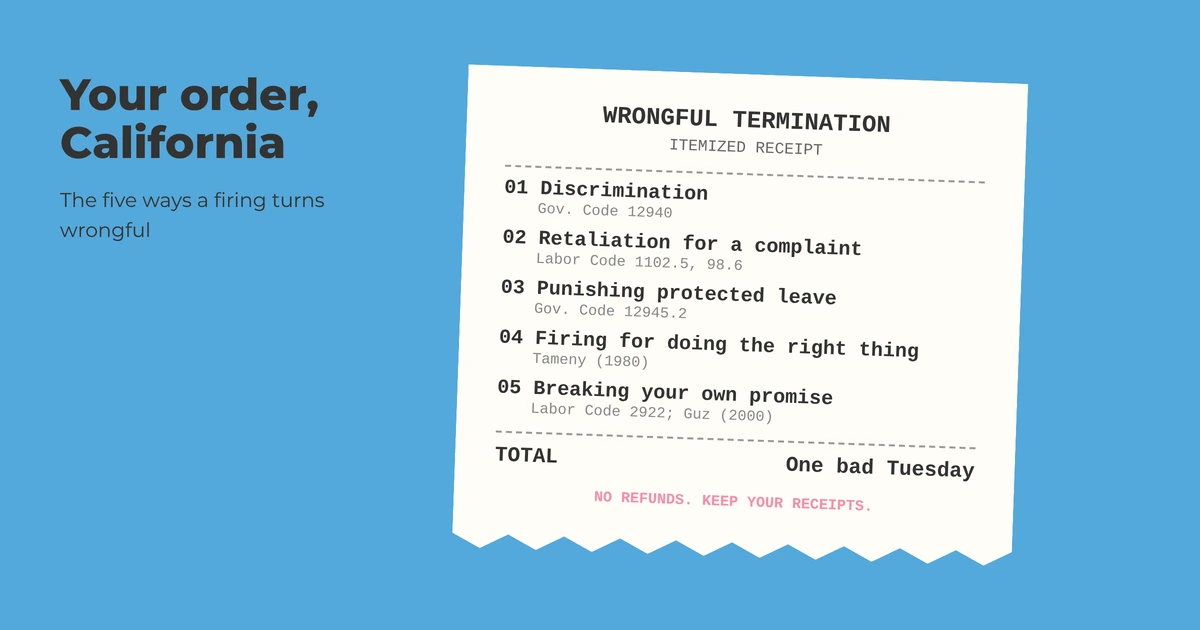
1. Discrimination. Firing someone because of a protected trait is illegal under the Fair Employment and Housing Act (Government Code 12940). That list includes race, religion, national origin, disability, medical condition, pregnancy, sex, gender identity, age (40 and over), sexual orientation, marital status and military or veteran status. It covers employers with five or more employees (Government Code 12926), and the harassment rules reach employers with even one (Government Code 12940(j)).
At your company it won't sound like a slur. It'll sound like "she's been checked out since the pregnancy announcement," said once, in a hallway, to someone who remembers everything.
2. Retaliation for a complaint or a report. If your employee complains about unpaid wages, reports something they reasonably believe breaks a law or refuses to take part in something illegal, they're protected (Labor Code 1102.5 and Labor Code 98.6). The complaint doesn't have to be formal, and it doesn't have to go to the government, because an email to you counts.
This is the one that gets good owners like you, because the complaint always felt small when it happened, just like a certain overtime email.
3. Leave and accommodation. Firing someone for asking for or taking job protected family or medical leave is illegal for employers with five or more employees under the California Family Rights Act (Government Code 12945.2). Same goes for pregnancy disability leave (Government Code 12945) and for asking for a disability accommodation.
The trap here is timing, because the performance problems started before the leave and everyone knows it, but the termination meeting happened right after it, and that's the only part a stranger sees.
4. Firing someone for doing the right thing. California courts let employees sue when a firing breaks a "fundamental public policy." The landmark case, Tameny v. Atlantic Richfield (1980), involved an employee fired after 15 years for refusing to help fix gas prices. At your company it looks like letting someone go for serving on a jury, filing a workers' compensation claim or refusing to backdate a document.
5. Breaking a promise you made. At will can be changed by contract. An offer letter that says "terminated only for cause," a contract for a set term or an Employee Handbook full of firing procedures you didn't follow can all limit your at will rights. In Guz, the court said written personnel policies can sometimes become part of the deal, even when there's an at will line in the same handbook.
Yes, that 40 page handbook you downloaded and never read might be making promises on your behalf, which is fun.
| What it's called | What it looks like at a small company | The law |
|---|---|---|
| Discrimination | A protected trait comes up near the decision | Gov. Code 12940 (5+ employees) |
| Retaliation | They complained about pay, safety or something illegal, then got fired | Labor Code 1102.5 and 98.6 |
| Leave and accommodation | They asked for or came back from protected leave, then got fired | Gov. Code 12945.2 and 12945 (5+ employees) |
| Public policy | They refused to break the law or did a legal duty | Tameny v. Atlantic Richfield (1980) |
| Broken promise | Your offer letter or handbook promised a process you skipped | Labor Code 2922; Guz v. Bechtel (2000) |
The Takeaway: the question to ask yourself is "could someone tell a believable story that my real reason was on this list?"
If you just felt your stomach drop a little, hang on, because the next section is the good news.
What Isn't Wrongful Termination in California
That word probably spooked you, so let's take some of the air out of it. On their own, these usually aren't wrongful termination in California.
- Firing someone without a warning first, if you never promised a warning process.
- Firing someone for a bad attitude, a personality clash or "it's just not working."
- Firing someone in a way that felt cold, rushed or awkward.
The California Supreme Court said it plainly in Guz: under at will, an employer may act without warning or fair procedures, and an unfair firing isn't a breach by itself.
Unfair isn't illegal, and if it were, every group project in history (and every Thanksgiving after you fired your best friend's cousin) would've ended in court.
But, the catch nobody puts on a poster is that unfair is what makes illegal believable. When you blindside someone after a year of saying nothing, with no warning, no paper and a reason that keeps changing, you give the other side all the room they need to fill in a worse reason. And, everyone else on your team just watched you put up with it for a year, so they're wondering what else you're quietly putting up with.
That's why the boring stuff matters, and nothing is more boring, or more dangerous, than a calendar.
The 90 Day Timing Trap (Remember That Overtime Email?)
This is the section I'd tape to every California owner's monitor.
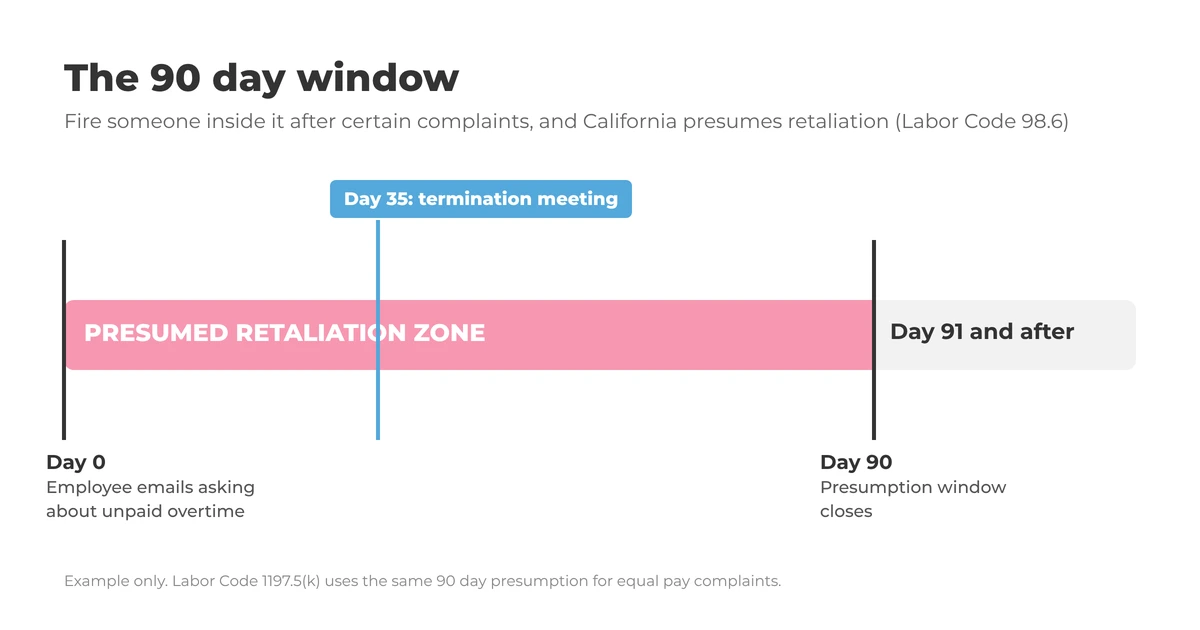
If you fire someone within 90 days of certain protected activity, like a wage complaint to the Labor Commissioner or a complaint that they're owed unpaid wages, California law presumes it was retaliation. Then it's on you to rebut it (Labor Code 98.6(b)). The same 90 day presumption shows up in the equal pay law (Labor Code 1197.5(k)).
Do the math on our agency founder. The overtime email landed on day 0, and the termination meeting happened on day 35. That's well inside the window, and that's why that one forgotten email mattered more than every missed deadline combined.
The penalty side isn't small either. Labor Code 98.6 and the whistleblower law, Labor Code 1102.5, each carry a civil penalty of up to $10,000 per employee for each violation, on top of lost wages (Labor Code 98.6(b)(3) and Labor Code 1102.5(f)).
And, for whistleblower claims, once the employee shows their report was a contributing factor, the burden flips to you. You have to prove by "clear and convincing evidence" that you'd have fired them anyway (Labor Code 1102.6). That's a higher bar than most people think, and it's very hard to clear without dated records.
Lawyers love timelines the way toddlers love the word "why." So, before you set the date, scroll back 90 days and ask what this person said, sent or asked for.
The Takeaway: a real reason used at the wrong time still looks like the wrong reason.
How Long Can an Employee Wait to Sue You? Longer Than You'd Guess
For discrimination, harassment and retaliation claims under the Fair Employment and Housing Act, your former employee has three years from the firing to file with the California Civil Rights Department (Government Code 12960(e)(5)). After the department issues a right to sue notice, they have one more year to file in court (Government Code 12965(c)). Other claims run on their own clocks, and a public policy claim like Tameny usually has two years (Code of Civil Procedure 335.1).
Three years is long enough that the manager who made the call might not even work for you anymore, and "he's not here, but trust us" isn't a defense. Your file has to tell the story without anyone in the room.
What to Do When an Employee Says "Wrongful Termination"
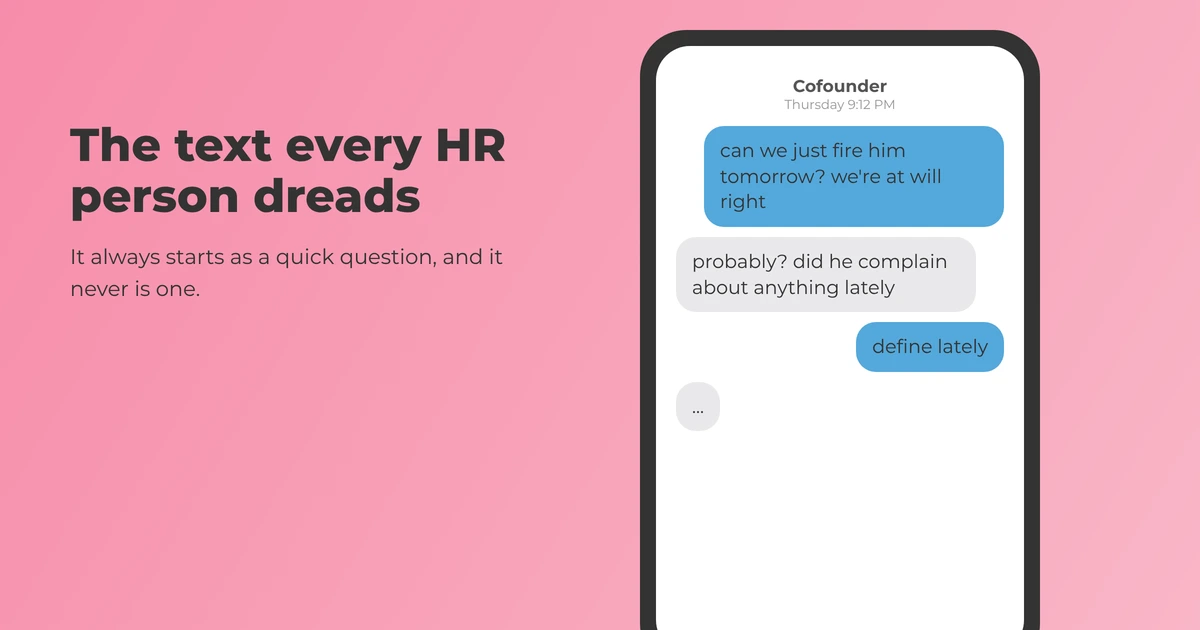
It might come up in the termination meeting, in an angry email that night or in a letter from a lawyer three weeks later. Wherever it shows up, I walk clients through the same six steps, in this order, and step two is the one people blow.
- Don't argue. Nothing you say in the moment helps, and plenty of it can hurt.
- Don't do anything that looks like round two. No bad references, no "I heard you're shopping this around" texts and no late final pay. This is the one people blow, because one angry text after the meeting can look like retaliation all by itself. If they start posting about you online, screenshot it and don't respond.
- Pay everything you owe, on time. In California, final wages are due at the time of termination, and late pay can run a day's wages for every day it's late, up to 30 days (California Labor Commissioner).
- Freeze the file. Keep every email, note and Slack message. Deleting things now is the worst kind of evidence.
- Write the timeline today, with dates, while people still remember it. Don't backfill notes and pretend they're old.
- Call your employment attorney. I prepare, your attorney reviews and makes the legal call.
The Takeaway: the first 48 hours after someone says "wrongful termination" decide whether you look careful or caught.
So, What Saved the Agency Founder?
It wasn't a better reason, because he already had a good one. What kept his year from getting much worse was a client email asking to take her off the account, which had a date on it, and two project tracker exports that showed the slipped launches, also with dates. Those boring, dated records, made before anyone had a reason to make them, were what his attorney leaned on. What hurt him was everything that lived only in his head, plus the overtime email he never answered.
Documentation written the night before the termination meeting reads like a book report written in the car on the way to school, and everyone can tell. The fix is addressing problems as they come up and documenting them that day, not the night you decide.
If you're about to let someone go, run the six questions below first.
I walk through the meeting itself step by step in how to fire an employee in California, and the one page version is the free California Termination Day Checklist and Script. If you want to see exactly what I handle on a termination, by name, it's in the Terminations and Employee Issues section on my services page.
Questions to Ask Yourself Before You Let Someone Go in California
1. Can I say the reason in one sentence, and does the paper trail say the same thing?
2. In the last 90 days, did this person complain, report something, ask for leave or ask for an accommodation?
3. Did I promise anything about process in their offer letter or my Employee Handbook?
4. Have I treated someone else with the same problem the same way?
5. Is the final paycheck, including accrued vacation, ready to hand over at the termination meeting?
6. If this person's lawyer read my file three years from now, would it make sense without me in the room?
If your company has no HR department, read why companies like yours end up here so often. The California page shows what that help looks like across the state, and since I work with companies from Hawaii to New York, the questions above still apply outside California, the rules just change names.
If any answer makes you wince, or lands on "uh, maybe," that's your moment to slow down. When it can't wait, put "urgent" in your message and you'll hear back within four business hours. Book a Termination Sanity Check before the meeting, not after the demand letter.
This is the HR point of view based on experience and my understanding, not legal advice.
Common Questions
What qualifies as wrongful termination in California?
A firing for an illegal reason. That includes discrimination under the Fair Employment and Housing Act, retaliation for a complaint or report, punishing protected leave or an accommodation request, and firing someone for refusing to break the law or for doing a legal duty. It also includes breaking a contract or promise about how they could be let go.
Can I fire someone in California without a reason?
Usually yes. Labor Code 2922 makes a job with no set term at will. The exceptions are the illegal reasons above and any promise you made in an offer letter, contract or Employee Handbook.
Can I fire someone without a warning in California?
Usually yes, unless your offer letter, contract or Employee Handbook promised a warning process. A warning isn't legally required, but a firing with no paper trail is harder to defend.
How long does an employee have to file a wrongful termination claim in California?
For discrimination, harassment and retaliation claims under the Fair Employment and Housing Act, three years to file with the Civil Rights Department (Gov. Code 12960), then one year after a right to sue notice to file in court (Gov. Code 12965). Other claims run on their own clocks; a public policy claim usually has two years (Code of Civil Procedure 335.1).
Is it wrongful termination to fire someone right after they complained?
Not automatically, but it's risky. Under Labor Code 98.6, firing someone within 90 days of certain protected activity, like a wage complaint, creates a presumption of retaliation that the employer has to rebut.
Do these rules apply to a company with fewer than five employees?
Some do. Discrimination and family leave rules start at five employees, but harassment rules apply to employers with one or more, and the Labor Code retaliation rules and public policy claims don't depend on headcount.
Should I call a lawyer if an employee threatens a wrongful termination claim?
Yes. Pay everything you owe on time, keep every record, write a dated timeline and bring in your employment attorney. I prepare, your attorney makes the legal call.
HR Help in Your Inbox
My free newsletter for owners with no HR person, with plain answers sent when there's something worth reading.
We respect your privacy. Unsubscribe at any time.