Future of Work Huddle: Score a Touchdown with Flexibility, Not Pajamas
When the pandemic sent everybody home, a lot of people found out they could answer email in pajama pants and nobody would ever know. Somewhere along the way, "flexibility" started to mean "where's your laptop today," and that's a pretty small version of a big idea.
Real workplace flexibility is about where, when and how work gets done. So, let's huddle up and walk through what it means, the types that work, the real benefits and tradeoffs, how to set a fair policy and how to keep score.
What Does Workplace Flexibility Mean?
Workplace flexibility means giving employees some say in where they work, when they work and how they get the work done, inside guardrails that keep the business running. Remote work is one piece of it, but it only covers the "where."
The "when" covers flexible hours, a compressed week or swapping shifts. The "how" covers job sharing, part time roles and choosing your own process as long as results show up. A flexible workplace writes those choices down, so nobody has to guess which manager to charm.
The Takeaway: If your flexibility policy only answers "where," you're running one play out of a playbook that has at least three.
Beyond the Remote Work Debate
The office versus home fight gets the headlines, but most of the action is in the middle. Among US employees whose jobs can be done remotely, Gallup found that 52% work hybrid, 26% work fully remote and 22% work on site as of May 2026.
The Bureau of Labor Statistics American Time Use Survey found that in 2025, 35% of employed people did some or all of their work at home on days they worked, while 70% did some or all of it at their workplace. Plenty of people do both in one day.
So, the pajamas were never the point. Flexibility supports different working styles and real life, from the parent doing school pickup to the night owl who does her best work after dinner.
The Takeaway: Stop arguing about the building and start deciding what kind of flexibility each job can actually handle.
Types of Workplace Flexibility (With Examples)
The most common flexible work arrangements are hybrid work, remote work, flexible hours, compressed workweeks, job sharing and part time schedules. Most small companies mix them by role.
- Hybrid work: People split the week between home and the office, usually with set "anchor days" when the team is together.
- Fully remote: People work outside the office all or almost all of the time.
- Flexible hours: Everyone covers core hours, then picks their own start and end times. You'll also hear it called flextime.
- Compressed workweek: The same 40 hours in fewer days, like four 10 hour days. Some people call it a four day workweek.
- Job sharing: Two part time people split one full time role.
- Part time or reduced hours: Fewer hours for less pay, which can keep a great employee who'd otherwise walk.
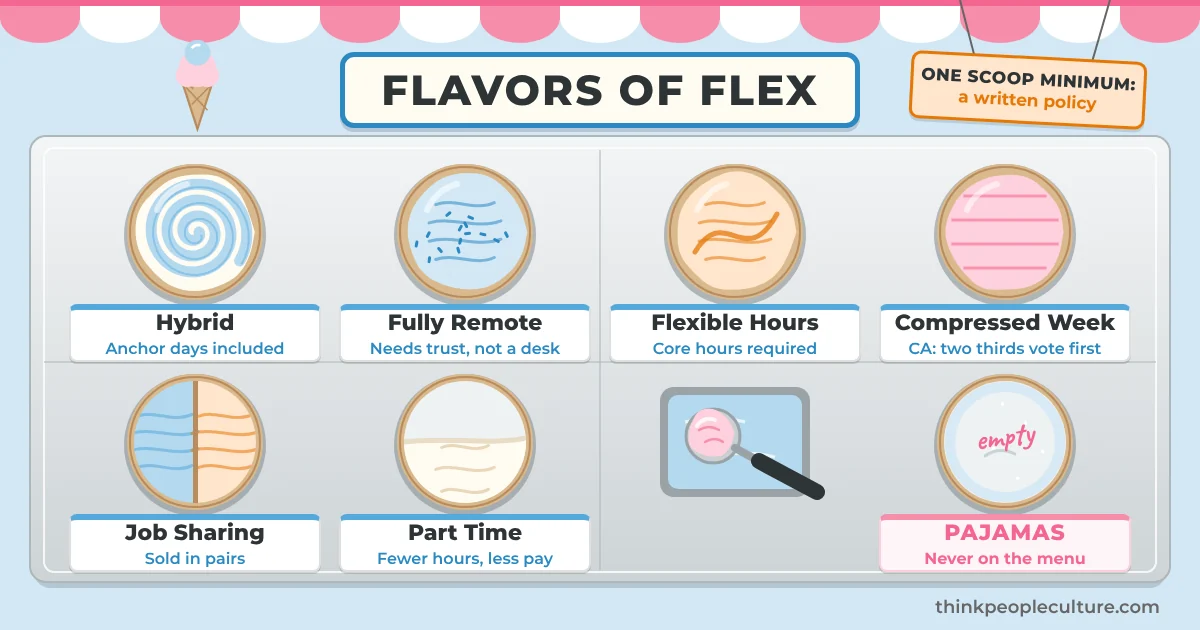
One California flag before you print the new schedule. Under California Labor Code section 511, a regular schedule of up to 10 hours a day in a 40 hour week without overtime pay has to be approved by at least two thirds of the affected employees in a secret ballot election, and the results go to the Division of Labor Standards Enforcement within 30 days. Talk to your attorney before you launch.
The Takeaway: Pick the types that fit each role, and check the law before you change anybody's hours.
Benefits of Workplace Flexibility for Employees and Employers
Done well, flexibility helps employees balance their work and personal lives, and it helps employers keep good people, lift Employee Engagement and reach more top talent.
Gallup says hybrid workers report significantly better work life balance, less burnout and higher productivity than peers who are fully on site. In its May 2026 numbers, 37% of fully remote employees and 34% of hybrid employees were engaged, compared with 29% of on site employees whose jobs could be done remotely and 28% of on site employees whose jobs can't be.
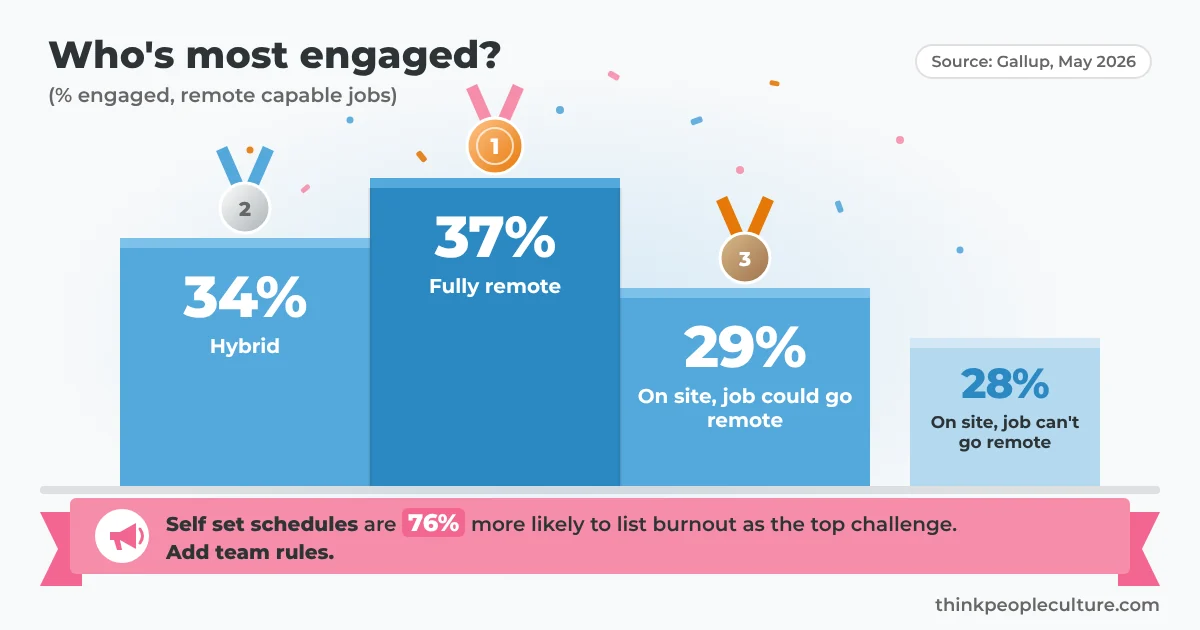
The strongest test so far is a randomized trial published in Nature in 2024. When 1,612 employees at one large company were randomly split into hybrid and fully on site groups, hybrid working improved job satisfaction and cut quit rates by one third, and it didn't change performance grades or promotions over the next two years.
For employers, retention is the big one. Pew Research Center found that among workers who work from home at least some of the time, 46% say they'd be unlikely to stay if their employer stopped letting them. If keeping people is your headache right now, my guide to mastering Employee Retention covers the rest of the playbook.
Flexibility also widens your hiring pool. In December 2023, remote roles made up only 10% of open roles on LinkedIn but drew 46% of all applications.
The Takeaway: Flexibility is one of the cheapest retention tools you have, as long as you run it well.
The Real Tradeoffs of Flexibility in the Workplace
Flexible work comes with real costs, mainly blurry work hours, shaky trust and an unfair split between who gets it and who doesn't. You can still offer it, you just need a plan.
The first cost is the always on problem. Gallup found that employees who set their hybrid schedule entirely on their own were 76% more likely to name burnout or fatigue as their greatest challenge than employees whose team sets it together. Top performers fall in first, which is why I wrote about how to prevent high performer burnout.
If your team works with people in other time zones, flexible hours are what make those calls possible. A Microsoft study of 20 million meetings found that meetings across time zones connect people who are more diverse and farther apart in the company, but they also get pushed into early mornings and late evenings, so rotate who takes the bad time slot.
The second cost is trust. Only 54% of managers who lead remote workers strongly agreed they trust their teams to be productive remotely, and managers who don't trust what they can't see start counting green dots in Slack.
Three weeks into the job, a new COO announced everyone was coming back to the office five days a week, starting the first of the month, no exceptions. One of his best people had been hired fully remote, with "remote" written right into his offer letter, and had moved his family a few hours away. On the first of the month he logged in from his kitchen table at 8:59 and sent the COO a copy of that offer letter. That same COO had once made the support team come in the day after Thanksgiving to show "commitment," then pinged them at noon asking why replies were slow. By lunch, HR sent a quiet email saying existing remote agreements would be honored. Nobody had read the file before writing the policy.
The third cost is fairness. As I wrote in Don't Suck at Culture, "Being fair doesn't mean being identical; it means giving each person what THEY need to succeed." Out of sight can't mean out of mind at promotion time.
And, in California, Labor Code section 2802 says employers must repay employees for necessary expenses they pay to do their job, so build reimbursement into any role where you require work from home.
The Takeaway: Every type of flexibility has a cost, so name it up front and build the fix into the policy.
Scoring Points with Strategic Flexibility
A flexible work policy managers can run fairly decides which roles can flex, lets teams set the details inside guardrails and judges people on results instead of seat time. This is how we build it with growing companies.
1. Decide Which Roles Can Flex and How
Go job by job and ask what the role really needs, like customer coverage, a set shift or just a laptop and a deadline. Write down which types fit, so the answer doesn't depend on who your manager is.
2. Let Teams Set the Schedule Inside Guardrails
The company sets the outer lines, like core hours and response times, and each team fills in the rest. Gallup found that 91% of employees whose team decides their hybrid schedule see the policy as fair, compared with 73% when the employer decides. That's an 18 point jump just for letting the huddle call the play.
3. Results Based Performance Metrics
Judge people on outcomes and deliverables instead of hours and badge swipes. Give every role two or three clear goals and check them in regular one on ones, not just in Performance Reviews. A badge swipe proves someone found the building, which is a pretty low bar for anyone you're paying to think.
4. Trust Based Leadership
Develop leaders who manage by results instead of presence. As I put it in Don't Suck at Culture, "Leadership behavior, not policies or pronouncements, creates the climate where Culture Add either thrives or withers." Most new managers were never taught that, so put manager training in your rollout plan before the first complaint shows up.
5. Technology Infrastructure
Pick a few tools that let people collaborate from anywhere, like a shared calendar, a project tracker and video calls. Two apps everyone uses beat six that nobody checks.
6. Clear Communication Protocols
Decide what goes in chat, what needs a meeting, how fast people respond during core hours and when it's fine to log off. If you don't write it down, the most anxious person on the team sets the rules.
The Takeaway: Write the playbook once, let teams run the plays and coach to results.
Making Flexibility Work for Everyone
A flexible work environment works for everyone when it's fair across every role, including the people who can't take their job home. That's where most companies fumble.
Gallup says remote capable workers are only about half of the US workforce, and on site employees whose jobs can't be done remotely have the lowest engagement of the four groups it tracks. So, give your front desk team and field techs the "when" and the "how" with shift swaps, schedules posted early and a say in which days they work.
Then test your plan with five questions. Does it line up with business goals, support wellbeing, keep the team connected, drive productivity and treat people fairly? Fairness is part of your Company Culture, which I break down in how Company Culture shapes day to day work.
The Takeaway: If only the laptop crowd gets flexibility, the rest of the team will notice, so build a version for every role.
How to Measure Workplace Flexibility
Measure workplace flexibility with a short scoreboard you check every 90 days, covering retention, fairness, results, burnout and promotions. If the only stat you watch is who's in the office on Tuesday, you're watching the wrong game.
- Retention: Compare turnover across teams and work arrangements, and ask about flexibility in Stay Interviews and Exit Interviews.
- Fairness: Add "Is our flexibility policy fair?" to your Pulse Surveys.
- Results: Watch each role's goals, customer response times and missed handoffs.
- Burnout: Look for late night messages and unused Paid Time Off.
- Promotions: Compare raises and promotions across remote, hybrid and on site employees.
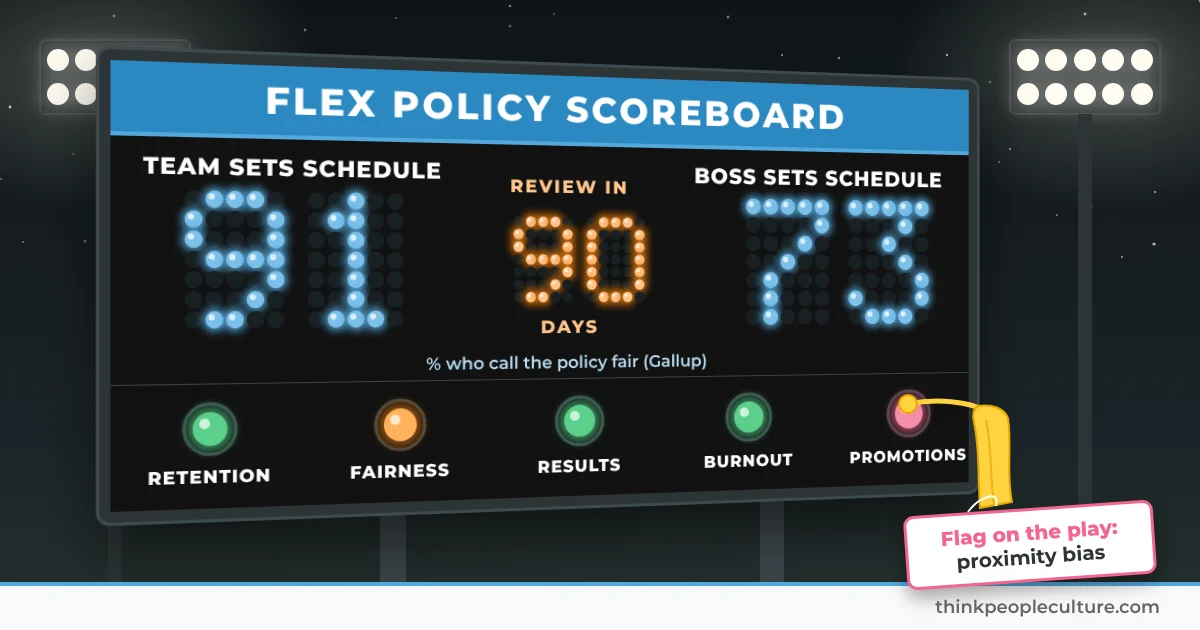
Then use what you find. Tweak the policy, coach the manager whose team scores low on fairness and tell everyone what changed. A scoreboard nobody looks at is just a very organized way to lose.
The Takeaway: A flexibility policy without a scoreboard is a guess, so pick your stats now and review them every quarter.
Frequently Asked Questions
What is workplace flexibility?
Workplace flexibility means giving employees some choice in where, when and how they work, inside guardrails that keep the business running. Working from home is just one type.
What are some examples of workplace flexibility?
Common examples are hybrid schedules, remote roles, flexible start and end times, compressed workweeks, job sharing and part time schedules. Shift swaps count too, especially for on site teams.
What are the benefits of flexibility in the workplace?
Employees get better balance and more control over their day, and employers usually see stronger retention and engagement.
What are the disadvantages of workplace flexibility?
The big risks are burnout, managers who don't trust what they can't see and unfair treatment between remote and on site people. Clear guardrails and trained managers fix most of it.
How can you improve workplace flexibility?
Decide which roles can flex and how, then let teams set flexible schedules inside clear guardrails. Train managers to coach to results and review the policy every 90 days.
Ready to Draw Up Your Flexibility Playbook?
The future of work was never a choice between the office and the couch. The companies that win focus on outcomes instead of location, with a policy that works for the business and its people.
That's what we do through HR Strategy and Fractional HR Leadership: we write the policy, train your managers to run it fairly and set up the scoreboard. If you're wondering how fractional HR leadership fits a growing company, start there.
If one role, one manager or one schedule fight came to mind while you read this, that's your starting point. Book a call and we'll draw up the first play together.
Hire Better. Lead Smarter. Don't Suck!
HR Help in Your Inbox
My free newsletter for owners with no HR person, with plain answers sent when there's something worth reading.
We respect your privacy. Unsubscribe at any time.