How to Run a Culture Assessment: A Step by Step Guide for Growing Companies
TL;DR: A Culture Assessment is a planned check of how work really gets done at your company, held up against what you say you value. For a small or mid size company, it's a short anonymous survey, a few small Listening Sessions and an honest read of the results by team, not just the average. Then you share what you heard within a few weeks and fix two or three things people can see. The survey is the easy part. The follow up is the part that decides whether anyone tells you the truth next time.
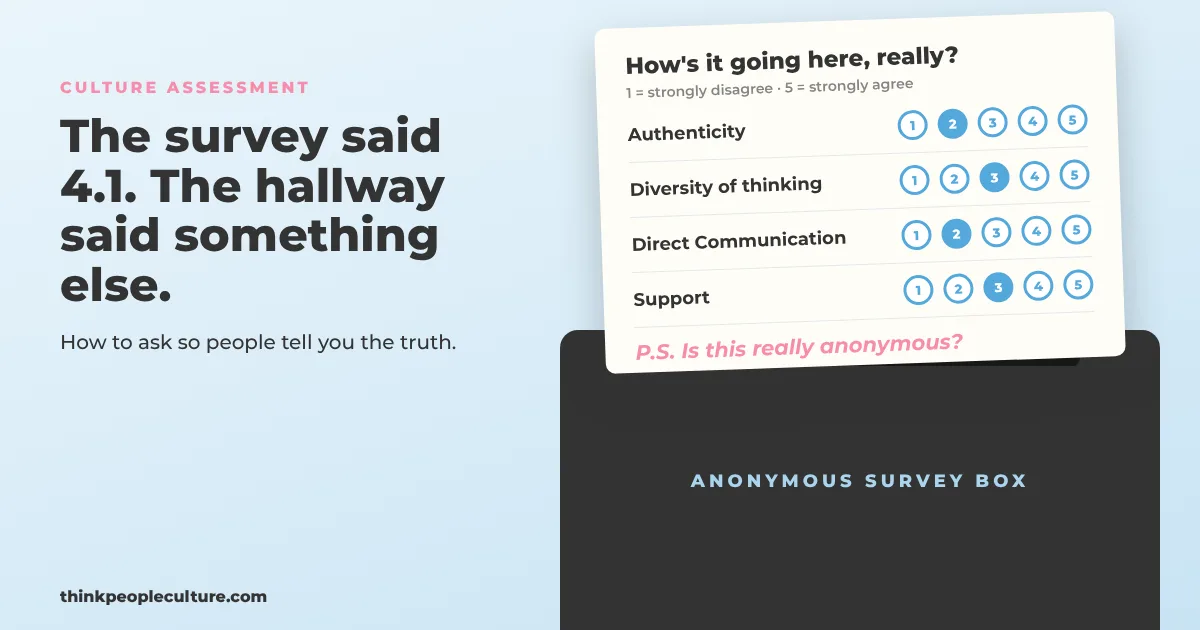
Picture this. You're the owner of a 70 person company, and your Engagement Survey came back with a 4.1 out of 5. You shared the number at the all hands, someone said "nice," and you moved on to the sales update.
Six weeks later, two of your best people quit in the same month. Both exit conversations sound oddly similar, and neither of them mentions pay.
The survey wasn't lying, exactly. It was answering a different question than the one you needed answered. There's one gap in almost every set of results that warns you about this, and it almost never shows up in the average. I'll show you where it hides once we get to reading the results.
What Is a Culture Assessment, Really?
A Culture Assessment is how you find out what it's actually like to work for you. It's not a vibe check at the holiday party, and it's not the owner asking "everyone happy?" on the way to the parking lot.
A real one has three parts. You ask everyone the same questions so you can compare, you talk to small groups so you can hear the why and you look for patterns across both. You don't need a wig, a fake mustache and a camera crew like the bosses on Undercover Boss. You need a plan and the guts to read what comes back.
The stakes are bigger than most owners think. When researchers at MIT Sloan Management Review studied why people quit, they found a toxic corporate culture was 10.4 times more powerful than pay in predicting a company's attrition rate compared with its industry.
And, most teams aren't exactly fired up to begin with. Gallup found only 31% of U.S. employees were engaged at work in 2025. Every month you guess at your culture instead of checking it, you're betting your best people are in that 31%.
Step 1: Decide What You're Actually Measuring
Most culture surveys fail before anyone answers them, because nobody decided what they were measuring. You end up with 40 questions about snacks, parking and "do you feel valued?" and no idea what to fix.
The simplest way to decide is the ADDS Framework from my book, Don't Suck at Culture. It gives you four lenses, and each one points at a habit you can change:
- Authenticity: Can people be honest here without paying for it later? This is Psychological Safety for real, not as a checkbox.
- Diversity of thinking: Do different thinking styles get heard, or do the same three voices win every meeting?
- Direct Communication: Do quieter people have a real way in, and does feedback move up as easily as it moves down?
- Support: Does challenging an idea get rewarded, or does going along with it?
Add two outcome questions to every survey. One asks whether people see themselves here in two years, and one asks whether they'd tell a friend to work here. Those two tell you whether the four lenses are adding up to something.
The free Chapter 3 preview of the book puts the whole reason for this in five words, "Sameness isn't safety. It's stagnation." A survey that only measures how comfortable people feel will reward sameness every time.
Step 2: Build a Short Survey People Will Finish
Keep it to about 15 to 20 questions people can finish in under ten minutes. If your survey has 60 questions, people will answer the first ten honestly and the last fifty like they're picking lottery numbers.
Use a 1 to 5 scale from "strongly disagree" to "strongly agree," with three or four statements per ADDS lens. A few that work well for a growing company:
- I can disagree with my manager without it hurting me. (Authenticity)
- When I share an idea that's different, people take it seriously. (Diversity of thinking)
- I know what's going on with decisions that affect my job. (Direct Communication)
- When I push back on a plan, I'm thanked for it, not tolerated. (Support)
Then add two open questions at the end, like "What's one thing we should stop doing?" and "What almost made you leave this year?" Those comments are where the real story lives.
Anonymity is the whole ballgame. Use an outside survey tool, and never report results for a group smaller than five people. If a team has three people, roll it into the next level up. And, please don't try to figure out who wrote what. "Who said this?" is the fastest way to guarantee nobody says anything next year.
Step 3: Run Small Listening Sessions
A survey tells you what people think. Listening Sessions tell you why. You need both, because a 2.8 on "I can disagree with my manager" means nothing until someone tells you what happened in the March budget meeting.
Keep each group to six to eight people from the same level, and keep managers out of the room. Nothing kills honesty faster than the CEO "popping in" with a coffee and a big smile. Asking people to rate the culture while their boss watches is like asking your kids if they liked dinner while you're standing there holding the spoon.
Ask three questions and let the group do the talking:
- What's one thing about working here you'd protect at all costs?
- What's one thing that makes your job harder than it needs to be?
- If you could change one habit around here, what would it be?
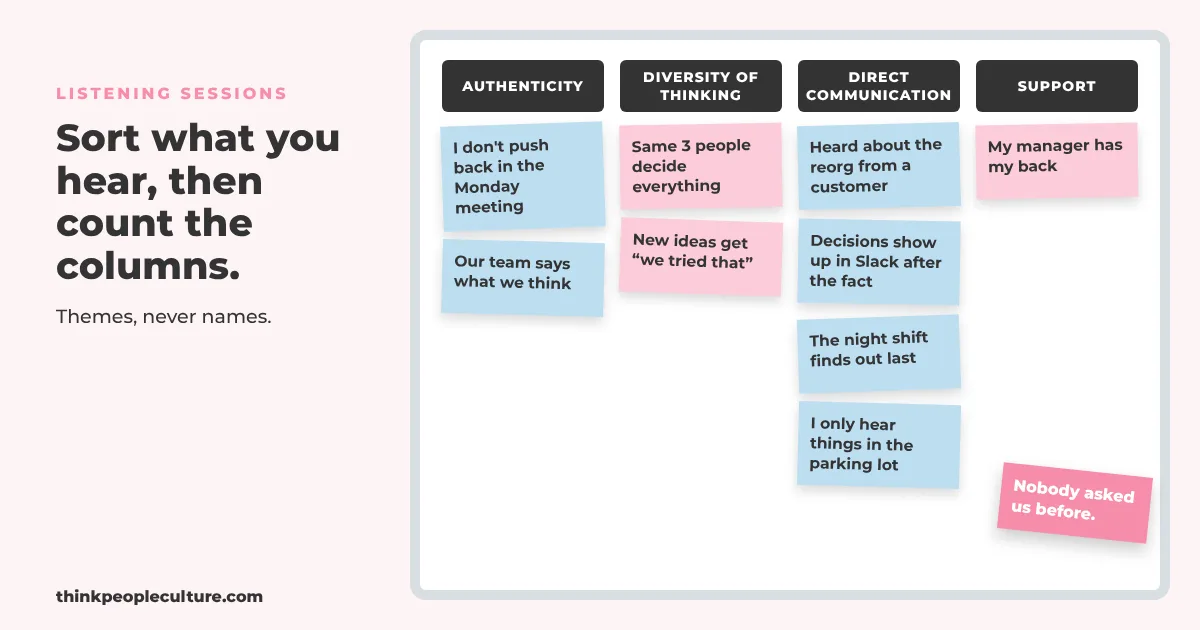
Take notes on themes, not names. Plan on 60 minutes per group and three to five groups for most growing companies. This is also where someone outside the company earns their keep, because people will tell a stranger what they'd never tell the person who signs their review.
Step 4: Read the Results Like a Detective, Not a Judge
An average is where bad news goes to hide. So, before you look at the overall score, look at these four things.
The gap between leaders and everyone else. This is the gap I promised at the top. When the leadership team rates the culture a 4.6 and the front line rates it a 3.1, your 3.9 average looks fine and means nothing. That gap is the early warning for the two resignations in the same month.
Team by team differences. One team at 2.5 can be dragging a great company average around like an anchor. Gallup says the manager drives 70% or more of the difference in engagement between teams, so a low team usually points to a manager who needs help, not a team that needs a lecture.
The pile of 3s. "Neutral" is often the polite way of saying "I'm not going to tell you." Lots of 3s on the Authenticity questions is its own answer.
Where the survey and the sessions agree. If the survey says Direct Communication is low and three separate groups brought up decisions they heard about secondhand, that's your first fix. One loud comment is a data point. The same theme from different rooms is a pattern.
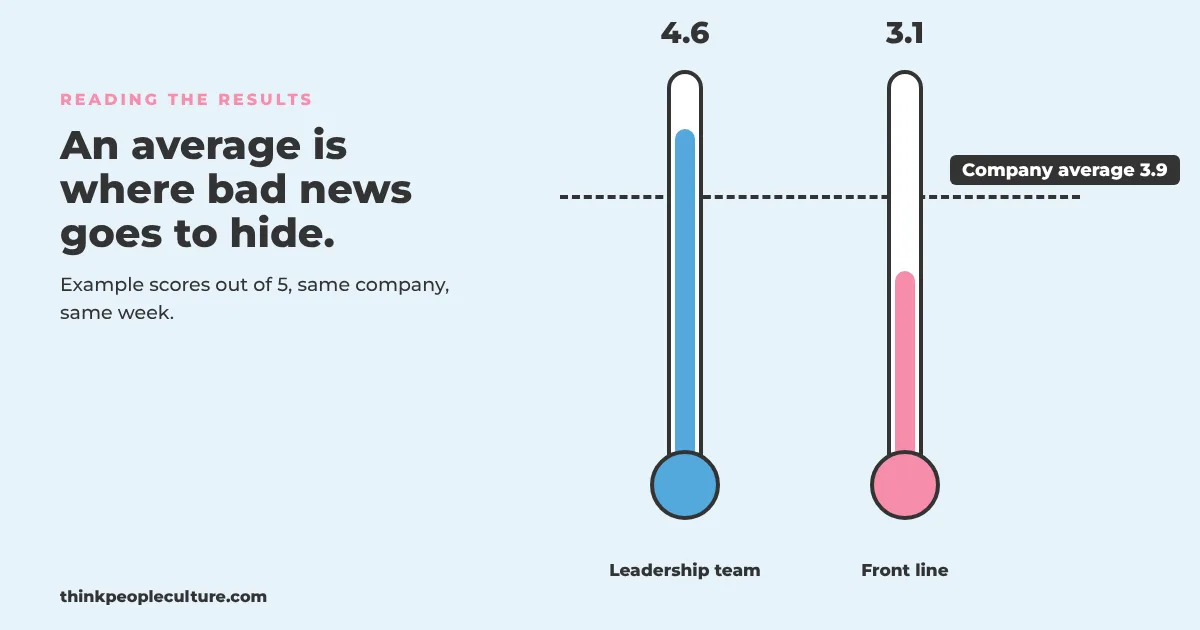
| Group (example only) | Average score out of 5 |
|---|---|
| Leadership team | 4.6 |
| Front line staff | 3.1 |
| Company average | 3.9 |
Step 5: Share What You Heard, Fast
This is the step almost everyone skips, and it's the one that matters most. Gallup found only 8% of employees strongly agree that their organization takes action on surveys.
Think about what that means. If you ask people for the truth and then go quiet, you've taught them that the truth goes nowhere. Next year's response rate will tell you exactly how they felt about it.
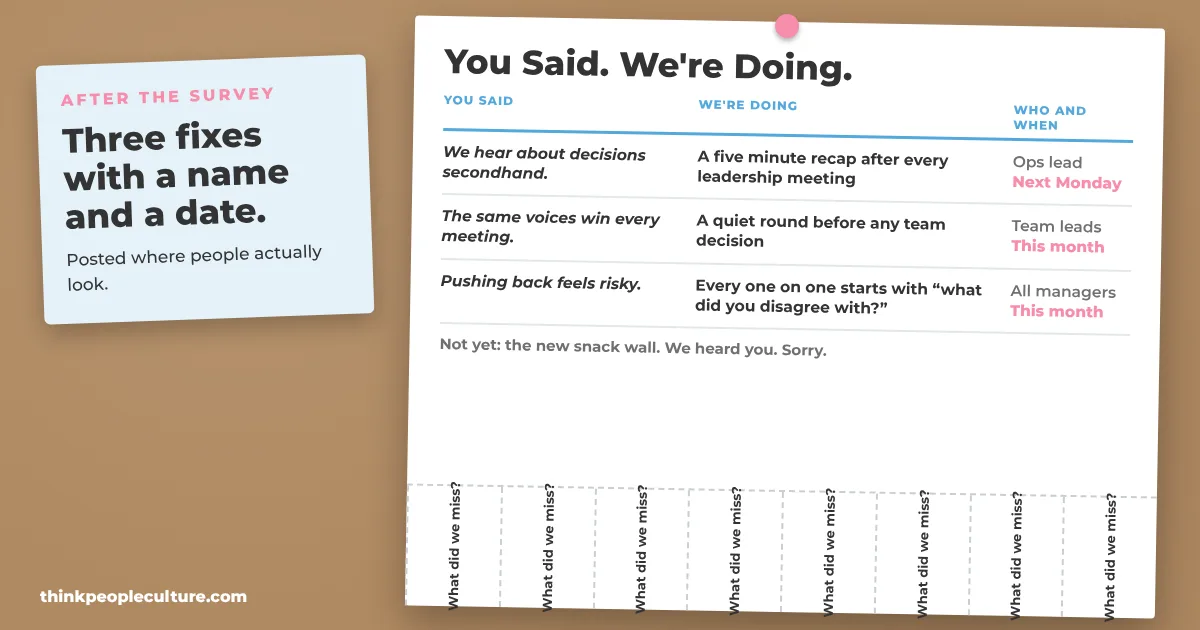
Within a few weeks of closing the survey, share three things with the whole company. Say what you heard, including the uncomfortable parts, then what you're going to do about it and what you're not going to do yet, and why. People can handle "not yet." What they can't handle is silence.
Step 6: Pick Two or Three Fixes and Check Again
Don't try to fix everything. Pick two or three changes tied to your lowest ADDS lens, give each one an owner and a date, and make them visible.
If Direct Communication came back low, maybe every leadership meeting now ends with a five minute "what did we decide and who needs to hear it" recap. If Support is low, maybe managers start each one on one by asking what the person disagreed with that week. Small habits beat big announcements, and our guide to how culture shows up in daily work has more on why.
Then check again. Run a short Pulse Survey of five to eight questions in about six months, and the full assessment once a year. If the low team scores trace back to a manager, getting first time managers ready is usually the fastest lift. If the problem is that everyone thinks alike, start hiring for Culture Add instead. The book's Chapter 3 says it plainly, "'Culture fit' often recreates blind spots," and these seven Culture Add shifts show what to do instead.
The Honest Mirror Test
1. Did we decide which ADDS lens matters most before we wrote a single question?
2. Would someone on the front line believe the survey is really anonymous?
3. Will anyone outside the management chain run the Listening Sessions?
4. Are we ready to look at results by team and by level, not just the average?
5. Have we put a date on the calendar to share results before we even send the survey?
When to Bring in Someone From Outside
You can run a solid Culture Assessment on your own. Plenty of owners do. But, there are three times it's worth getting help. The first is when trust is already low and people won't be honest with anyone on the payroll. The second is when the results point at a senior leader. The third is when you have the data and nobody has the time to turn it into a plan.
That's what our Culture Development work is built for. We run the Culture Assessment as the outside ear and give you clear first recommendations. If you want to go further, the full program adds workshops and help putting the fixes in place so your managers can actually run them. For a company with 12 to 350 employees, that's usually the difference between a nice report and a culture that changes.
If retention is the reason you're looking at this at all, the guide to keeping your best people pairs well with your results. You can also see everything else we do on the services page.
Somebody on your team already knows exactly what your survey is going to say. Pick a slot that works and tell me what you've been hearing in the hallway. You'll leave knowing whether this is a job you can run yourself or one you want help with, and if I'm not the right person for it, you'll hear that from me too.
Frequently Asked Questions
What is a culture assessment?
A culture assessment is a planned look at how work really gets done in your company compared with the values you say you have. It usually combines an anonymous employee survey with small group Listening Sessions, then turns what you learn into a few specific changes.
How long does a culture assessment take?
For a small or mid size company, plan on about six to eight weeks. That covers planning the questions, two weeks for the survey, a week or two of Listening Sessions, reading the results and sharing them with the team.
What questions should a culture survey include?
Use 15 to 20 statements on a 1 to 5 agree scale, grouped by what you want to measure, such as honesty, how ideas get heard, how information moves and whether pushback is welcome. Add two outcome questions about staying and recommending the company, plus two open questions for comments.
Should a culture survey be anonymous?
Yes. People only tell you the truth when they're sure it can't come back on them. Use an outside survey tool, don't report on any group smaller than five people and never try to work out who wrote a comment.
How often should you run a culture assessment?
Run the full assessment once a year and a short Pulse Survey of five to eight questions about six months later. Also run one after big changes, like a merger, a layoff or a new leader at the top.
Can a small business run a culture assessment without HR?
Yes. A free or low cost survey tool and a clear plan will get you most of the way. An outside facilitator helps most when trust is low, when the results point at a senior leader or when nobody has time to turn the results into action.
HR Help in Your Inbox
My free newsletter for owners with no HR person, with plain answers sent when there's something worth reading.
We respect your privacy. Unsubscribe at any time.