SB 553 Training Requirements: What California Employers Owe Every Year
The visitor log said "printer repair." That's how a former client of a 30 person property management office got past the shared front desk one Thursday. He walked right up to the account manager who'd ended his contract and started yelling that she'd "regret this." Building security walked him out, and nobody was hurt.
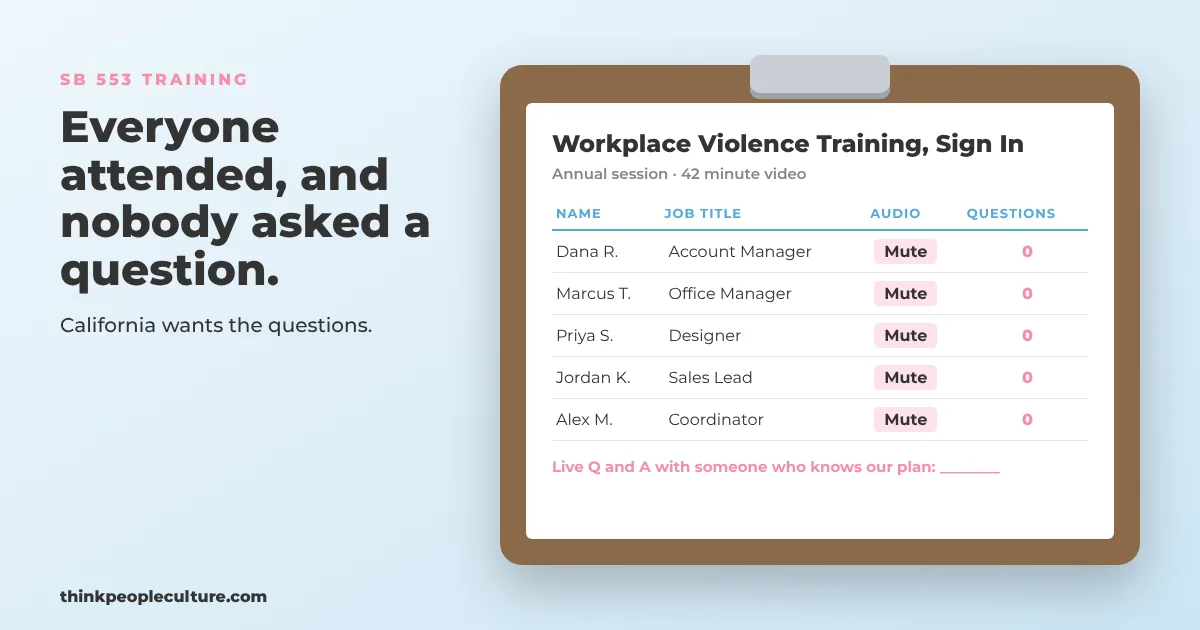
Then the owner started asking questions. Who was supposed to call security? Two people did, and one called 911 too. Had he threatened anyone before? Twice, by email, and nobody wrote it down because "he was just venting." They did have a workplace violence plan. It was a downloaded template, and the training was a video everyone played on mute.
What fixed it took less time than that video, and it started with the person who answered the front desk phone.
TL;DR: SB 553 training is the yearly workplace violence training most California employers owe their people under Labor Code 6401.9. It has to cover your own plan, how to report without fear of payback, the hazards of each job and the violent incident log. It also has to give people a real chance to ask questions of someone who knows your plan. You train when the plan starts, every year after and again when a new hazard shows up or the plan changes. Keep training records for one year and the incident log for five. Cal/OSHA's fuller rule for all industries is due by December 31, 2026.
Who Has to Take SB 553 Training?
If your first thought was "does this even apply to us?", start from yes. The law covers almost every employer and place of employment in the state. Cal/OSHA's own FAQ says employers with staff working in California owe that training to their California people.
The exceptions are narrow. A site that's closed to the public and never has 10 or more employees there at once can be out. It still has to follow the general safety program rules in Title 8, section 3203. A home office the employee picked and you don't control is out. Health care settings under their own Cal/OSHA rule are out, and so are some police and prison settings. Your front desk, your sales floor and the conference room clients walk into are in.
Managers count too, and so do part time staff. If someone has ever had to tell a client "I'm going to need you to lower your voice," they're exactly who this training is for.
What the Training Has to Cover, Line by Line
Labor Code 6401.9(e) lists six things. Every session needs all of them:
- Your plan, how to get a free copy and how to help build and run it.
- What the law means by workplace violence and what it requires.
- How to report an incident or a concern to you or to the police without fear of payback.
- The hazards in each person's actual job, what you've done about them, how to get help and ways to avoid getting hurt.
- The violent incident log and how to get copies of the records.
- A real chance to ask questions and get answers from someone who knows your plan.
The law also says the training has to fit your people's education, reading level and language. If half your team reads Spanish first, an English only slideshow isn't effective training, it's just a slideshow.
Why a Video on Mute Doesn't Count
A lot of SB 553 training sold online is a video and a quiz, the kind people take so there's proof if OSHA ever shows up. Those can be useful, but on their own they can't cover the last item on that list. The law wants an interactive Q and A with a person who knows your plan, not a person who knows a plan.
Think about the airplane safety demo. Everybody has seen it, nobody watches it and if the plane actually lost power, half the cabin would be trying to remember which strap goes where. A generic video does the same thing to your team. It checks a box, and then the first real threat shows up and nobody knows who to call.
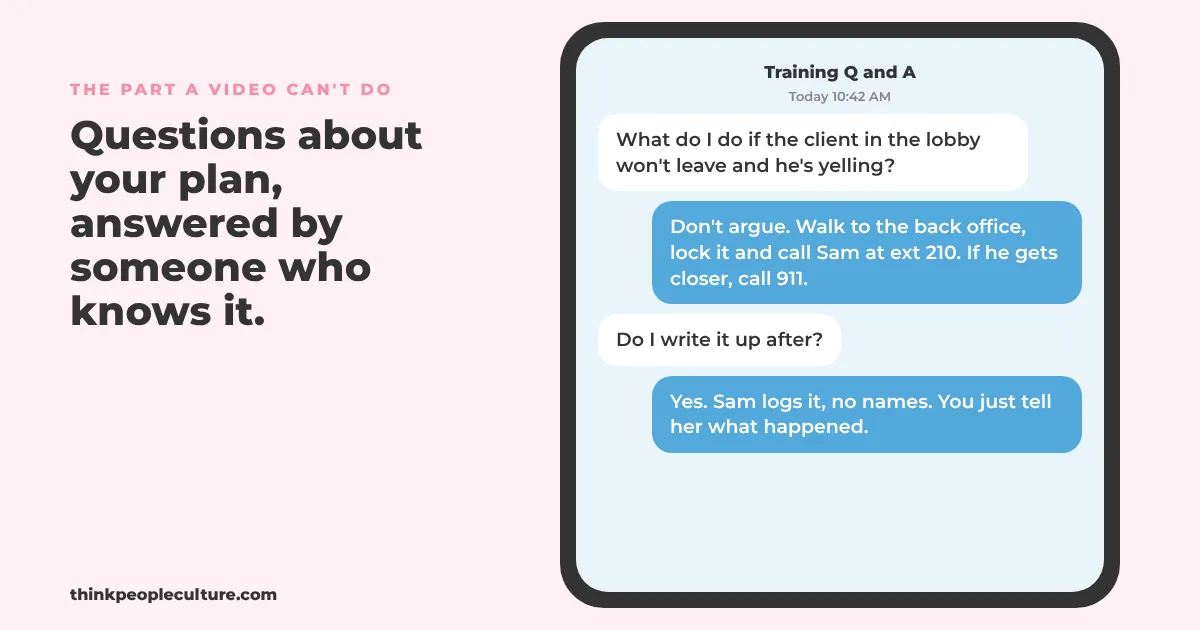
The good news is the live part doesn't have to be long. A 20 minute session where people ask "what do I do if the guy in the lobby won't leave?" and get your answer, for your office, does more than an hour of stock footage.
When Training Happens: The SB 553 Calendar
There are three triggers for training and three for reviewing the plan. They're easy to mix up, so here they are side by side:
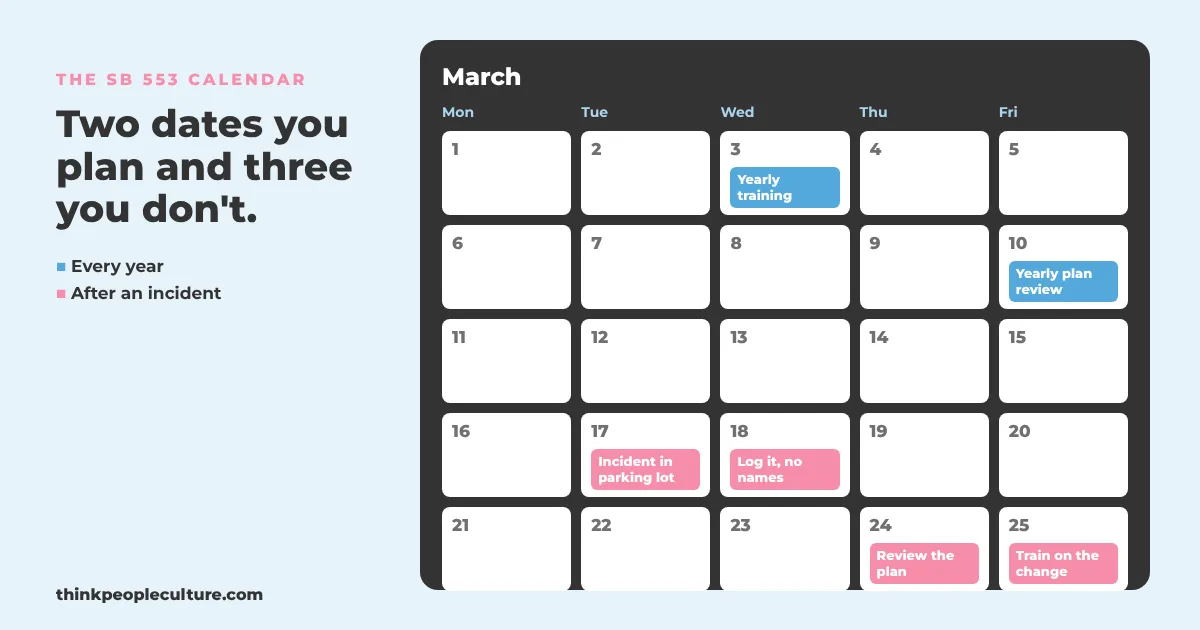
- Train when the plan first starts, every year after that and whenever a new hazard shows up or the plan changes. The extra session can cover just the new hazard or the change.
- Review the plan at least once every year, after any workplace violence incident and whenever you spot a gap.
So, if a former employee shows up in your parking lot in March and makes threats, that's an incident. It goes in the log, the plan gets reviewed and if you change anything, people get trained on the change. One bad Tuesday can set off all three.
The Violent Incident Log: What Counts and What Goes In
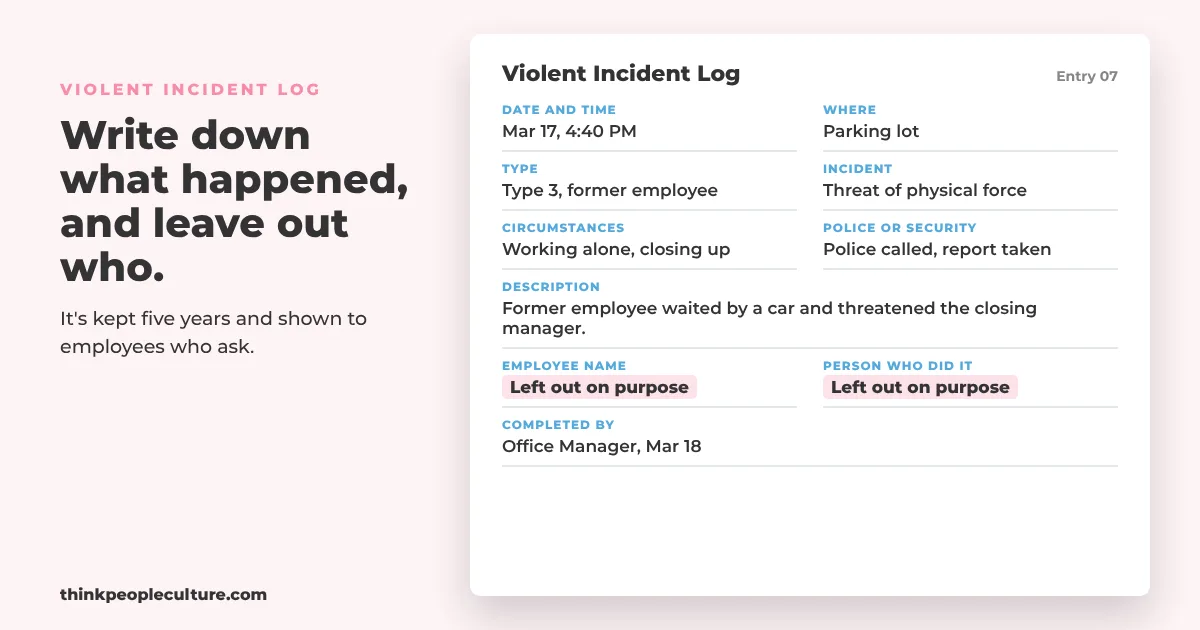
"What counts as an incident?" is the question I hear most, right after "that would never happen here." Every workplace violence incident goes in the log, and the law's definition is wider than most owners think. A threat counts, even if nobody gets hurt. Cal/OSHA's FAQ says even an unintentional act by a client or customer counts if it fits the definition.
Each entry needs the date, time and place, the type of violence, a detailed description and who did it (a client, a coworker, a stranger, a partner and so on). It also needs the circumstances (working alone, short staffed, rushed), where it happened, the type of incident, what happened next, including whether police or security came, and who filled out the log and when.
Now for the part that trips people up, the log must leave out anything that could identify the people involved, like names, addresses, phone numbers and emails. This is not a Burn Book. You're writing down what happened, not who you're mad at.
Keep the log for five years. If someone was injured badly enough to need more than first aid, it may also belong on your Cal/OSHA Form 300 injury log, so check both.
Training Records: The Part Everyone Forgets
You did the training. Can you prove it? Training records have to show the date, what was covered, who ran it and what makes them qualified, plus the name and job title of everyone who attended. Keep them for at least one year.
And, if you're wondering who gets to see all this, the answer is your employees. They can ask for copies of your hazard records, training records and the incident log, and you have 15 calendar days to hand them over at no cost. If your records live in somebody's inbox under "misc," that's a long two weeks.
What Cal/OSHA's 2027 Rule Could Change
SB 553 told Cal/OSHA to write a full rule for workplace violence in every industry, and its Standards Board has to adopt it by December 31, 2026. Cal/OSHA posted discussion drafts of the new rule, called Title 8 section 3343, on April 23 and July 22, 2026.
The drafts can still change, so don't rebuild anything around a draft. But, one message is clear. A SHRM article from September 2026 says employers should expect Cal/OSHA to check whether a plan is specific, implemented and supported by evidence. In plain words, the binder isn't the proof anymore. The training sign in sheet, the log and the notes from your yearly review are.
Check Yourself Before Cal/OSHA Does
Ten yes or no questions, pulled from every training and records rule above. It takes about two minutes, and you'll see your SB 553 Readiness Score as soon as you finish.
Who Runs Your Training?
The funny thing about the "person who knows your plan" rule is that the best person for the job is usually already on your payroll. It's the office manager or the ops lead who knows which door sticks and which client always shows up angry. They just need a plan worth knowing and a guide to run the session.
That property management office figured this out the hard way. The office manager who took that first call now runs a 20 minute Q and A every year with the plan open on the screen. The whiteboard has one rule on it, which is that any client email that reads like a threat goes in the log, even when he's "just venting."
That's what our California workplace violence prevention package builds. We write the plan for your work areas and set up the incident log with the fields the law asks for. You also get a facilitator guide one of your own managers can run, with the Q and A built into the agenda. Your attorney reviews it before it goes live. If you want the full picture of the plan itself first, start with the plain words guide to SB 553.
A good session also leans on your managers, because they're who people tell first. If yours are new to the job, how to get first time managers ready covers where to start. And, if a threat ever turns into a lawsuit threat, what to do first when an employee threatens to sue walks through the next few hours.
Your next training date is already on the calendar somewhere, or it should be. Pick a time with me before it arrives, show me what you used last year, and you'll get a clear answer on whether it holds up or needs a rebuild.
I'm an HR pro, not a lawyer. This is my read of the law as of October 2026, so run your own situation by an employment attorney.
Frequently Asked Questions
Does SB 553 training have to happen every year?
Yes. Labor Code 6401.9 requires training when the plan is first set up and then once a year. You also train again when a new hazard shows up or the plan changes, and that session can cover just the new hazard or the change.
Can SB 553 training be done online?
An online course can cover a lot of it, but the law also requires an opportunity for interactive questions and answers with a person who knows your plan. A generic video with no way to ask about your workplace doesn't meet that part on its own.
What has to be in the violent incident log?
Each entry needs the date, time and location, the type of workplace violence and a detailed description. It also needs who committed it by category, the circumstances, where it happened, the type of incident, what happened next and who completed the log. Names and contact details of the people involved must be left out. Keep the log for at least five years.
Do threats count as workplace violence incidents?
Yes. California's definition includes any act of violence or threat of violence at a place of employment, including a threat of physical force or of using a weapon, whether or not anyone is hurt.
How long do we keep SB 553 training records?
At least one year. The records must show the training dates, what was covered, the names and qualifications of the people who ran it and the names and job titles of everyone who attended. Employees can ask for copies, and you have 15 calendar days to provide them at no cost.
Is Cal/OSHA's new workplace violence rule in effect yet?
Not as of October 2026. Cal/OSHA released discussion drafts of a general industry rule in April and July 2026, and its Standards Board has to adopt a standard by December 31, 2026. Until then, Labor Code 6401.9 is the rule you follow.
HR Help in Your Inbox
My free newsletter for owners with no HR person, with plain answers sent when there's something worth reading.
We respect your privacy. Unsubscribe at any time.