California Employee Handbook Changes for 2027: What to Update Before January 1
TL;DR: California Employee Handbook changes for 2027 are the policy fixes you need because new state laws kick in on January 1, 2027. The big ones are Bereavement Leave for a "designated person" and immigration language in your Anti Retaliation Policy. You'll also want a second look at any Dress Code rule that splits by gender, and at how you monitor people, since bathrooms are now off limits. The state Minimum Wage goes to $17.40 an hour, which lifts the Exempt salary floor to $72,384 a year. New rules for AI used in discipline start July 1, 2027.
Say it's a Tuesday in February 2027. One of your best people knocks on your door and asks for three days off. Her aunt died, the one who raised her after her mom got sick. Your manager opens the Employee Handbook to the Bereavement Leave Policy. It lists a spouse, kids, parents, brothers and sisters, grandparents, grandkids and a domestic partner, and there's no aunt on it.
Last year, that list matched the law. As of January 1, it doesn't, and your own handbook is now telling your manager to say no to something California says she gets.
That's one of seven changes in this post. There's also one plain sentence in a lot of dress codes that needs a hard second look in 2027. I'll point to it when we get to the stereotypes law.
What Changes in California Employee Handbooks for 2027?
A lot of handbooks are stuck in Groundhog Day. They wake up every January with the same "Revised 2023" date on the cover while the law moves on without them.
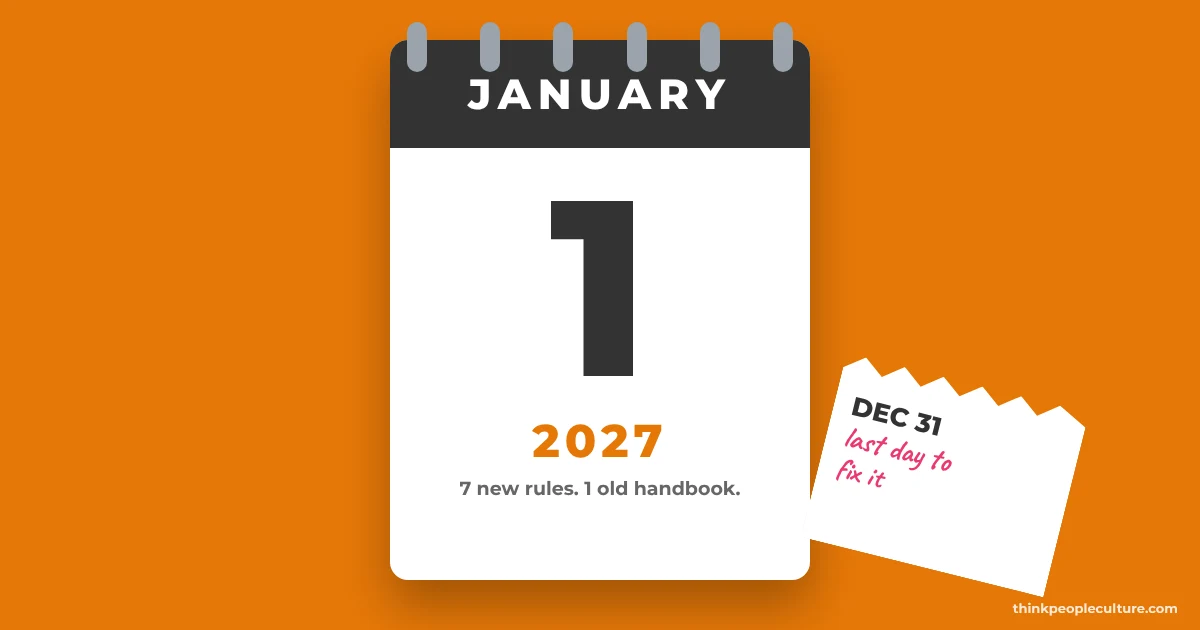
Governor Newsom finished signing bills on September 30, 2026. Most of the new employment laws take effect January 1, 2027, and a few of them land right on pages you already have. If you run a company with 12 to 350 employees, odds are nobody on your team has "watch Sacramento" in their job description. So, here's the short list in plain words.
| Law | What changes | Starts |
|---|---|---|
| SB 1149 | Bereavement Leave covers a "designated person" | January 1, 2027 |
| AB 2495 | Wider ban on immigration related threats and retaliation, with fines as high as $10,000 for each person | January 1, 2027 |
| AB 2563 | Sex discrimination includes treatment based on sex or gender stereotypes | January 1, 2027 |
| AB 1331 | No surveillance tools in workplace bathrooms | January 1, 2027 |
| AB 1883 | No AI tools that read emotions or collect neural data | January 1, 2027 |
| Minimum Wage | $17.40 an hour, Exempt salary at least $72,384 | January 1, 2027 |
| AB 1697 | Stay or pay ban applies to contracts signed from this date | January 1, 2027 |
| SB 947 | Human review and notice when AI drives discipline or firing | July 1, 2027 |
| AB 1803 | Anti hate speech added to harassment prevention training | January 1, 2028 |
1. Bereavement Leave Now Covers a "Designated Person" (SB 1149)
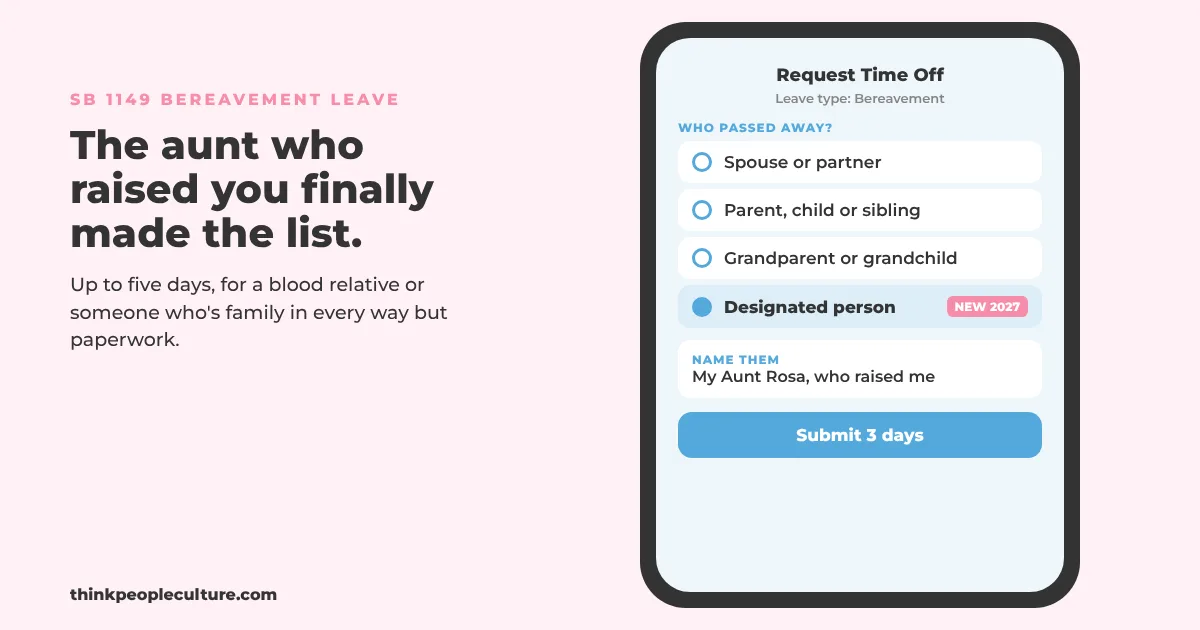
SB 1149 was signed September 27, 2026. It adds a "designated person" to the family members who count under California's Bereavement Leave law, Government Code 12945.7.
A designated person is anyone related to the employee by blood. It's also anyone whose bond with the employee is the same as family. Think of the aunt who raised her, a cousin, a godparent or the best friend who's been a brother since third grade. The employee can name that person when they ask for the leave.
The rest of the rule doesn't change. It covers employers with five or more employees. Anyone who's worked for you at least 30 days qualifies. They get up to five days, the days don't have to be in a row and they have three months from the death to use them. You can ask for proof within 30 days of the first day off, like an obituary or a note from the funeral home.
Your policy update is short, and it touches four spots.
- Add "designated person" to the list of who counts, using the law's own words.
- Say the employee can name the person at the time they ask.
- Decide whether to limit it to one designated person per 12 month period. The law lets you, so it's your call, and the policy should say which way you went.
- Fix the leave request form so the only choice for an aunt isn't "other."
Nobody wants to be the manager who asks for a family tree before approving a funeral. A clear policy means they never have to.
2. Your Anti Retaliation Policy Needs Immigration Language (AB 2495)
AB 2495 was signed September 29, 2026, and it's the one with the biggest number attached.
California already made it illegal to use immigration threats to punish people for speaking up. Think asking for more papers than the I-9 needs, or threatening to call immigration. Starting January 1, 2027, Labor Code 1019 goes further. Now it also covers anything you say or do about what you think someone's status is. If it would tend to scare them off a legal right at work, it counts. That's a right under any local, state or federal law that applies to employees, not just the Labor Code.
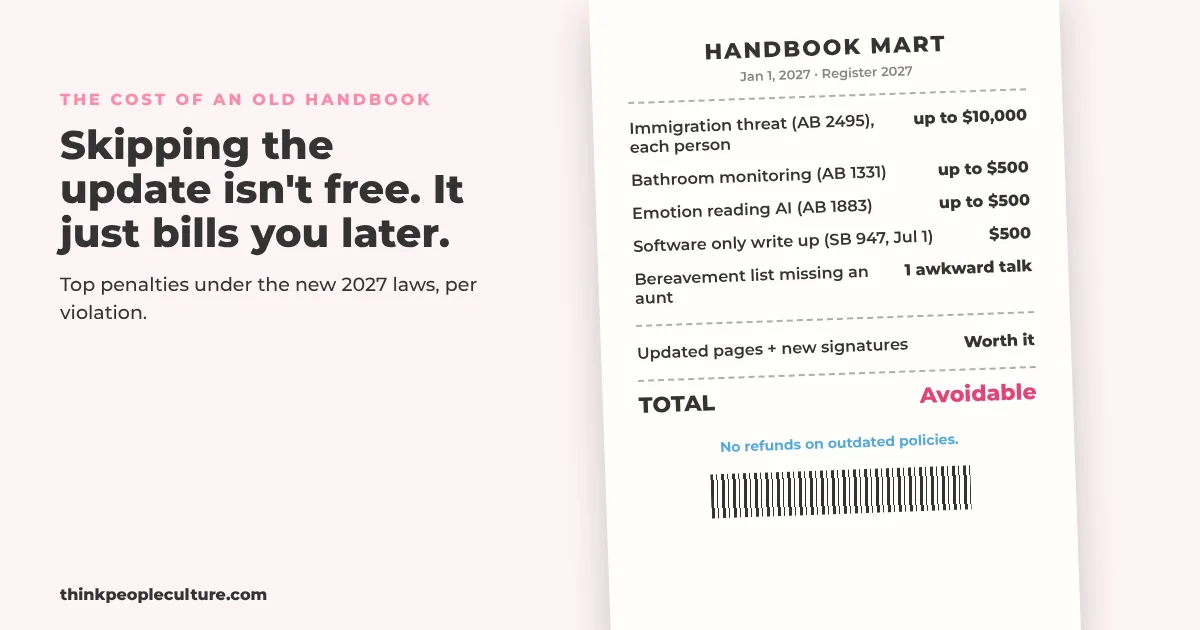
Three details make this one expensive. It's about perceived status, so the person's real status doesn't matter. It protects applicants and former employees, not only current staff. And, the fine can reach $10,000 for each person, for each violation. It goes to the person, on top of everything else they can win.
So, imagine a supervisor in a pay dispute who says, "You sure you want to make noise, with your paperwork situation?" That one line can now cost more than the back pay he was fighting about.
Your Anti Retaliation Policy should say it out loud. Add a line that no one may threaten, question or joke about anyone's immigration status, real or assumed, to keep them quiet. Then train your managers, because they're the ones who'll say it at 5:45 on a Friday. To see how fast payback turns into a claim, the wrongful termination rules for California employers walk through it.
3. Dress Code and Grooming Rules: The Line to Reread (AB 2563)
AB 2563 was signed September 30, 2026. It says sex discrimination includes treating people differently when they don't fit the old picture of how a man or a woman should look or act. It also tells courts to read those protections broadly. The definition of "sex" in the Fair Employment and Housing Act now points to that wider meaning.
The sentence I promised at the top is the one in your Dress Code that starts with "Men must" or "Women must." Think hair rules for men only, makeup for women only or a "professional look" that means a skirt. Each one is built on the kind of stereotype this law names.
My read is that a Dress Code tied to the job and applied the same way to everyone is the safe version. "Closed toe shoes in the warehouse" works for everybody. "Ladies wear makeup at the front desk" is a lawsuit wearing a name tag.
4. Monitoring Rules: Bathrooms and Emotion Reading AI (AB 1331 and AB 1883)
Two bills signed September 30, 2026 change what your Electronic Monitoring Policy can say.
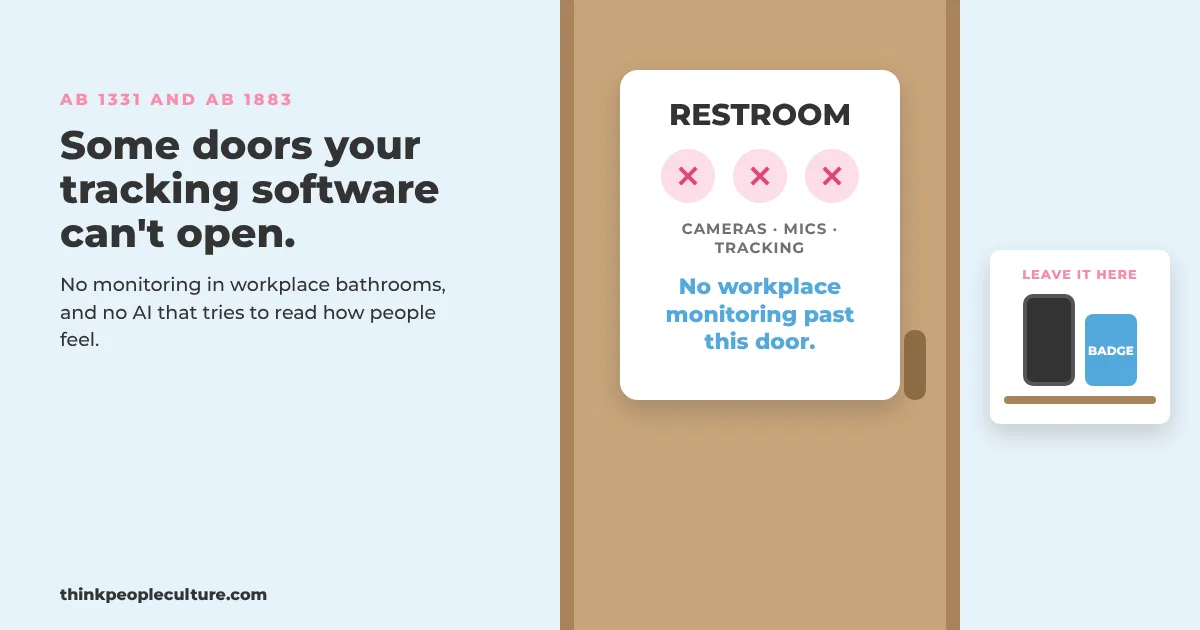
AB 1331 says an employer can't use a workplace surveillance tool to watch people in a bathroom at work, unless a court orders it. "Surveillance tool" is broad. It covers video, audio, time tracking, GPS and anything else that gathers data on people while no person is doing the watching.
Employees also get the right to leave those tools behind, like a tracked work phone, when they walk into the bathroom. There are a few exceptions. That right doesn't apply when another law requires someone to stay reachable during breaks. A required badge that has no camera, no microphone and no built in AI is fine, and so is checking a tool for the one time entry and exit.
AB 1883 bans tools that use AI to read or guess how an employee feels. It also bans tools that collect neural data, which is data from the brain and nerves. Safety tools are still allowed when they don't do either of those things. Both laws carry a penalty of up to $500 for each violation.
Add a short section to your monitoring policy. Say there's no monitoring in bathrooms, people can leave tracked devices outside and the company doesn't use tools that read emotions. Then ask your vendors. If your call software or camera system scores "sentiment" or "engagement," find out whether it's scoring your own people. Your camera doesn't need to know Kevin is sad, everyone in accounting already knows.
5. Pay Numbers That Expire on January 1
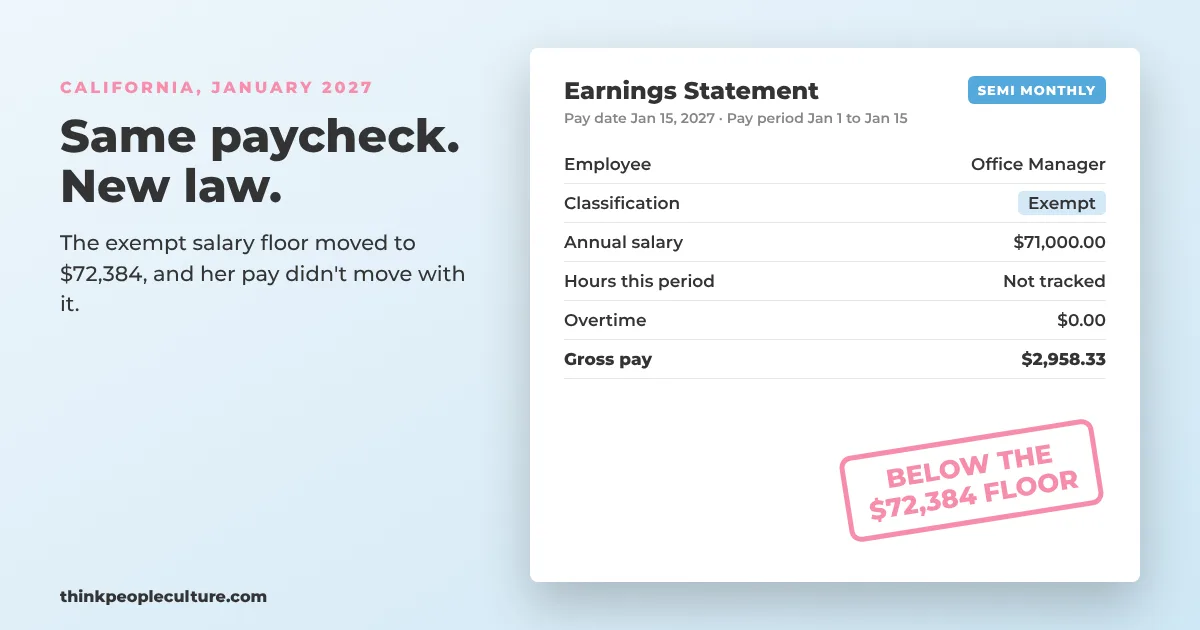
California's Minimum Wage goes to $17.40 an hour on January 1, 2027, according to the Labor Commissioner's Office. That moves the minimum salary for most Exempt employees to $72,384 a year, which is $17.40 times 2 times 40 hours times 52 weeks.
If your handbook quotes a dollar amount anywhere, it goes stale on New Year's Day. My advice is to take the number out. Say you pay at least the state or local minimum, whichever is higher, since some cities set their own rates.
Salary alone doesn't make someone Exempt, either. They still have to pass the duties test for their exemption. If you have people close to that line, our post on fixing pay and job classification is worth a read before your next payroll run.
6. Stay or Pay Agreements Get a Hard Start Date (AB 1697)
AB 1697 was an urgency bill signed September 30, 2026, so it's already law. It pushed California's stay or pay ban, first passed in 2025 as AB 692, to contracts signed on or after January 1, 2027.
After that date, most contracts that make a worker pay you back when they leave are off the table. The exceptions come with strict rules. One is paying back school costs for a credential the worker can take anywhere, if the amount shrinks over time and sits apart from the job offer. Government loan programs and approved apprenticeships are also exempt. So are some bonuses, if they're in a separate agreement and the worker gets at least five business days to talk to a lawyer. Paying back advanced PTO when someone quits is allowed too, capped at 40 hours and with no interest.
In the handbook, check your Tuition Reimbursement Policy and any rule that takes back a sign on bonus. Check any rule about borrowing PTO before it's earned, too. If a policy says "leave within two years and you owe us all of it," that's a line to rewrite before January.
What's Coming in July 2027 and 2028
SB 947, signed September 30, 2026, starts July 1, 2027. After that, software can't be the only thing behind a write up or a firing. The law calls that software an automated decision system. If you mostly rely on one, a person has to check the call against real facts, like manager reviews, the personnel file or the work itself. If the output can't be backed up, you can't use it.
You also owe the employee a written notice in plain words when you tell them the decision. They can ask what data about them the system used, too. The penalty is $500 per violation. If your attendance software writes up people automatically, put a human between the software and the write up. That's good practice anyway, as the steps in our California termination guide show.
AB 1803 was signed September 27, 2026. Starting January 1, 2028, your required harassment training has to cover hate speech at work, too. Nothing changes for your 2027 sessions, but ask your training provider now so you're not scrambling later.
One thing did not pass. AB 1940 would have added menopause to the meaning of sex discrimination. It was vetoed on September 30, 2026, so there's no new category to add for it.
The 2027 Redline Check
1. Does our Bereavement Leave Policy name a "designated person," and does the leave form match?
2. Does our Anti Retaliation Policy ban threats, questions and comments about immigration status, real or assumed?
3. Does any Dress Code line begin with "men must" or "women must"?
4. Does our monitoring policy keep every tool out of the bathroom and rule out emotion reading AI?
5. Does the handbook print a wage or salary number that goes stale on January 1?
How to Roll Out a 2027 Handbook Update
You don't need to reprint the whole book. Update the changed pages, put a new revision date on the cover and send everyone a short note that says what changed and why. Then get a fresh signed Acknowledgment Page. When someone says nobody told them, "we emailed it" loses to a signature every time.
Have an employment attorney review the changes before they go out. Then walk your managers through them, since they're the ones who'll get asked first. If your managers are new to this, how to get first time managers ready is a good place to start. If you're building a handbook from scratch, start with our guide to what California requires in an Employee Handbook and come back to this list.
Back to that Tuesday in February. With the new policy, your manager says "I'm so sorry, take the days," checks one box and moves on. Without it, he says no, and an employee in the worst week of her life ends up reading SB 1149 on her phone in the parking lot.
This is the cleanup we do in the 90 Day Engagement on our services page. You get an Employee Handbook that matches California law and how your company really runs. An employment attorney reviews it before it goes to your people. If most of your team works in the state, our California HR page shows how we cover the rest of the compliance calendar too.
Somewhere in your files, there's a handbook with an old date on page one and a bereavement list that's now too short. Tell me about it in a 25 minute chat, and we'll figure out whether it needs a few new pages or a fresh start, and whether I'm the person to write them.
I'm an HR pro, not a lawyer. This is my read of the law as of October 2026, so run your own situation by an employment attorney.
Frequently Asked Questions
What California laws change Employee Handbooks in 2027?
Six new laws start January 1, 2027. SB 1149 covers Bereavement Leave for a designated person, and AB 2495 covers immigration related retaliation. AB 2563 covers sex and gender stereotypes, AB 1331 bans bathroom surveillance and AB 1883 bans AI that reads emotions. AB 1697 covers stay or pay contracts. The state Minimum Wage also rises to $17.40 an hour that day, and SB 947 on automated discipline decisions starts July 1, 2027.
Who counts as a designated person for Bereavement Leave in California?
Under SB 1149, a designated person is anyone related to the employee by blood. It's also anyone whose bond with the employee is just like family. The employee can name the person when they ask for leave. The rule applies to employers with five or more employees, starting January 1, 2027.
Can an employer limit designated person Bereavement Leave?
Yes. The law lets an employer limit an employee to one designated person per 12 month period. The usual rules still apply. Employees who've worked for you at least 30 days get up to five days, used within three months of the death.
Can California employers monitor employees in the bathroom?
No. Starting January 1, 2027, AB 1331 says you can't use any tool to watch or track people in a bathroom at work, unless a court orders it. Employees can also leave surveillance tools, like a tracked work device, outside when they go in, with limited exceptions. Violations can bring a penalty of up to $500 each.
What is the California Exempt salary for 2027?
At least $72,384 a year for most exemptions, starting January 1, 2027. That's double the new $17.40 state Minimum Wage, figured on a 40 hour week. The employee also has to meet the duties test for the exemption.
When does California's AI discipline law take effect?
SB 947 starts July 1, 2027. Employers can't let software alone decide to discipline or fire someone. When they mostly rely on one, a human has to check the decision. The employee gets a written notice and can ask what data about them the system used.
HR Help in Your Inbox
My free newsletter for owners with no HR person, with plain answers sent when there's something worth reading.
We respect your privacy. Unsubscribe at any time.