Exempt vs Nonexempt in California: The 2027 Salary Test
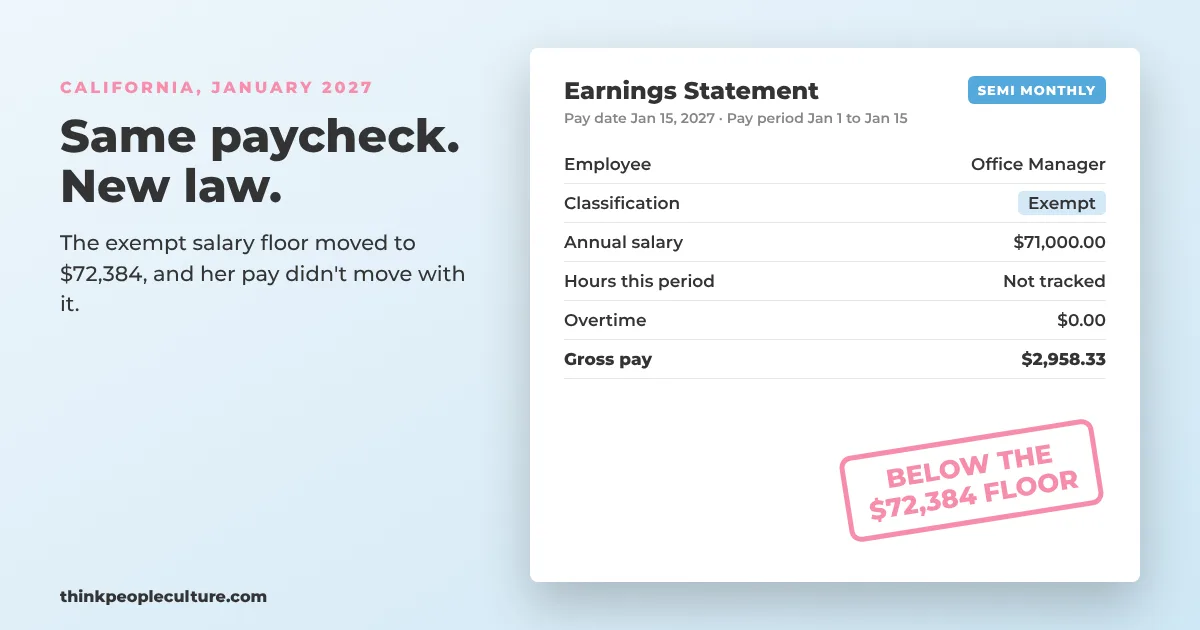
Picture this, it's January 15, 2027, and payroll runs like it always does. Your office manager is on salary at $71,000, she's been Exempt for three years and nothing about her job changed over the holidays. Nobody touched her pay, nobody touched her title and nobody sent her a memo.
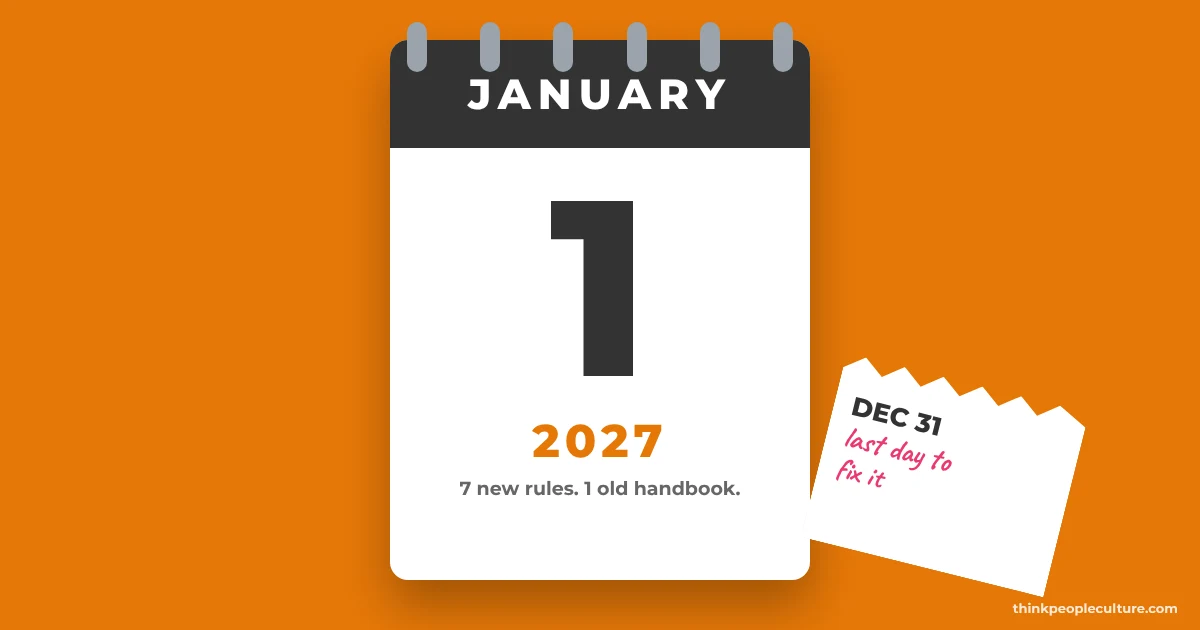
But, on January 1 the law moved, and she didn't move with it. Starting that morning, every hour she works past eight in a day is an hour you may owe her Overtime for. Nobody will notice for a while, and that's the expensive part.
The good news is that the cheapest fix for her isn't always the one you'd guess, and the math on it is a little shocking.
TL;DR: In California, an Exempt employee is someone who isn't owed Overtime because they pass two tests, a salary test and a duties test. For 2027 the salary test is at least $72,384 a year ($6,032 a month), which is two times the new $17.40 state minimum wage for full time work. The duties test says they must spend more than half their time on real executive, administrative or professional work. Fail either test and the person is Nonexempt, no matter their title or how they're paid.
What Is the 2027 California Exempt Salary?
It's $72,384 a year. On July 31, 2026, California's Department of Finance certified a 2.99 percent raise to the state minimum wage, from $16.90 to $17.40 an hour, starting January 1, 2027. The Labor Commissioner's Office then spelled out the exempt salary math in its August 13, 2026 release.
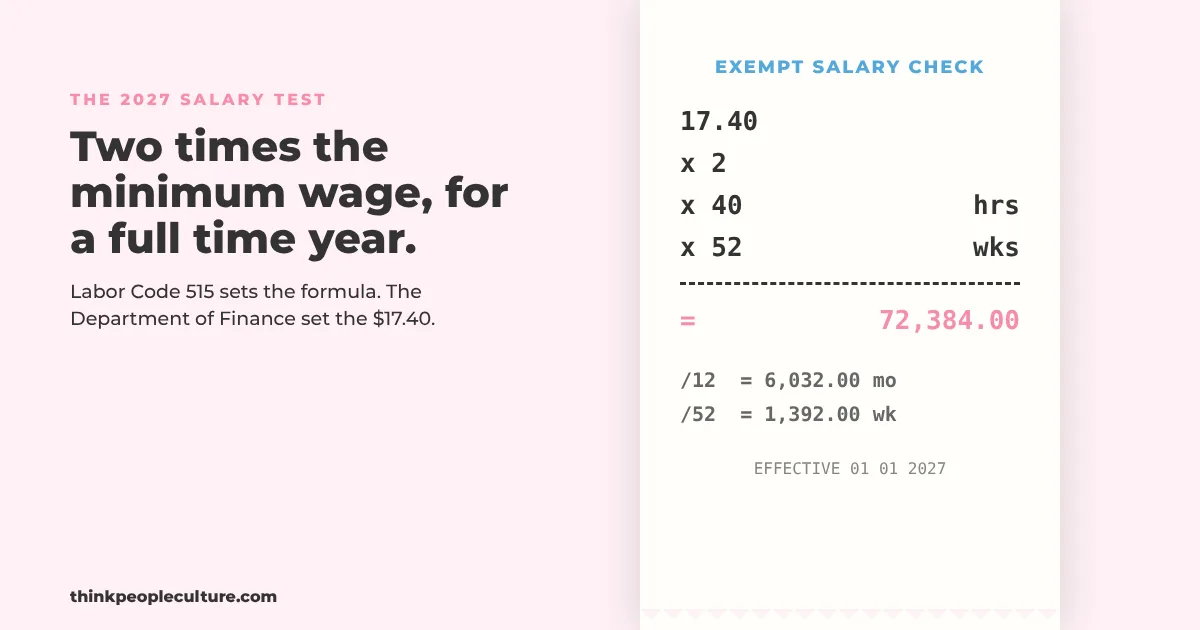
The formula comes from Labor Code 515. An Exempt employee has to earn a monthly salary of at least two times the state minimum wage for full time work. The law says full time means 40 hours a week. So, the state figures it this way.
$17.40 x 2 x 40 hours x 52 weeks = $72,384
| Year | State minimum wage | Exempt salary floor per year | Per month | Per week |
|---|---|---|---|---|
| 2026 | $16.90 an hour | $70,304 | $5,858.67 | $1,352 |
| 2027 | $17.40 an hour | $72,384 | $6,032 | $1,392 |
That's a $2,080 jump for every Exempt person you pay close to the line. Raises you give in December feel generous. Raises the state already ordered for January feel more like a parking ticket.
Exempt vs Nonexempt in Plain Words
A Nonexempt employee is owed Overtime, meal breaks and rest breaks. An Exempt employee isn't, because they've passed both tests. The Labor Commissioner's glossary lists what Exempt status takes away, including the Overtime premium, the meal period rule and the rest period rule. That's why the state guards it so closely.
In California, Overtime kicks in faster than most owners expect. Under Labor Code 510, a Nonexempt person earns time and a half after eight hours in a day or 40 in a week. After 12 hours in a day, it's double their rate. A ten hour Tuesday counts, even if Friday was short.
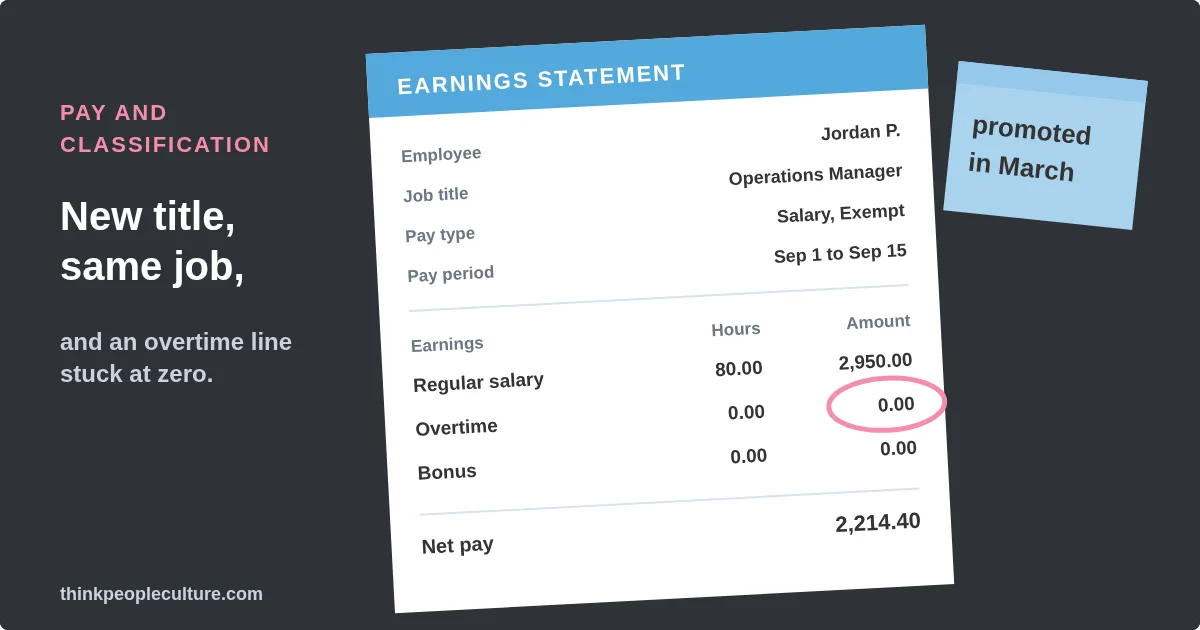
Putting someone on salary doesn't make them Exempt any more than buying a whistle makes you a referee. Salary is how you pay. Exempt is a legal status they earn by passing the tests.
The Duties Test: Where Most Owners Trip
The salary number is the easy half because it's printed in a press release. The duties test is where the trouble hides. The key word is "primarily," and Labor Code 515 says it means more than half of the person's work time. It isn't their most important hour or the work they were hired to do someday. It's what fills more than half their actual week.
There are three main white collar exemptions, and each one has its own duties test.
- Executive. They run the business or a real department and have a real say in hiring and firing. They also direct the work of at least two full time people, or the equal in part time staff. The state's own guidance says a manager over only two people rarely spends half their time managing.
- Administrative. They do office work tied to how the business runs, not the product or service you sell, and they regularly use discretion and independent judgment on things that matter. The glossary warns that following the company manual doesn't count as judgment.
- Professional. They're licensed in California and practicing law, medicine, dentistry, optometry, architecture, engineering, teaching or accounting, or they work in a learned or artistic field that takes advanced study or real originality. That's from the professional exemption definition.
Software people get their own rule. A qualifying computer software employee can be Exempt at a separate pay floor. For 2027 the Department of Industrial Relations set it at $61.03 an hour, $10,592.37 a month or $127,108.34 a year.
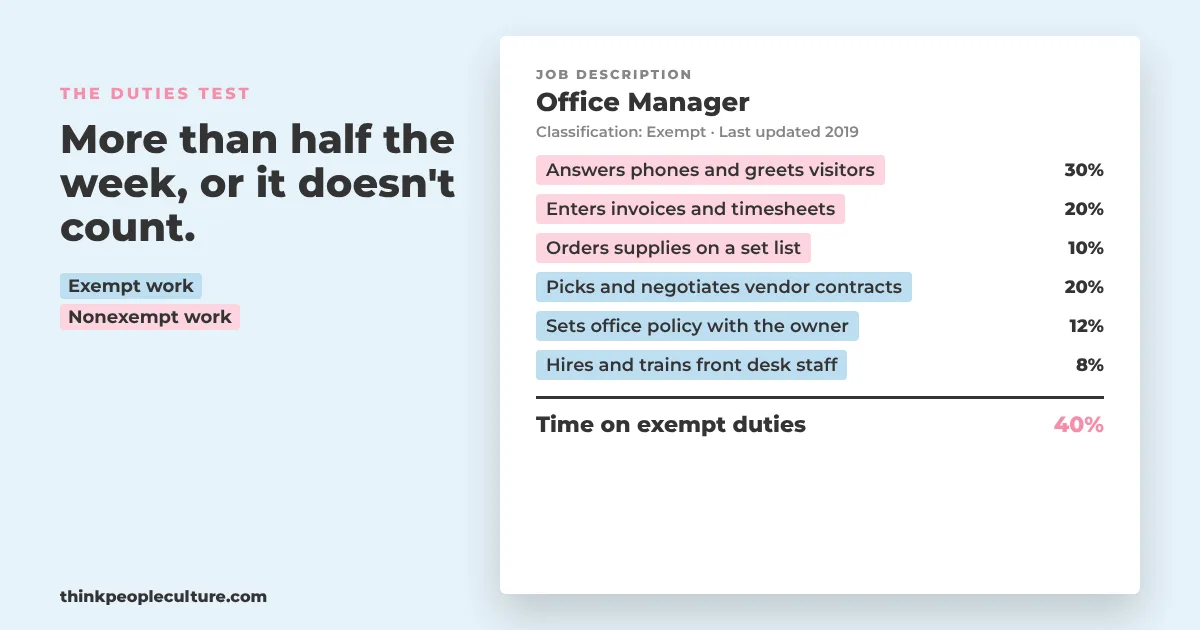
The test isn't how important the person feels. It's how they spend their Tuesday.
Does the Federal Rule Change Any of This?
No, and the gap is huge. The federal salary level is $684 a week, or $35,568 a year. On May 14, 2026 the US Department of Labor republished its 2019 rule after a court threw out the higher 2024 rule. So, $684 a week is the federal number today.
| Rule | Exempt salary for 2027 |
|---|---|
| Federal (FLSA) | $684 a week, or $35,568 a year |
| California | $1,392 a week, or $72,384 a year |
When the two disagree, the Labor Commissioner's FAQ says you follow the one that's better for the employee. In California, that's almost always California. If your payroll software or a multistate PEO set your thresholds from the federal number, check them before January.
Five Things Owners Get Wrong About Exempt Status
These come up again and again in companies that grew faster than their HR did.
- "They're on salary, so they're Exempt." Salary is only one of the two tests. A salaried person who fails the duties test is a salaried Nonexempt employee, and they're owed Overtime.
- "Their title says Manager." Titles don't count. The glossary says job titles alone are "of no assistance" in deciding status.
- "We set it once and moved on." The floor moves every January when the minimum wage moves. Someone who passed at $71,000 in 2026 fails in 2027.
- "They supervise someone." One assistant isn't enough for the executive test. It takes at least two full time people, or the equal, and more than half the week spent managing.
- "Our city's minimum wage covers it." Labor Code 515 ties the exempt salary to the state minimum wage. Local rates still matter for your hourly people, so check both.
Remember Dwight Schrute's business card from The Office? It said "Assistant to the Regional Manager." Nobody in Scranton thought that made him the boss, and a Deputy Labor Commissioner won't think your title makes someone Exempt either.
What Misclassification Could Cost: The Math on One Person
Let's go back to that office manager at $71,000. Say she works nine hour days, five days a week, all year. If she's really Nonexempt, here's a rough look at what one year could add up to. This is my simple math to show the size of the risk, not a legal calculation, and a real claim could look different.
| Item | How it's figured | Rough amount |
|---|---|---|
| Her regular rate | $71,000 divided by 52 weeks, then by 40 hours (Labor Code 515(d)) | $34.13 an hour |
| Unpaid Overtime | 5 hours a week at 1.5 times her rate, for 52 weeks | $13,312.50 |
| Wage statement penalty | Up to the cap in Labor Code 226(e) | Up to $4,000 |
| Waiting time penalty if she quits | Up to 30 days of wages under Labor Code 203 | About $8,192 |
| Rough total for one person, one year | Before attorney fees and anything else a claim adds | About $25,505 |
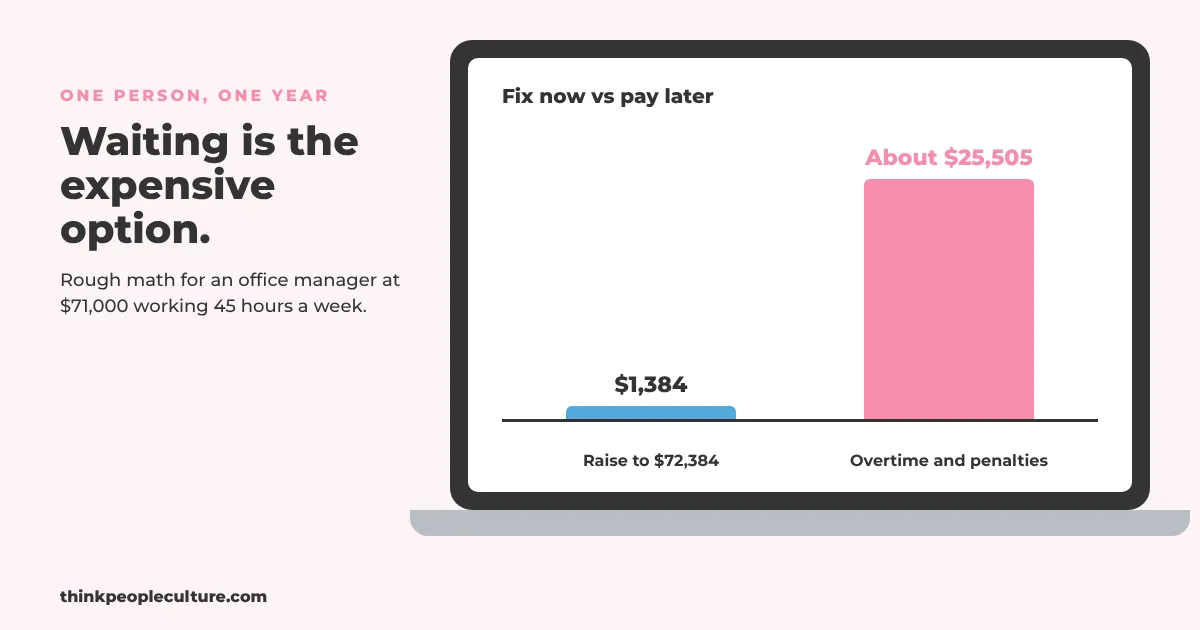
Now look at the fix. If her duties pass the test, getting her from $71,000 to $72,384 costs $1,384 a year. That's less than she'd be owed in Overtime in about six weeks.
And, that's one person. Most companies that have this problem have it in a cluster, usually the office manager, the bookkeeper and the "coordinator" who quietly runs everything.
Your Three Fixes Before January 1
Remember how I said the cheapest fix isn't always the one you'd guess? A raise isn't the only answer. You've got three honest choices for each person near the line.
- Raise them to at least $72,384. This works only if they also pass the duties test. If they don't, the raise just makes an expensive Nonexempt employee.
- Move them to Nonexempt. They can stay salaried or go hourly, but they track hours, take meal and rest breaks and get Overtime. For someone who rarely works late, this can cost less than the raise.
- Fix the job. If the role should be Exempt, give it the real authority and the duties, and then write the Job Description to match what the person does all week. A Job Description written in 2019 and never opened since is a historical document, not evidence.
Whichever you pick, tell the person in writing before the change, and explain why. "The state raised the bar and we're making sure you're paid right" lands a lot better than a surprise timesheet.
The January Payroll Gut Check
1. Does every Exempt person on our payroll earn at least $72,384 a year starting January 1, 2027?
2. Does each one spend more than half their week on executive, administrative or professional work?
3. Does every Exempt manager direct at least two full time people, or the equal?
4. Did anyone set our pay thresholds from the federal $35,568 number?
5. Could we show a current Job Description for every Exempt role by Friday?
Where to Start This Week
Pull a list of every Exempt employee, their salary and their title. Anyone under $72,384 goes on the urgent list. Anyone over it whose week is mostly answering phones, entering data or doing the same task on repeat goes on the second list.
If that list makes your stomach drop, you're in good company. At a company with 12 to 350 employees, there's rarely anyone whose job is to check classification every year, so it drifts. For the bigger pay picture, read how pay and titles drift out of whack as you grow. If you're still running HR off the founder's memory, the post about a 60 person team where things keep breaking will feel familiar. And, if a reclassification ever ends in someone leaving, the California termination guide covers final pay timing, which is where waiting time penalties start.
Classification cleanup is exactly what our fractional HR work handles. We check each Exempt role against the tests and rewrite the Job Descriptions to match the real work. Then you get a plan for each person near the line, with the words for the talk. Your attorney reviews anything with legal risk before it goes out. You can also see how we work with California employers across the state.
January 1 will show up whether your payroll is ready or not. Book a slot with me and bring your list of Exempt roles. We'll sort out who's safe, who needs a raise and who needs a new Job Description before the first 2027 paycheck.
I'm an HR pro, not a lawyer. This is my read of the law as of October 2026, so run your own situation by an employment attorney.
Frequently Asked Questions
What is the minimum salary for Exempt employees in California in 2027?
It's $72,384 a year, or $6,032 a month, starting January 1, 2027. That's two times the $17.40 state minimum wage for 40 hours a week, 52 weeks a year. The employee must also pass the duties test for their exemption.
Is the California exempt salary the same as the federal one?
No. The federal level is $684 a week, or $35,568 a year. California's is $72,384 for 2027. Employers in California must follow the rule that's better for the employee, which is the California number.
Can a salaried employee be Nonexempt in California?
Yes. Salary is just a way to pay. If the person earns less than the exempt salary or doesn't spend more than half their time on exempt duties, they're Nonexempt and owed Overtime, meal breaks and rest breaks even though they're on salary.
What does "primarily engaged" mean for the duties test?
Labor Code 515 says "primarily" means more than half of the employee's work time. The person has to spend more than half their actual week on executive, administrative or professional duties, not just some of it.
Does a city minimum wage raise the exempt salary in California?
Labor Code 515 ties the exempt salary to the state minimum wage, so the statewide floor for 2027 is $72,384. Higher local minimum wages still apply to hourly and other Nonexempt employees working in those cities.
What happens if I misclassify an employee as Exempt?
You can owe unpaid Overtime for the hours they worked, plus penalties. Those can include up to $4,000 per employee for wrong wage statements and up to 30 days of wages if final pay is late when they leave, plus the employee's attorney fees on a wage statement claim.
HR Help in Your Inbox
My free newsletter for owners with no HR person, with plain answers sent when there's something worth reading.
We respect your privacy. Unsubscribe at any time.